

Tides of Annihilation is built on Unreal Engine 5, Epic Games' current-generation engine, and leans on its flagship rendering systems to render the shattered supernatural London and the mystical otherworld of Avalon. The studio behind the game, Eclipse Glow Games, has framed Unreal Engine 5 as the technical foundation that lets a debut project from a newly formed studio aim for a high-fidelity current-gen visual target. Nanite handles the detail of the world, Lumen carries the lighting, and a stack of platform-specific upscalers and reconstruction techniques carries the output to consoles and PC.
Overview
Unreal Engine 5 is the fifth major generation of Epic Games' cross-platform engine, aimed squarely at PlayStation 5, Xbox Series X|S, and high-end PC hardware. Its headline features are Nanite, a virtualized micropolygon geometry system, and Lumen, a dynamic global illumination and reflection solution. Together they remove many of the classic authoring limits on polygon counts and baked lighting, which suits a game like Tides of Annihilation that wants to mix detailed modern urban geometry with shifting supernatural environments without cutting one side to make the other work.
Eclipse Glow Games has pitched the title as a single-player action-adventure with high-fidelity visuals powered by Unreal Engine 5, realistic lighting, and smooth character animation. That framing has been repeated across developer interviews, the State of Play reveal in February 2025, and subsequent trailers, including the gameplay show and the path tracing reveal. The engine is central to the studio's pitch, not an implementation detail.
Why Eclipse Glow Chose UE5
Ary Chen has given the studio's own reason plainly: the team had deep experience developing other PC games, and that experience brought with it expertise in using Unreal Engine 5. He has added that because the studio had shipped PC and console titles before, it set strict rules at the very beginning of development for how the game would adapt to each platform, and that the build is continuously optimised for the different console variants rather than tuned at the end.
The wider logic is the one the industry keeps arriving at. Unreal Engine 5's feature set is already cutting-edge, its tooling is mature, and there is a large hiring pool of developers who have shipped on it. Choosing UE5 lets a new team punch above its weight on visuals without building a bespoke engine to do it.
The game's core creative hook reinforces that choice. Tides of Annihilation depends on the visual contrast between a recognisable real-world London and a fractured Arthurian otherworld, with the two constantly bleeding into one another through the Mirror Space Folded Realm. Selling that contrast requires dense urban geometry, consistent dynamic lighting across both sides of the veil, and seamless transitions between them. UE5's feature set is tuned for exactly that kind of scene.
Key UE5 Features Used
Coverage of the game so far has pointed to a standard current-gen Unreal Engine 5 stack, built around three flagship systems.
Nanite is UE5's virtualized micropolygon geometry system. It streams only the triangles that actually contribute to each pixel, which allows artists to use film-quality assets with hundreds of millions of polygons in a real-time scene. In Tides of Annihilation, Nanite carries the dense, complex environments of ruined London, where modern architecture is intertwined with supernatural overgrowth, and the massive surfaces of the Colossal Knights that players climb as vertical levels.
Lumen is UE5's dynamic global illumination and reflection system. It bounces light off surfaces in real time without relying on baked lightmaps, so lighting keeps working when geometry shifts or lights move. This is especially visible in Mirror Space sequences, where architecture transforms around the player and the light has to follow. The interaction between natural and supernatural lighting, mixing London's overcast sky with Avalon's otherworldly glow, relies on Lumen to keep its consistency.
Virtual Shadow Maps are UE5's high-resolution shadow pipeline designed to pair with Nanite-scale geometry. They produce per-pixel shadows across large, detailed scenes without the usual filtering artefacts, which matters in an open cityscape full of collapsed architecture and towering enemies casting long shadows across the streets.
Graphics and Scale
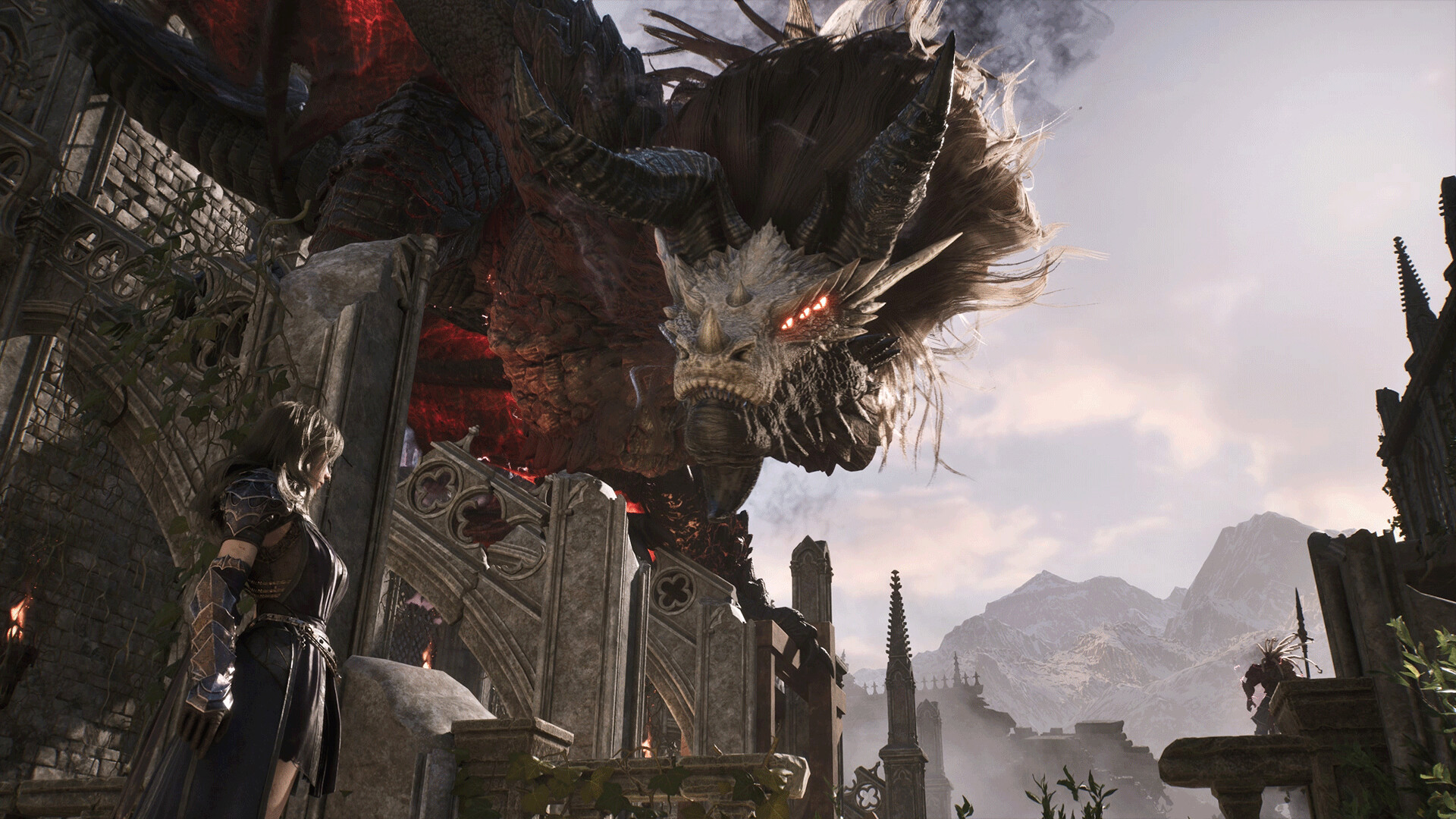
The scale the game is pitching is part of why UE5 matters to it. Tides of Annihilation was described in a 2024 developer interview as a 30+ hour action-adventure with over thirty bosses, interconnected zones across London, and a parallel Avalon realm. The Colossal Knights in particular are treated as moving levels: players climb their bodies and fight across their surfaces, so individual enemies are authored at a scale that would have been difficult to hit in a previous engine generation without aggressive LOD tricks. Nanite's virtualized geometry is what makes carrying that kind of detail from hero closeups to full-body views practical inside a single streamed environment.
The studio added one more shape to that in September 2026: alongside the main line and the side content, the finished game is to contain semi-open areas for players to explore. That is a structural statement rather than a rendering one, but it matters to the engine discussion, because streaming a semi-open area is a different problem from streaming a corridor and it is the kind of layout Nanite and Lumen are built to hold together without a loading break.
Both of those figures carry their date for a reason. They came from a 2024 question-and-answer session and were hedged there as subject to change, and when the studio was asked again in September 2026 it declined to restate either one, saying that bosses were still in development and that the development plan was still being adjusted. Neither answer withdrew the older figures, so they stand as the only numbers on record while remaining the oldest facts on this page.
Trailer footage and screenshots released through Xbox Partner Preview, State of Play, and GDC 2026 materials have leaned on dense urban scenes: broken office blocks and transit infrastructure in London, mirrored skies and folded architecture in Avalon, and large-scale encounters that move freely between the two. The studio states that all footage in the Break the Mirror gameplay trailer was captured in-game on PC, so what those scenes show is the engine running rather than an offline render. The visual pitch is consistent with what Nanite plus Lumen plus Virtual Shadow Maps are designed to deliver.
Mirror Space Realm Rendering
The Mirror Space Folded Realm is the game's central visual gimmick: mortal London and mystical Avalon fold onto one another so a single playable space can exist in both forms at once. Reflections, duplicated geometry, and alternate versions of the same street appear around the player as they move, and combat arenas can flip between sides mid-fight as part of the Dual Frontline Battle System.
That mechanic leans hard on UE5's lighting pipeline. Baked light is a poor fit for a space that reshapes itself around the camera, so Lumen's fully dynamic global illumination is the natural match. Nanite holds the detailed geometry on both sides of the overlap at the same time, and Virtual Shadow Maps keep shadows consistent as the architecture rearranges. The result is a realm that the developers can twist without the lighting or shadows obviously breaking, which is a large part of why the effect reads as seamless in footage rather than like a cut to a different level.
Path Tracing and Ray Tracing
The studio confirmed both features itself in September 2026, after the game had been played publicly. Asked directly whether the PC build would support DLSS and path tracing, Ary Chen said it would, and described an ongoing working relationship with hardware partners aimed at lifting the overall image quality and at tuning the game to the hardware it runs on. That is a first-party confirmation of a feature set that had previously only been announced through a trailer and a hardware partner.
Tides of Annihilation is also being positioned as a graphics show for the PC side. A dedicated path tracing trailer accompanied the DLSS 4.5 reveal, confirming that the launch build on PC will offer a fully path-traced mode on top of the default Lumen-based lighting. Path tracing simulates light by tracing rays through the full scene rather than approximating bounces, and it is more expensive than traditional ray tracing but delivers physically accurate global illumination, reflections, caustics, and shadows.
The console side uses a lighter touch. On PlayStation 5 Pro, the game uses ray tracing for reflections and global illumination rather than full path tracing, paired with PlayStation Spectral Super Resolution as the reconstruction layer. On the base PlayStation 5 and Xbox Series X|S, the game relies on Lumen's software path for global illumination without adding full ray tracing on top, which keeps those versions inside each console's budget while still using the same underlying lighting system.
Performance Targets
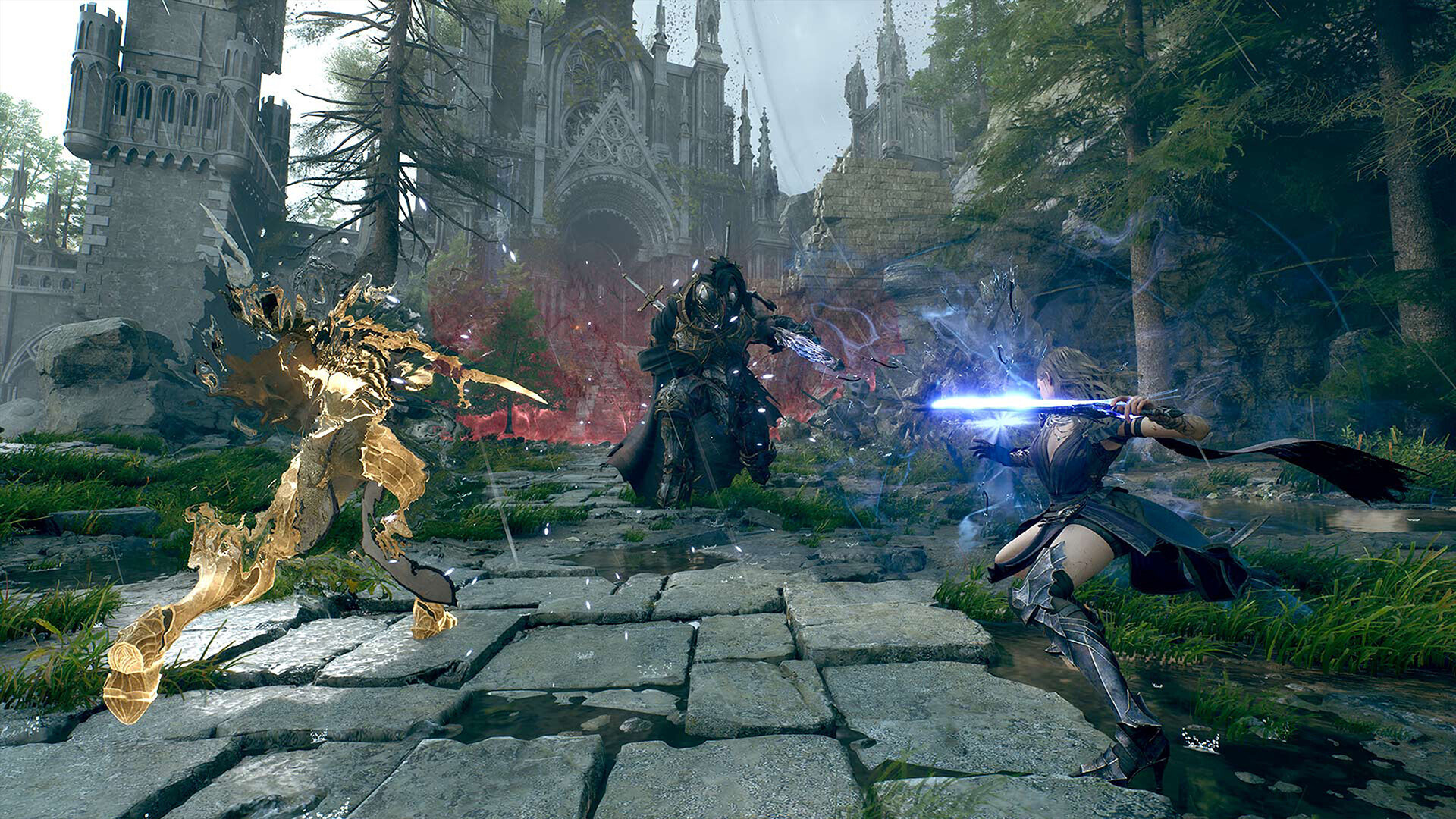
Publicly shared performance information centers on the PC launch technology and the console targets aimed at stability. NVIDIA has confirmed the PC graphics features but has not published specific frame-rate numbers for the game.
Platform | Announced target |
|---|---|
PC | DLSS 4.5 with Dynamic Multi Frame Generation and a fully path-traced mode. No frame-rate or resolution figures published. |
PlayStation 5 Pro | Higher output resolution than the base PS5, ray-traced reflections and global illumination, improved image fidelity, and a stable 60 frames per second target, with PSSR doing the reconstruction work. |
Base PlayStation 5 and Xbox Series X|S | Standard UE5 Lumen lighting without full ray tracing, tuned to hold a stable frame rate inside each console's power budget. |
Engine Collaboration with Unreal Engine and NVIDIA
Ahead of the first hands-on event, in May 2026, Eclipse Glow Games detailed a direct technical collaboration with engineers from Unreal Engine and NVIDIA aimed at matching the game's high visual ceiling with stable performance across every platform. The same announcement introduced the studio's own label for the game's look and combat, Neo-Medieval.
Contributor | Role | Stated contribution |
|---|---|---|
Wei Liu | Technical Director, Unreal Engine China | A systematic analysis of CPU and GPU bottlenecks, used to build a refined animation and gameplay logic pipeline that significantly reduces computational overhead during gameplay-heavy scenes. |
Kai Yuan | Lead Technical Artist, Tides of Annihilation | A Nanite-based setup built specifically for the Colossal Knights encounters, referred to in the showcase as Giant Knights, pairing automated collision and shadow optimisation with virtualized geometry so the titans hold high-mode texture fidelity during high-speed movement without costing runtime performance. |
NVIDIA | Hardware partner | Deep performance analysis and driver-level optimisation, on top of the previously announced DLSS and full path-tracing support for the PC build. |
The Nanite work on the Giant Knights is the same system that carries the dense ruined-London environments, applied at the architectural scale of a single climbable enemy. The producer has framed the partnership as pushing the visual ceiling to the limit of current technology while staying committed to rigorous optimisation, rather than chasing fidelity at the expense of stability.
Character Rendering
Character faces became the most discussed technical topic around the August 2026 hands-on build. The studio's position, given at the event, is that Gwendolyn's character model has not changed since the game was first shown. The difference players were picking up comes from the rendering path rather than the asset: improved skin rendering, revised cloth materials, changes to lighting, and new facial technology, all running in real time. The producer noted that the earlier promotional footage was also real-time rendered and that the face shape is identical in both, that the demo build had been put together quickly, and that further optimisation of how faces read under varied lighting is still to come.
Hands-on players broadly agreed that facial expression rendering, on the protagonist and on humanoid enemies alike, is the area with the most room left. It is worth separating the two claims: the geometry is unchanged, the shading and lighting around it are not, and the studio has committed to more work on the latter.
Hands-On Build Observations
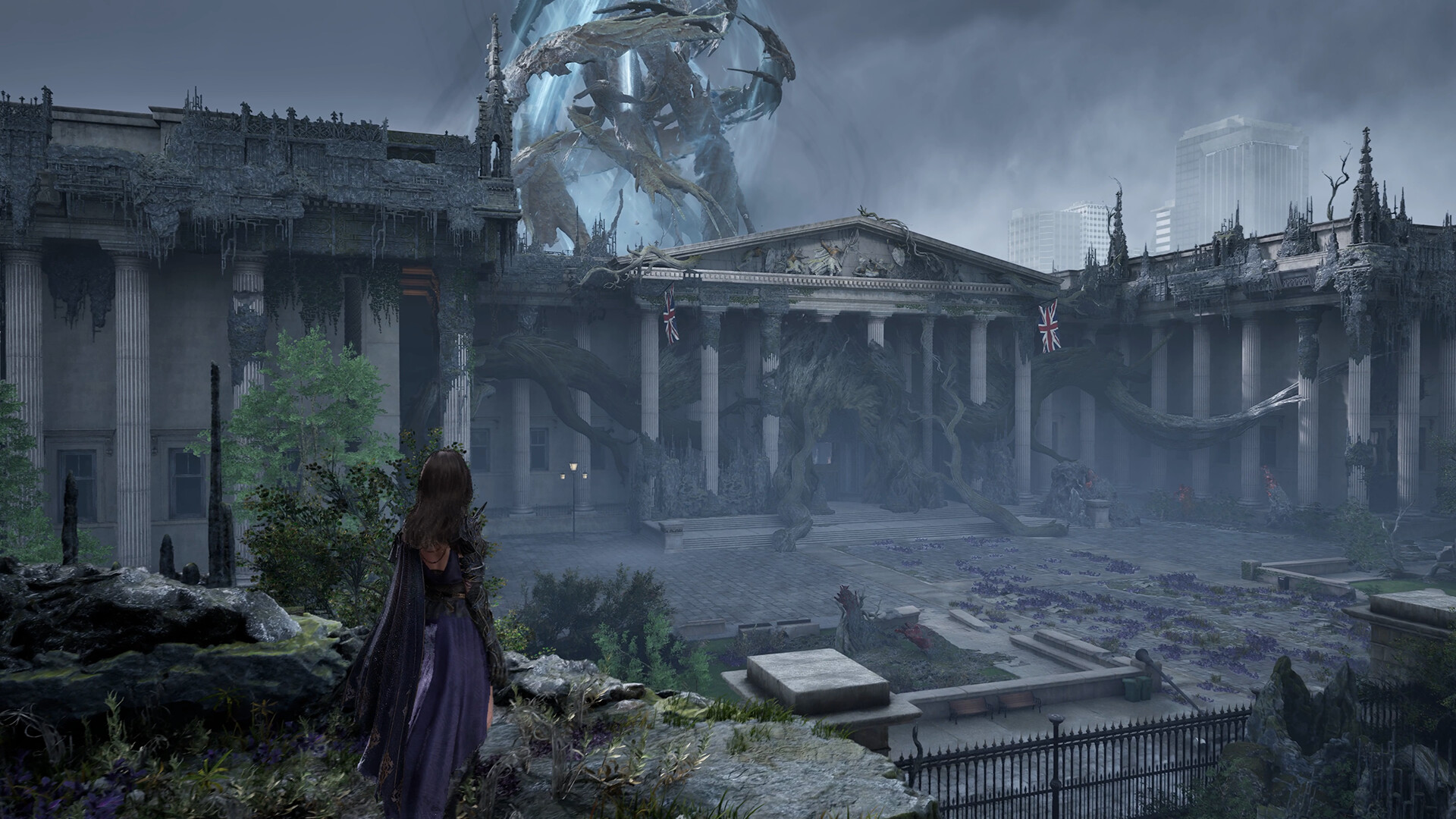
The Chengdu sessions in August 2026 were the first time anyone outside the studio saw the engine work running live. What that build demonstrated should be kept separate from what has been announced for the PC release.
Most scenes and fights held steady at maximum settings, with frame drops reported on first entry into the larger maps.
Noticeable pop-in on distant objects, and motion-blur smearing on transitions into cutscenes: both familiar Unreal Engine 5 artefacts.
The over-bright, smeary particle look often associated with the engine was largely absent, which hands-on writers put down to art direction rather than a technical fix.
One hands-on report identified the Chengdu demo machines as running GeForce RTX 5080 hardware, and other attendees were not told the specifications at all. For gamescom the studio said so itself: the stations there run GeForce RTX 5080 cards and are the first public showing of the game with NVIDIA DLSS 4.5 Dynamic Multi Frame Generation enabled, on displays supplied by TCL. None of that is a guide to how the game will run on any particular configuration.
Neither path tracing nor DLSS was demonstrated in that build, and no frame-rate or output-resolution figure has been published for it. The DLSS 4.5 and path-tracing features described here belong to the announced PC release, not to the August demo. Capture uploaded by attendees was recorded at up to 3840 by 2160, which reflects their capture settings rather than a confirmed in-game output mode.
DLSS 4.5 and Multi Frame Generation
The PC build supports DLSS 4.5 with Multi Frame Generation, and the game has been used as one of the flagship titles featured for DLSS 4.5 Dynamic Multi Frame Generation alongside other current-gen show titles. Multi Frame Generation extends the earlier DLSS 3 frame generation approach by inserting several generated frames between each native frame, which is how demanding settings such as full path tracing become playable at high frame rates on supported GeForce RTX hardware.
The point of showing the game under those conditions is not that most players will run it at those settings. It is that the underlying asset quality and lighting simulation hold up under the most demanding settings the engine can offer. The path-tracing mode is treated as an optional high-end target on PC, not a baseline requirement, and the rest of the Platforms and Release support covers the more realistic settings most players will actually use.
Cross-Platform Implementation
Tides of Annihilation is a multi-platform release covering PlayStation 5, PlayStation 5 Pro, Xbox Series X|S, and PC via Steam and the Epic Games Store, with Xbox Play Anywhere support described by the studio as planned rather than shipped. That cross-platform scope is a big part of why Unreal Engine 5 is the right pick for a debut studio: UE5's platform backends, streaming systems, and graphics features scale across every target Eclipse Glow has committed to.
Each platform has its own upscaler plugged into the engine: PSSR on PS5 Pro, DLSS 4.5 on RTX GeForce hardware, with the engine's standard Temporal Super Resolution and other established upscalers covering the rest of the PC market and the base console targets. Under all of them, Nanite, Lumen, and Virtual Shadow Maps run as the shared core, so a player on base PlayStation 5 is looking at the same underlying rendering pipeline as a player on a high-end RTX card with path tracing, just with a different set of quality dials turned up or down.