

This article is a stub
It lacks sufficient information and needs to be expanded. You can help by adding more content.
Tournaments
Competitive martial arts tournaments are recurring events in the Jianghu. Players can enter these tournaments to test their skills against other fighters in structured competition. The developers have stated that "winning in the competitions brings players honor and money," making tournaments one of several ways to earn income through combat rather than business or professions.
Since The Bustling World is a single-player game, tournament opponents are NPCs rather than other players. The tournaments appear to function as event-based competitive brackets where the player fights through rounds against increasingly skilled opponents. Winning builds reputation in the Jianghu, which has downstream effects on how factions and NPCs perceive the player.
Tournaments also serve as a proving ground. A player who does well in tournaments demonstrates their mastery of the weapon types and techniques they have collected. For players who have invested heavily in combat skills, tournaments are the formal way to show that investment paying off.
Contests
Players can test their combat abilities in martial arts contests, one of the competitive leisure events in the game. Winning these tournaments brings both honor and money.
Motion Capture and Visual Style
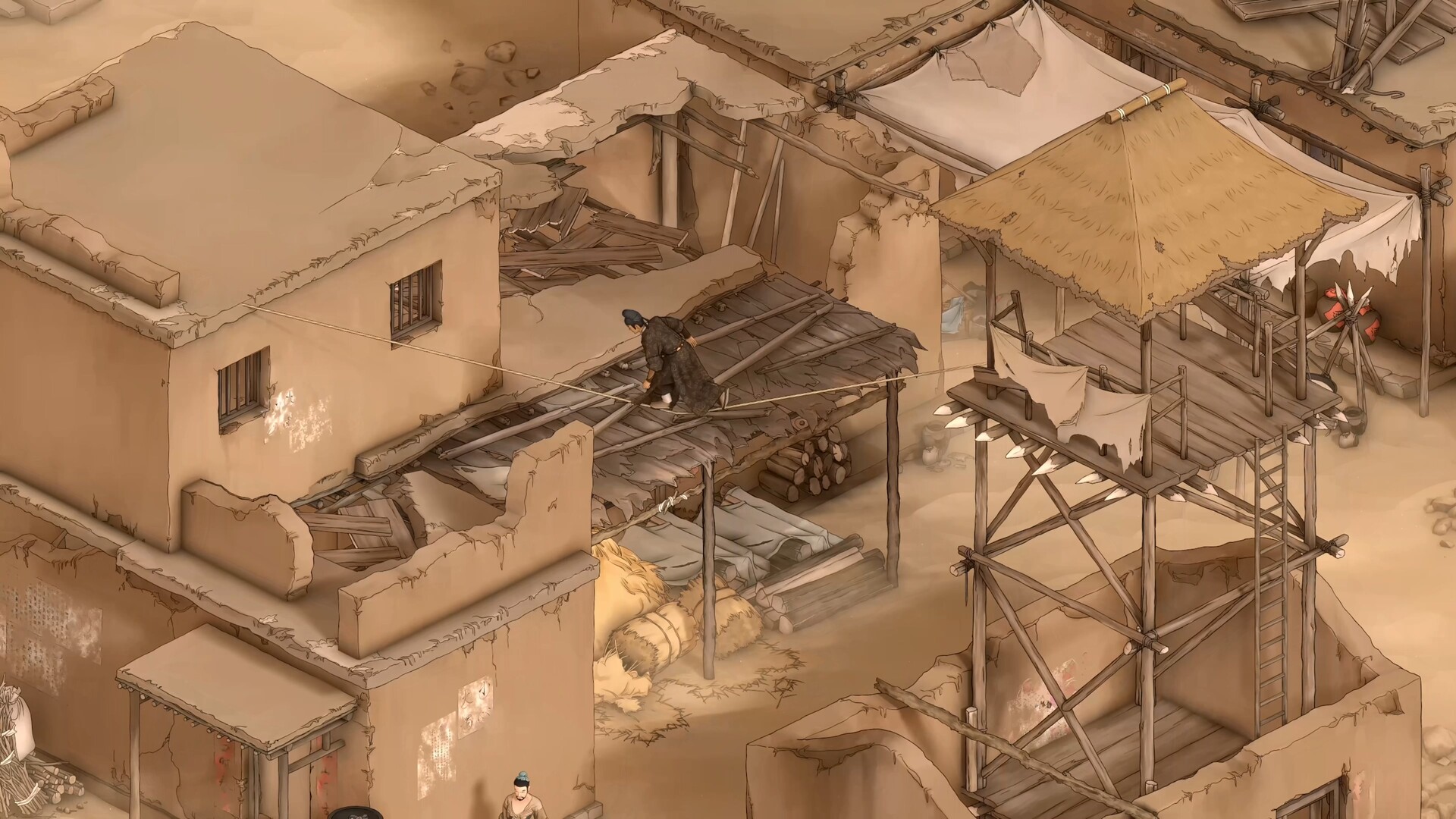
All combat animations were created using motion capture. This applies to weapon attacks, martial arts techniques, and defensive movements. The motion capture data gives combat a physicality that hand-keyed animation often lacks. When a character swings a heavy guan dao, the weight of the weapon is visible in the body mechanics.
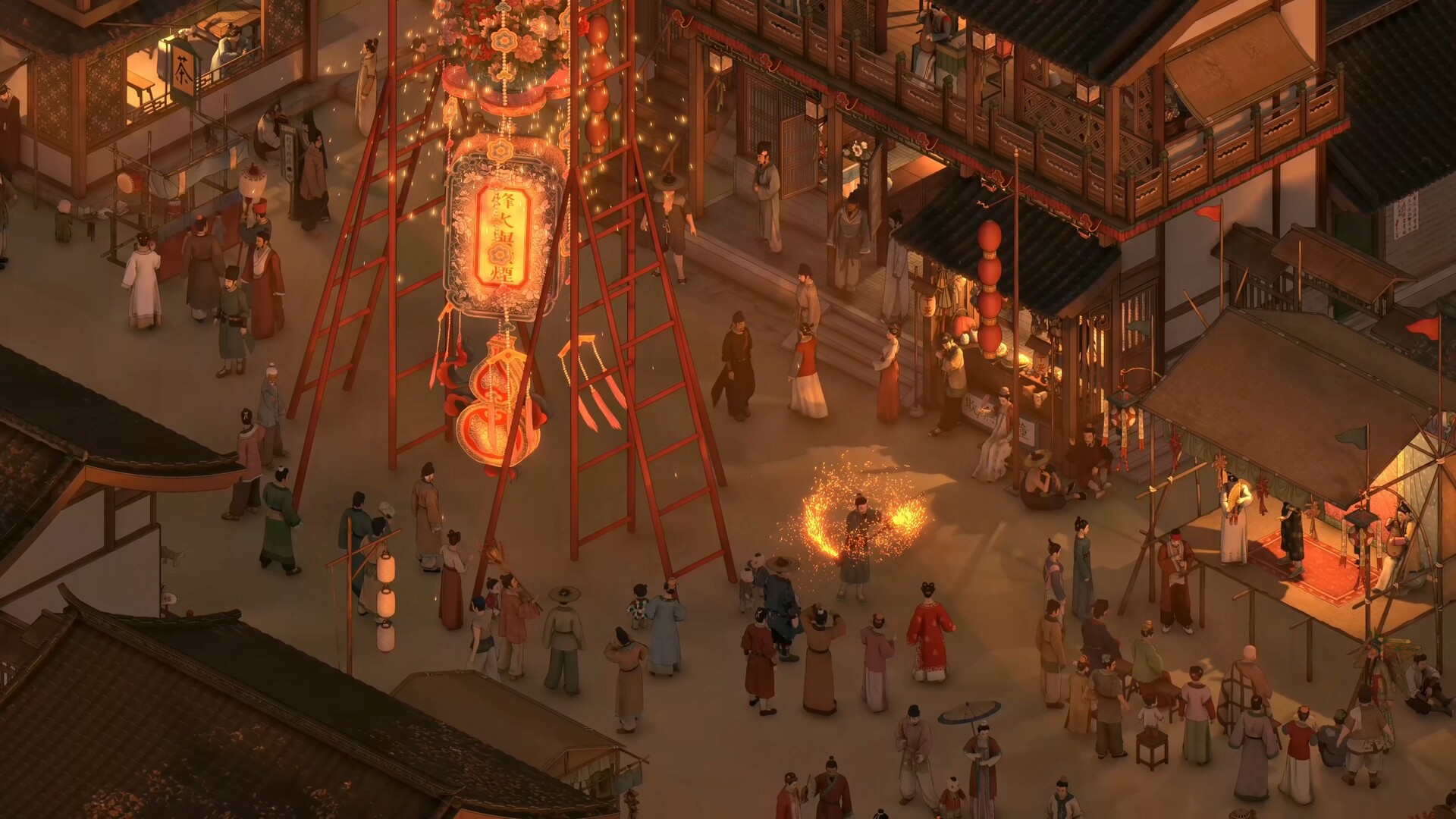
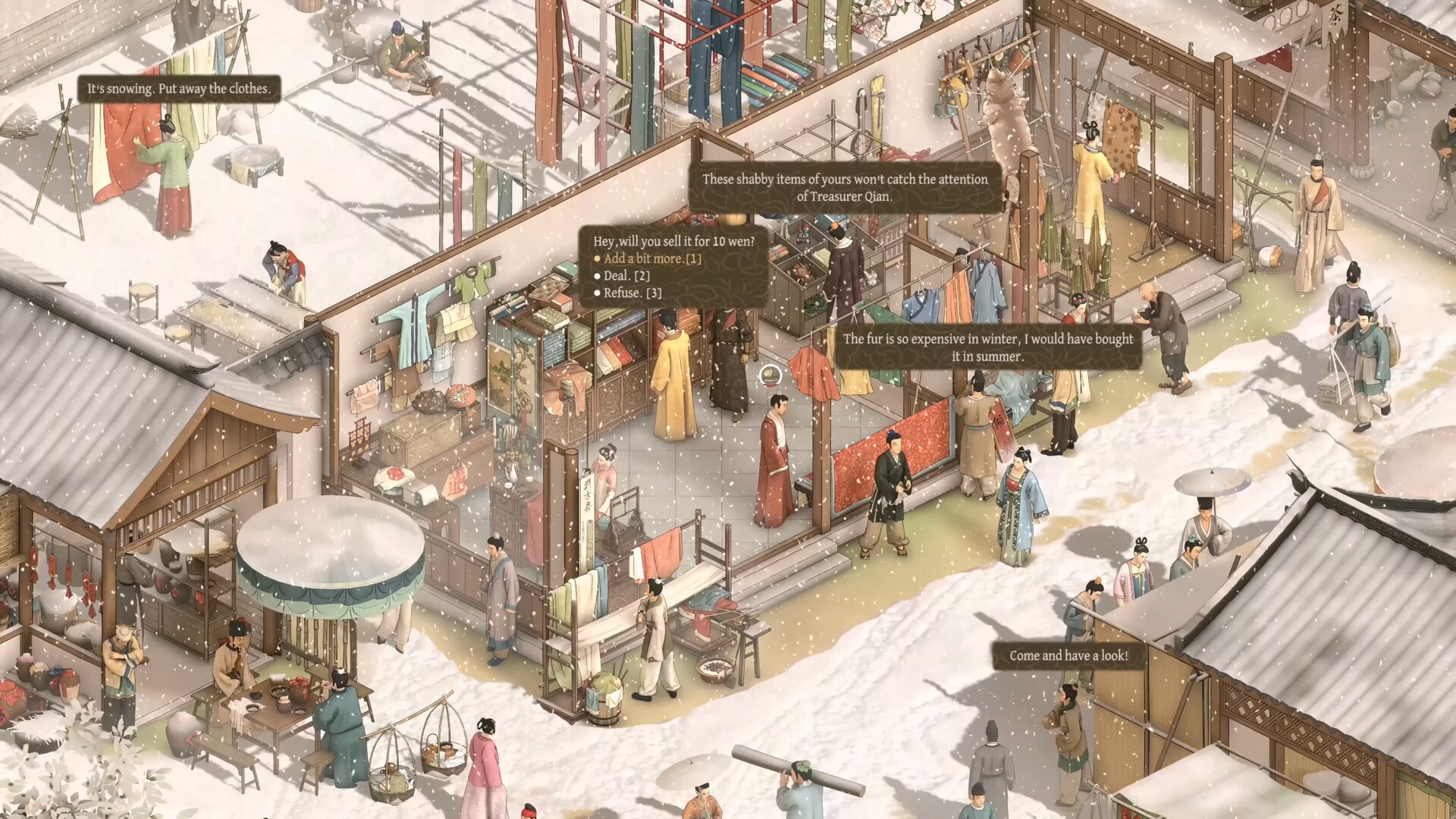
Combat uses the same 3D perspective as the rest of the game, so fights are presented in the context of the world around them. You can see buildings, NPCs, and terrain while fighting, which matters tactically when positioning or retreating.
How Techniques Are Acquired
There is no skill tree to pick from at character creation. Martial arts techniques are scattered across the world, and the player gets them by going out and looking for them. The developers have framed this as part of the sandbox: a player who explores ruins ends up with a different set of techniques than a player who joins a martial arts school, and both routes are valid.
Discovery in the world. Manuals and scrolls are hidden in temples, caves, and ancient ruins. Players who invest in exploration tend to accumulate techniques faster than players who focus on settled life.
Joining a school. Martial arts schools train members in their own techniques. The player must earn the school's trust, complete an initiation, or otherwise prove themselves before techniques are taught.
Trading and bribing. Some techniques can be bought from NPCs who know them, or pried loose through favors and money. The merchant networks and underground markets in the dark side of jianghu are part of this surface.
Taking by force. If the player cannot earn or buy a technique, the option remains to seize it through combat. Forcing a faction to hand over a manual has consequences for reputation and faction relationships.
Schools And Faction Gating
Specific martial arts traditions are locked behind specific factions. Official feature copy names the Sunflower Sect, the Beggar Gang, and the Red Clothes Sect as examples of the sects a player can seek out. Most schools are unnamed in public materials and will be encountered in-build. The general pattern is consistent across the materials: each school keeps its strongest techniques internal, and joining is the cleanest path to learning them.
Sect membership. Joining a sect grants access to its in-house techniques over time as the player's standing improves.
Reputation pressure. Some sects refuse to teach outsiders; the player must build a reputation in adjacent circles before they will even hear an audition.
Rival training. A player who trains under one sect's teachings may find that rival sects refuse to deal with them. This is part of the game's factions system.
Competitive Events
Tournaments and contests are the formal way to demonstrate martial arts skill. They appear in the calendar as recurring events, and winning brings both money and reputation in the Jianghu.
Event Type | Format | Reward |
|---|---|---|
Martial arts tournament | Bracketed combat against increasingly skilled NPC opponents. | Cash prize and reputation gain in the jianghu. |
Martial arts contest | Smaller-scale skill challenges; one of the leisure events on the calendar. | Honor and modest cash rewards. See leisure activities. |
Sect duel | One-off match against another faction's champion. | Standing change between the two factions involved. |
Tournament opponents are NPCs. The developers have confirmed that the launch build is single-player, so competitive events do not involve other human players. A future multiplayer update is on the roadmap but has not shipped. See multiplayer for the current status.