

Tears of Metal combines fast-paced hack-and-slash combat with roguelike progression systems. Players control a playable hero and cut through hordes of enemies across large battlefields, making strategic decisions about artifact combinations and soldier management between each run.
Combat
Each playable hero has a distinct combat style with a set of escalating attacks. Combat takes place across vast battlefields filled with waves of enemies. Players can chain attacks, utilize hero abilities, and leverage artifact bonuses to overcome increasingly difficult encounters. A dedicated Warcry button lets the player rally the battalion mid-fight, added after players asked for it during the 2025 betas. Parrying produces an area-of-effect result rather than a single-target counter, so a well-timed parry punishes a whole cluster of attackers. Heroes also draw on a Weapon Combo Kit, and Paper Cult reworked keyboard input during testing so that it responds as sharply as a controller. The game supports both solo play and online co-op with up to three additional players.
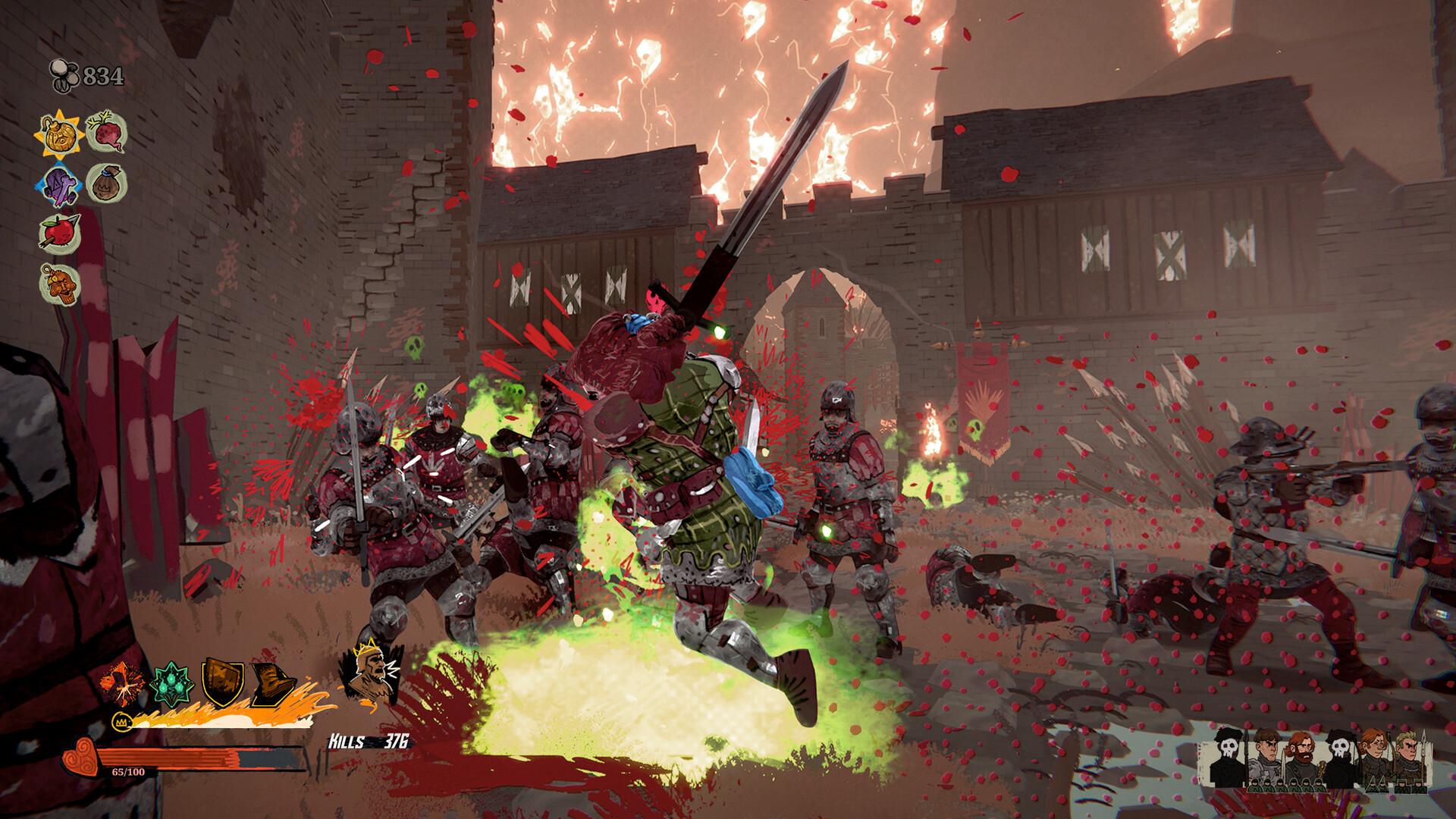
Combat is built around Strikes, Combos and Finishers. A Chain Streak counter rewards continuous killing, a name the studio adopted on July 24, 2026 in place of the earlier Kill Streak because it better described the mechanic. Attacks and combos that deal extra damage to an enemy's block are marked with their own icon, and boss attacks that break through blocks became parryable in the same patch.
Campaign Structure
Each campaign run is divided into three Acts. Every Act features its own set of enemies, tougher Elite foes, and a Boss encounter at its conclusion, so the difficulty and enemy variety escalate as players advance from one Act to the next. The first Act culminates in the boss Gilles the Hog. Paper Cult describes the Early Access build as fully playable from beginning to end, with the complete progression loop available at launch.
The first Act ends with Gilles the Hog. Two further named bosses appear later in the campaign, Iseult the Banshee and Harold the Dragon, though Paper Cult has not stated which Act each of them closes. Post-launch patch notes name Act 2 Captain archetypes including Dagger, Sword and Shield, Polearm, Giant and Rage Master, alongside recurring enemies such as Bombers, War Drummers, Arbalests, Pikemen and a ranged teleporting foe called The Dreadshot. See Bosses and Enemies for the full picture.
Act 2 drew enough feedback about its difficulty spike that Paper Cult reworked it. The August 1, 2026 patch smoothed the curve so the transition into the Act is less abrupt, adjusted several Act 2 Captains' health and block health, and rebalanced a Norsemen encounter; the studio described Act 2 as still the greater challenge, only more approachable.
Threat and Hazards
A Threat and Hazards system governs how dangerous a battlefield becomes as a run continues. Threat escalates with the player's progress and feeds into what the battlefield throws at the party, while hazards add environmental danger on top of the enemy waves. The system was introduced in the second open beta in 2025 and carried into the demo. Paper Cult has acknowledged that an early version of it scaled boss difficulty too aggressively, turning Gilles the Hog into a damage sponge, and the studio reworked the boss's behaviour and stats afterwards to make the encounter a closer, more direct fight.
The Company
The Company system organises the troops that fight alongside the hero, sitting between individual soldier upgrades and the wider battalion. It was one of the systems added in the run-up to the demo, alongside a post-victory roam that lets players keep exploring a battlefield after clearing it, and a content percentage tracker that shows how much of the available material a player has uncovered.
Artifacts and Builds
The artifact system is central to Tears of Metal's roguelike structure. Players discover and collect more than 100 artifacts throughout each run, combining them with upgrades to create distinctive builds. Since artifacts are acquired differently from run to run, each campaign offers a different combination of powers and synergies. Finding strong artifact combinations is key to surviving the later stages of each run.
War Preparations
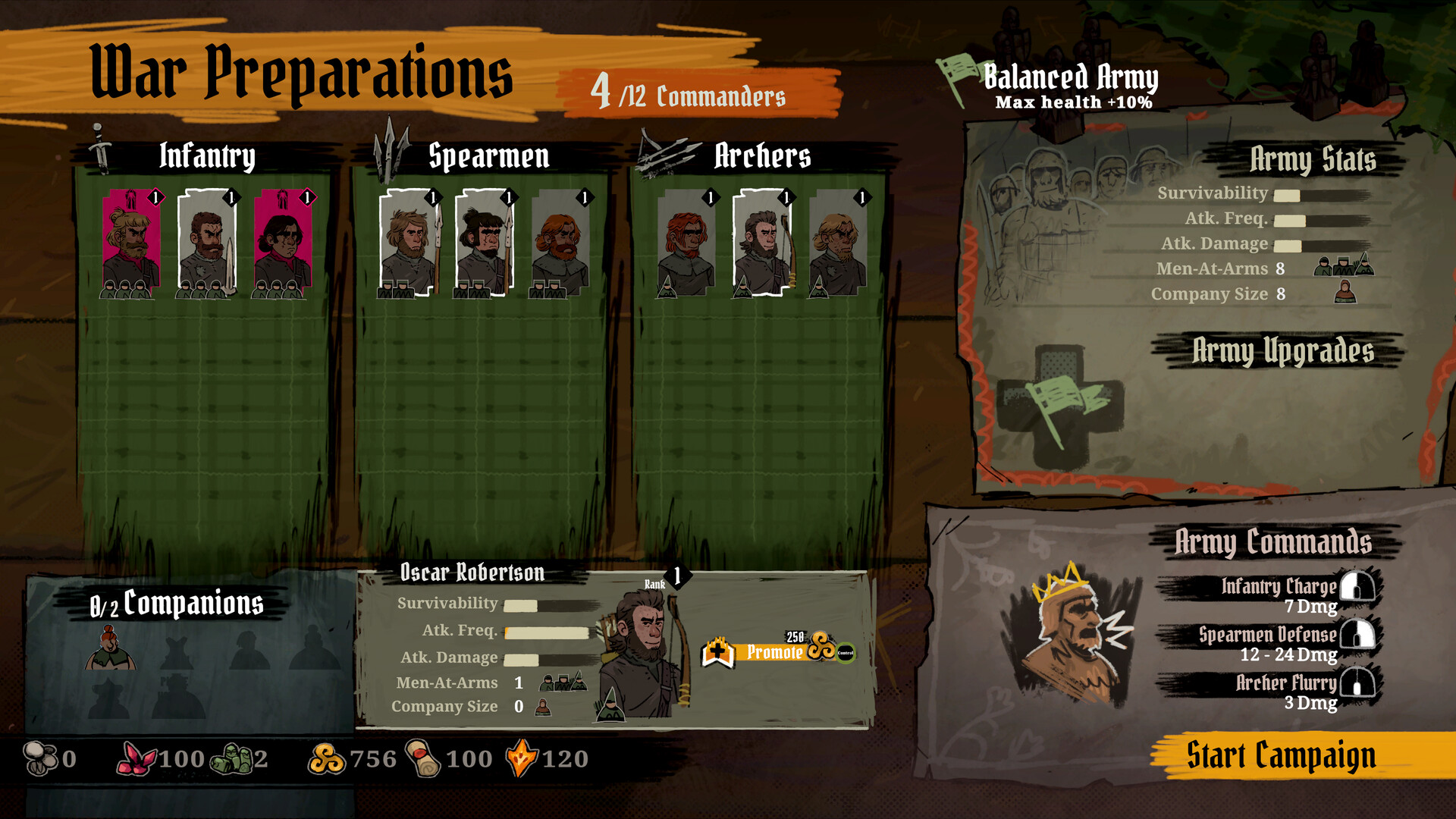
Every campaign starts from a War Preparations screen where the player assembles the army before marching out. Troops are organised into three types, each with its own commander slots, and the screen tracks how many of the available commander slots are filled out of a total of twelve.
Troop Type | Role Shown in the Army Commands Panel |
|---|---|
Infantry | Infantry Charge, an offensive command listed at 7 damage |
Spearmen | Spearmen Defense, listed at 12 to 24 damage |
Archers | Archer Flurry, listed at 3 damage |
Individual commanders are named characters with their own rank and stat spread, and they can be promoted for a currency cost to raise that spread. The stats tracked for both a single commander and the army as a whole are Survivability, Attack Frequency, Attack Damage, Men-At-Arms and Company Size, which is the number of troops that commander brings into the field. The same screen carries an Army Upgrades panel, slots for companions, and an army composition bonus: a balanced spread of troop types grants an army-wide bonus to maximum health, labelled Balanced Army on the screen and shown as a 10% increase.
Soldiers and Permanent Progression
Players recruit soldiers to form their Scottish battalion and can grant them permanent skill upgrades as they survive campaigns and gain experience. Soldiers who fall in battle are lost permanently, so protecting experienced troops matters across multiple runs. Between campaigns, players return to their settlement to manage their battalion, equip upgrades, and prepare for the next assault.
Settlement
The settlement serves as the home base between campaigns. By investing in settlement expansion, players unlock new shops offering permanent upgrades, additional challenge modes, and other gameplay options. The settlement grows over time as players complete runs and meet special objectives, providing a persistent layer of progression that carries across individual roguelike runs. Alongside the battalion, players manage companions, a roster of allies confirmed as one of the core systems available in the Early Access build. The first companion Paper Cult has named publicly, Aodh the Vigil, became unlockable on August 13, 2026. See Companions.
The meta-progression layer is also queued for a rebalance. Paper Cult listed reducing grindiness as one of its three stated priorities for the reworking phase of Early Access, though it has not said which parts of the settlement, soldier or unlock economies it intends to change.
By September 18, 2026 that rebalance was in testing. Paper Cult said it had reworked meta-progression entirely so that unlocks come much more often, and hoped to ship it by the end of that month. The studio also plans new village purchases that give more control over a campaign: ways to change the odds of a particular Emblem family appearing, Challenge rewards other than Charms and Threat reduction, meta-currency, Emblems and healing. Existing upgrades include the Barracks upgrades Companion x2 and Companion x3, and since September 8, 2026 the second requires only the first.
Emblems and Charms
Players wield power from clan-based Emblem families. The public demo featured four incomplete families, while the full game is planned to include eight base Emblem families, each with tiers from 1 to 3 plus unique Emblems that create synergies between families. Emblems granted to allies persist from run to run and are only lost when that ally dies, so investing in a surviving companion compounds over a campaign. Completing in-game challenges unlocks more than 30 Charms, which are purchased with challenge rewards and provide additional bonuses and customization options. Paper Cult has indicated that more Emblems and Charms will be added during the Early Access period.
Post-launch balancing reworked which Charms sit in which rarity tier, with the stated goal of making the tiers meaningfully different and laying groundwork for stronger Charms in later content updates. Named Charms in the shipped build include Cutthroat's Blade, a Common Charm added on July 24, 2026 that grants 10% additional critical hit chance on Finishers, along with the Large Reliquary and the Tithing Box. From August 1, 2026 the Emblem draw for a campaign favours families that have not appeared yet rather than picking at random.
Both layers are due to change. On August 21, 2026 Paper Cult named build crafting as one of the three areas it plans to rework during Early Access, saying it wants to give players more control over the process and to draw sharper distinctions between build directions. The Emblem families are to be re-iterated, with more and better synergies between Emblems and the rest of a build. None of this has shipped yet, and the studio placed it after a stability patch rather than before one.
Two smaller changes were announced in September 2026. Items will be added as a reward choice after boss fights, and Charm descriptions will be shown before a Charm is picked up or an interactable is used. Separate Emblems and Charms pages list every Emblem and Charm named so far.
Challenge Shop
After defeating a boss, players can access the Challenge Shop, which provides high-risk, high-reward scenarios for solo or co-op play. This mode is designed to test player skill and offer greater rewards than standard campaign runs. Paper Cult used the name Challenge System for the same higher-difficulty layer in the material published around the demo.
Special Objectives
Throughout each campaign, players encounter special objectives beyond defeating enemies. Completing these objectives reveals new secrets about the Dragon Stone Meteor, unlocks new playable characters, grants artifacts, and rewards cosmetics. These objectives provide additional replayability and discovery across multiple runs.
Environments
The game features over 45 handcrafted locations, each with varied objectives, enemy compositions, and secrets to uncover. Environments range across the Scottish island setting and grow increasingly difficult as players advance deeper into the campaign.
Locations named in patch notes include Glenfinnan Castle, the Quarry, the Birchtrees level and at least two Swamp biomes. In September 2026 Paper Cult said its level designer was building a set of new battlefields, previewed in three teaser images.
The Emporium and Daily Challenges
The Emporium is the hub for Daily Challenges, short runs built around a fixed set of unusual conditions and a difficulty well above the normal campaign. Clearing one awards a badge, and collecting badges unlocks a cosmetic frame that displays in online campaigns. Daily Challenges were first run publicly during the October 2025 Steam Next Fest and sit alongside the shrines, unlocks and secret discoveries scattered through each campaign.
Emblem Clans in Practice
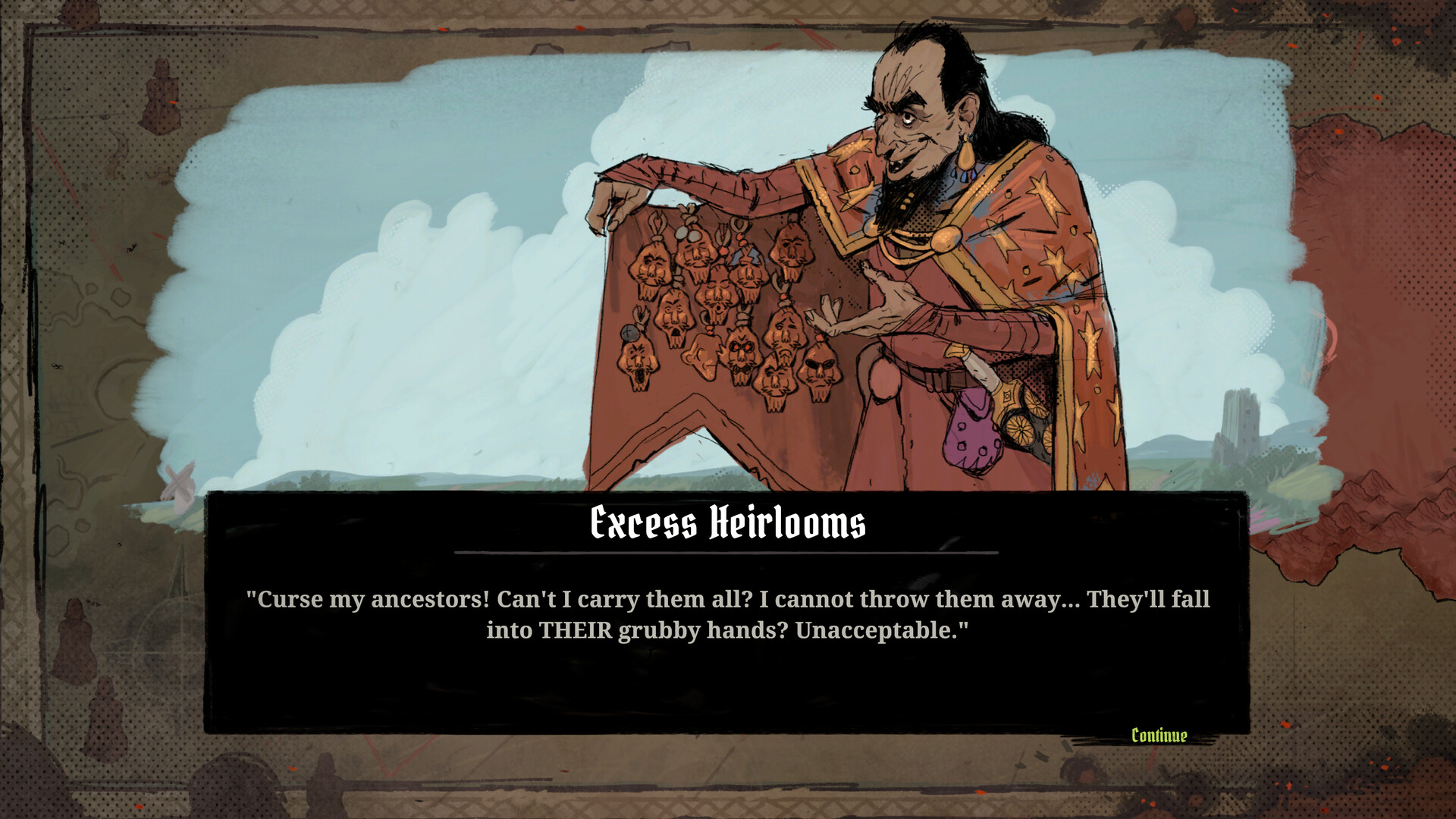
Each Emblem family is presented as a clan with its own identity and a short description of who they are. Clan Hogg, for example, is described in-game as ancient scholars who study angel apparitions, and its first-tier Emblems attach effects to basic actions rather than granting standalone abilities.
Emblem | Tier | Effect |
|---|---|---|
Exposing Strike | 1 | Strike applies Fragile, and a Finisher Strike deals 15 Smite damage |
Vortex Block | 1 | Blocking creates a Vortex that deals 10 Smite damage |
God Rays | 1 | Recovers 5% of maximum health at the end of a battle |
The pattern this illustrates is that Emblems modify the verbs the player already has, striking, finishing and blocking, and that they carry named status effects such as Fragile and damage types such as Smite. Higher tiers and the cross-family synergy Emblems build on the same foundation. Two further clans are named in post-launch patch notes without their Emblem lists being published: the Gambling Clan and the Crusader. Each has an ally Emblem, the Crusader's creating a vortex that was cut from 8 to 5 in size on August 13, 2026, and the Crusader also carries a passive called Purifying Light.
Battlefield Events
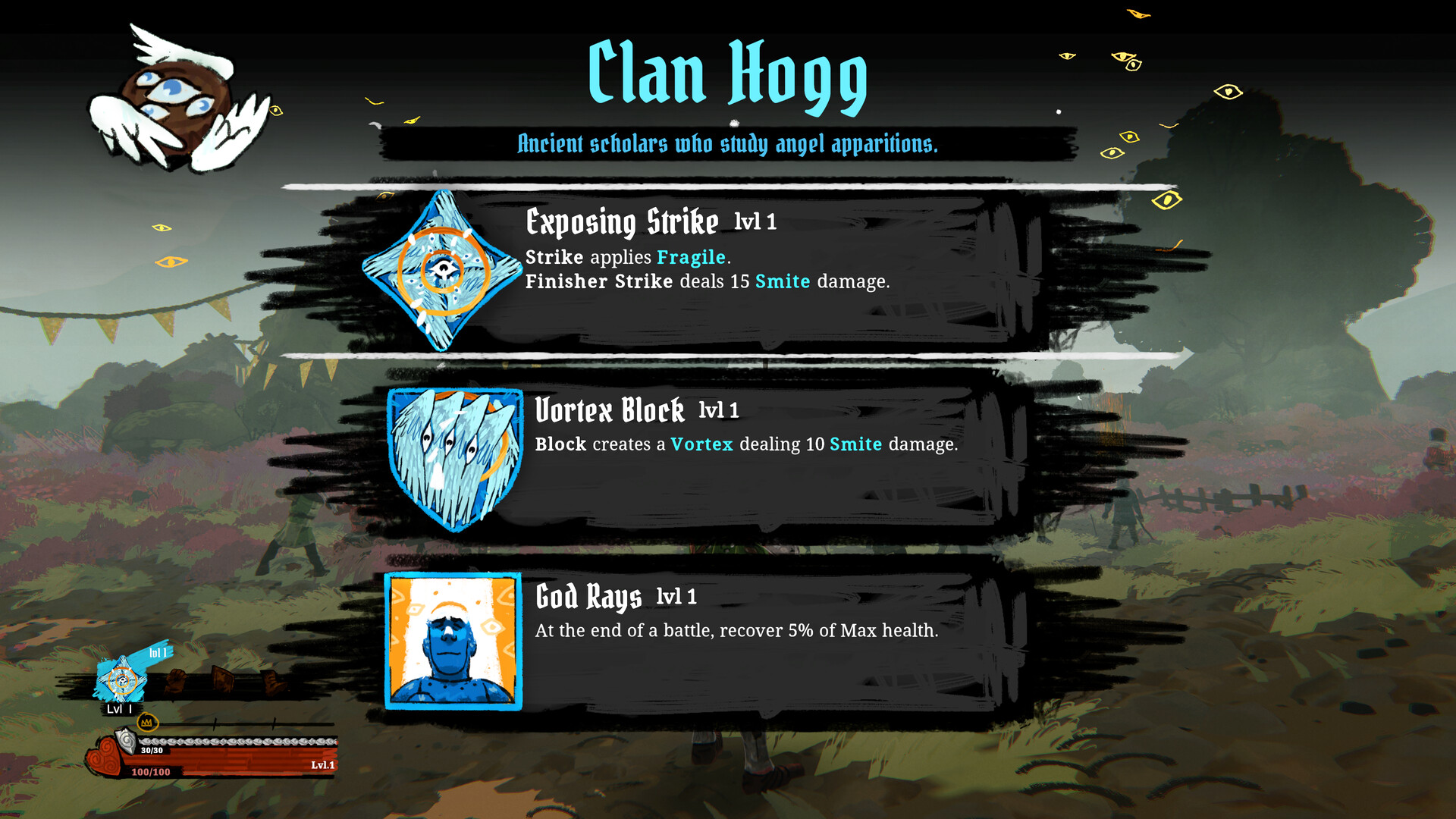
Campaigns are punctuated by illustrated narrative events that interrupt the fighting with a titled scene and a short piece of writing before returning the player to the battlefield. They give the campaign texture beyond combat encounters and sit alongside the shrines and secret discoveries scattered through each run.
Campaign Economy
Runs are funded by several separate currencies. Coins are the general in-run currency, spent at shops, at Healing Fountains and on some narrative events. Dragonstones are the scarcer currency, used for Dragonstone treasure chests that guarantee a high-tier Charm and for the small burning statues that reduce Threat. Triskelle and Region Currency sit in the meta-progression layer, alongside Scrolls, which the August 2026 patch added as Act 2 and Act 3 rewards once Act 2 has been cleared.
Source | What It Gives |
|---|---|
Grey Fountain | Restores health for coins; restores five more health since August 1, 2026 |
Golden Fountain | A stronger healing option, priced separately per Act |
Treasure chest | Charms and loot, at a coin cost that rises through the Acts |
Dragonstone treasure chest | Costs one Dragonstone and guarantees a high-tier Charm |
Small burning statue | Reduces the Threat level; cost cut from two Dragonstones to one |
Cursed Spealbone | Grants a Charm in exchange for health |
Statue Region rewards | Meta-progression currency, increased in quantity after launch |
H.W. in a barrel | An item buyer. Since September 8, 2026 it asks for a completely random item and offers an amount based on the item's rarity and the current Act |
Oak Barrel | Grants Emblem rerolls |
Travelling Merchant | A shop whose stock can carry discounts |
Prices across shops, fountains and chests were rebalanced twice in the first two weeks after players reported steep inflation between Acts, and the meta-progression economy was reworked after feedback that it felt too grindy.
Beacons
Beacons are timed battlefield objectives that appear during a run. Their frequency, delay and quantity were rebalanced on August 1, 2026 so that they arrive in clearer waves, and the Morale Beacon was fixed so that taking damage freezes the Special charge bar at its current value rather than draining it. From August 13, 2026 a Beacon that is left alone destroys itself after 90 seconds.
Castle Records
Castle Records is the in-game compendium of unlocked content. It tracks which Charms and other items the player has obtained, marks locked entries clearly, and since July 28, 2026 flags entries that cannot currently be obtained at all. Several rounds of fixes were needed after launch before its unlocked-item tracking was reliable. The game also carries a Codex, which was fixed on August 13, 2026 so that it correctly raises notifications for newly discovered content on a fresh save; Paper Cult has not explained how the two relate.
Saving
The Early Access build has no mid-run save. A campaign has to be completed or abandoned in one sitting, and Paper Cult named mid-run saving one of its two top development priorities within days of launch, alongside multiplayer stability. A safer save system with a recovery pipeline, intended to prevent corrupted save files, arrived on July 28, 2026. Mid-run saving itself was still unfinished as of August 13, 2026, when the studio said the feature had turned out to be considerably more complicated than expected but remained actively in development.
On September 18, 2026 Paper Cult said mid-campaign saving was coming very soon, solo only at first: a player will be able to save a campaign, leave the game and come back to continue it later.