Loading...
Loading...
Tenkyo
August 26, 2026 at 04:23 AM
Created the Tenkyo page for the second confirmed flagship lunar city, covering the neon nightlife quarter, the Showa-era theming and the caveat that it is the setting's own conceit rather than real history, the engineered habitability, the transit links, and the class divide
Tenkyo is one of two flagship lunar cities in SOL Shogunate, presented as a nightlife quarter drenched in neon and themed after the Showa era. It is the counterweight to Shin-Edo, the feudal-Edo capital the studio leads with, and the two were walked through together in the first developer diary. For the wider region, see The Moon.
Field | Detail |
|---|---|
Type | Lunar city, presented as a neon-drenched nightlife quarter. |
Era Theming | Showa era, framed around a 1980s entertainment district. |
Role | One of two flagship cities the studio has actually presented. |
Companion City | Shin-Edo, the Lunar Glass City. |
Habitability | Earth-like conditions held by centrifugal force and engineered atmospheres, as elsewhere on the Moon. |
Connections | Lunar bullet trains to other cities, and space elevators to orbit. |
First Shown | The World of SOL Shogunate developer diary, April 2026. |
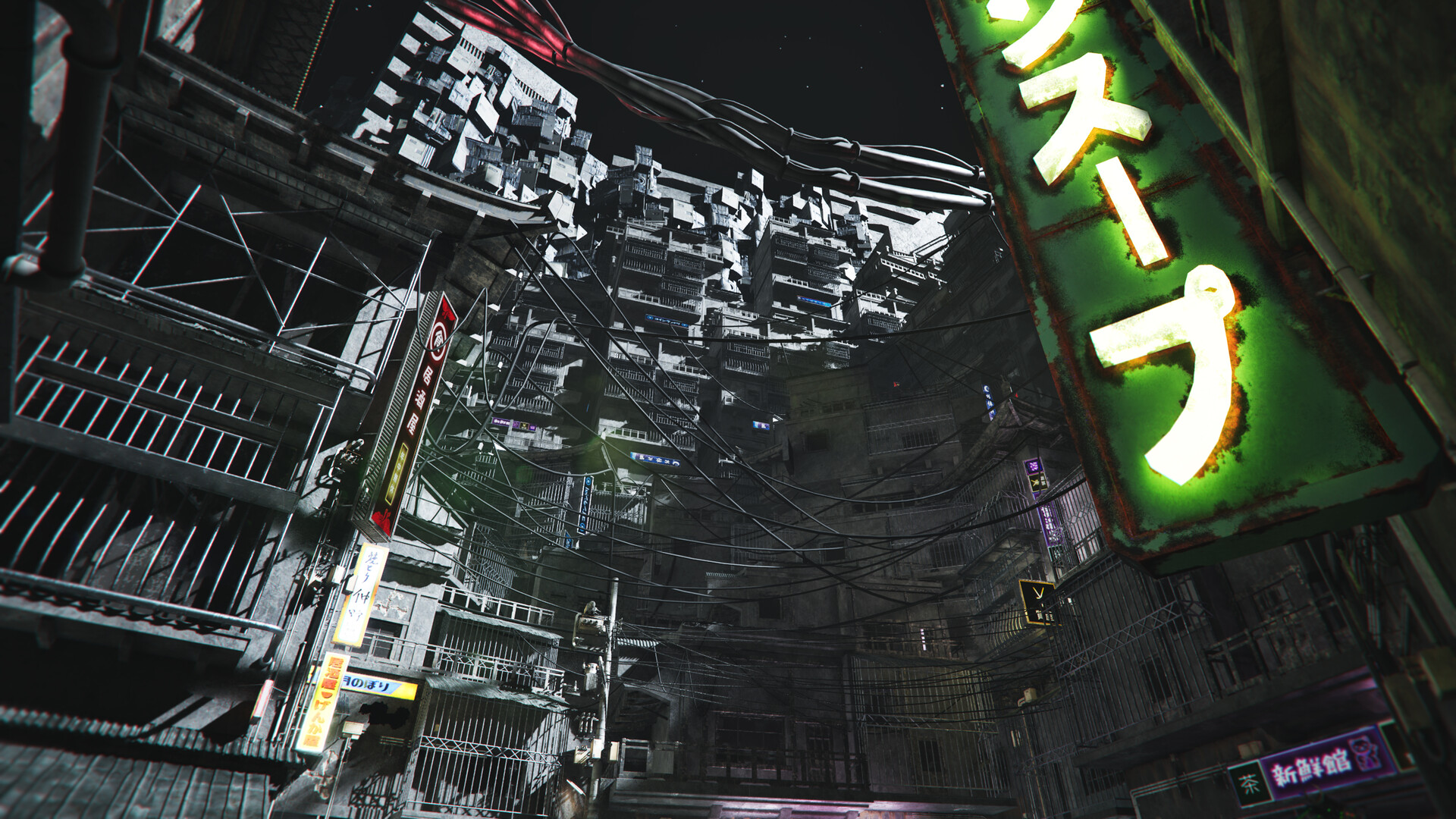
Where Shin-Edo is the studio's daylight establishing shot, Tenkyo is its night. The studio's own copy calls it a neon-drenched nightlife paradise, and the concept art published so far matches that: a narrow alley running between stacked concrete apartment blocks, power lines and heavy conduits crossing overhead, shop signage crowding both walls, and a bare starfield where a sky would be.
That last detail is the tell. The scene reads as a dense entertainment district right up until the point where the roof of the world turns out to be vacuum. Tenkyo is a city built for leisure inside a shell that has to be engineered before anyone can stand in it, which is the tension the setting keeps returning to.
Each major lunar city is themed around a different era of Japanese history, and Tenkyo draws its own from the Showa era, specifically the look of a late-twentieth-century entertainment quarter. Shin-Edo takes the feudal Edo period; Tenkyo takes the neon one.
The theming is a surface rather than a description of the population. The studio has said each city is meant to read as a real, lived-in futuristic metropolis made up of many different backgrounds and cultures, so the period dressing sits on top of a mixed populace rather than standing in for it.
It is also not a claim about real history. The era styling is the setting's own conceit about how a spacefaring ruling class chose to dress the world it built, and nothing about the real Showa period should be read into the city on that basis. What the game depicts is the reference point; the history it borrows from is not.
Tenkyo lives under the same engineering as the rest of the Moon's cities. Centrifugal force and engineered atmospheres hold conditions close to Earth normal inside the shell: walkable gravity, breathable air, and stable temperatures. Step outside and the surface is hard vacuum, high radiation, and temperature swings that would kill an unaltered human. Yuzuki crosses that boundary because her bio-ceramic skin hardens when she does, which is covered on the Augmentation page.
Tenkyo sits inside the same transit web as every other settlement. Bullet trains tie the cities and districts together across the lunar surface, and space elevators connect the surface to orbit. The Tennoji clan built much of that train network, which is part of why the house carried the political weight it did before the massacre that opens the campaign.
Beyond the cities are the crater mining settlements tied to the Karasuma clan and long stretches of exposed terrain crossed by mount rather than on foot. The world is not one seamless open map: it is a narrative-driven campaign built out of designed levels, with access widening as the story progresses.
The same split that runs through the rest of the Moon runs through Tenkyo. The visible side of lunar life is the aristocracy inside the domes and the leisure the domes are built to hold. The largely unseen side is the workforce that keeps the mines and the transit running, living without the engineered comfort the entertainment district is an expression of. A nightlife paradise is, by construction, a place someone else maintains.
The studio has not described who staffs Tenkyo, who its patrons are, or how the clans divide it, so the specifics of that divide inside this city are still open. See The SOL Shogunate for how the regime orders its world more broadly.
Tenkyo was walked through in the April 2026 developer diary titled The World of SOL Shogunate, which covered the city alongside Shin-Edo and the stark lunar surface beyond them, and set out the Tennoji and Karasuma rivalry. That remains the fullest public look at the place, and Tenkyo has not had a showing of its own since.
Most of what a reader would want to know about the city is not yet public:
The explorable footprint, and how much of the city the player can reach.
Named districts, landmarks, venues, or interiors. None has been announced.
Population and physical scale.
Which clans hold territory here, and whether the Tennoji or Karasuma have a presence.
Whether the city is a single level, several, or a hub returned to across the campaign.
How the game handles a day and night cycle inside a simulated one, and whether Tenkyo is permanently night.
What role the city plays in the campaign, and at what point the story reaches it.
Whether the neon quarter shown in concept art is representative of the whole city or one district of it.
This page will be updated as more of the city is revealed.