

Overview
Navigating Silvernia's vertical, layered cityscape requires multiple traversal tools. The city's architecture stacks districts on top of each other, with upper-class neighborhoods above street level and shadowy wards below.
The game's team sums the layer up in a line: parkour is the default, with mounts and ziplines available on top of it. Every tool below is one of those three, and the sections are ordered by how far they move the player rather than by how often they come up.
Silverium Pegasus
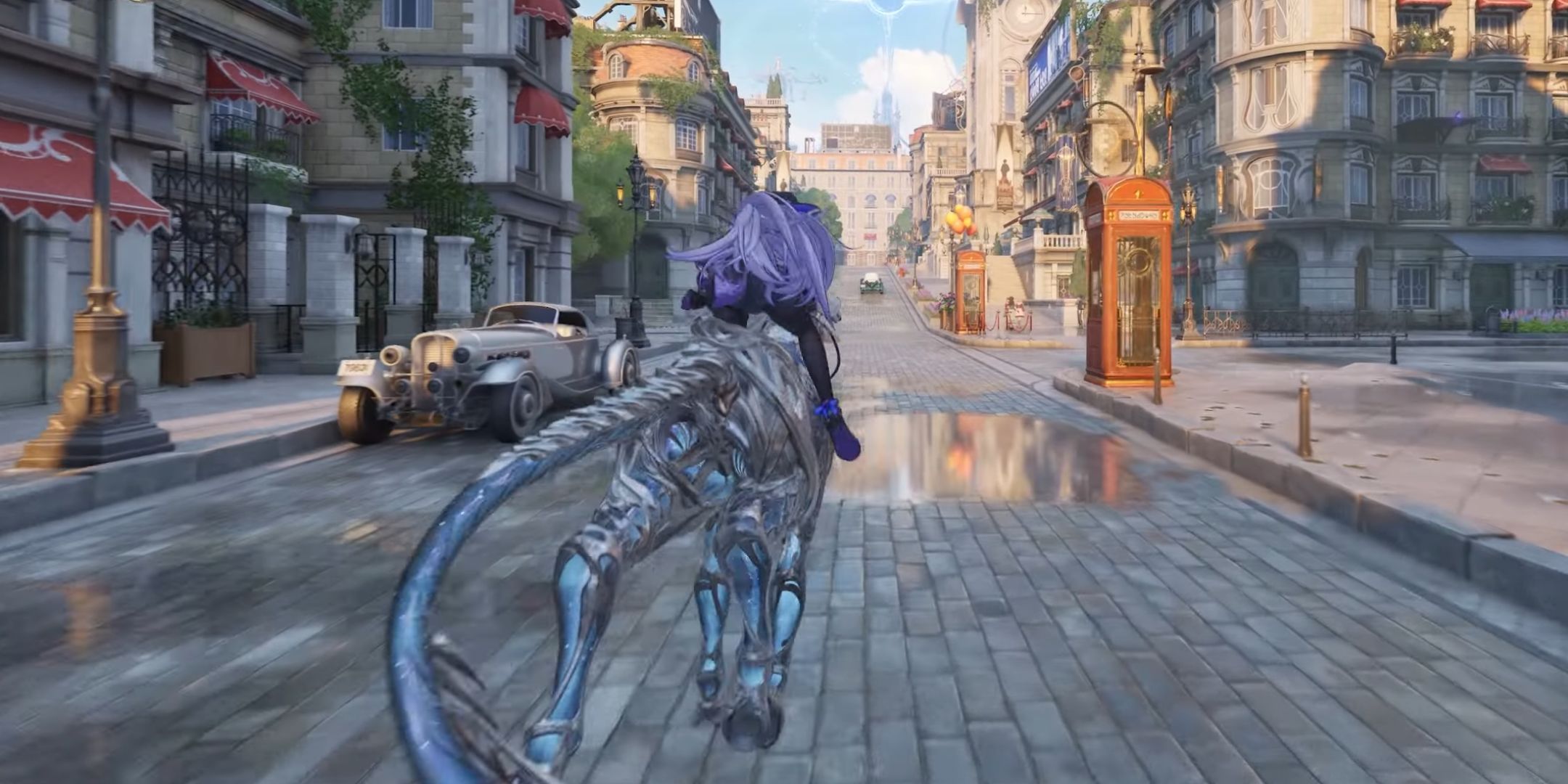
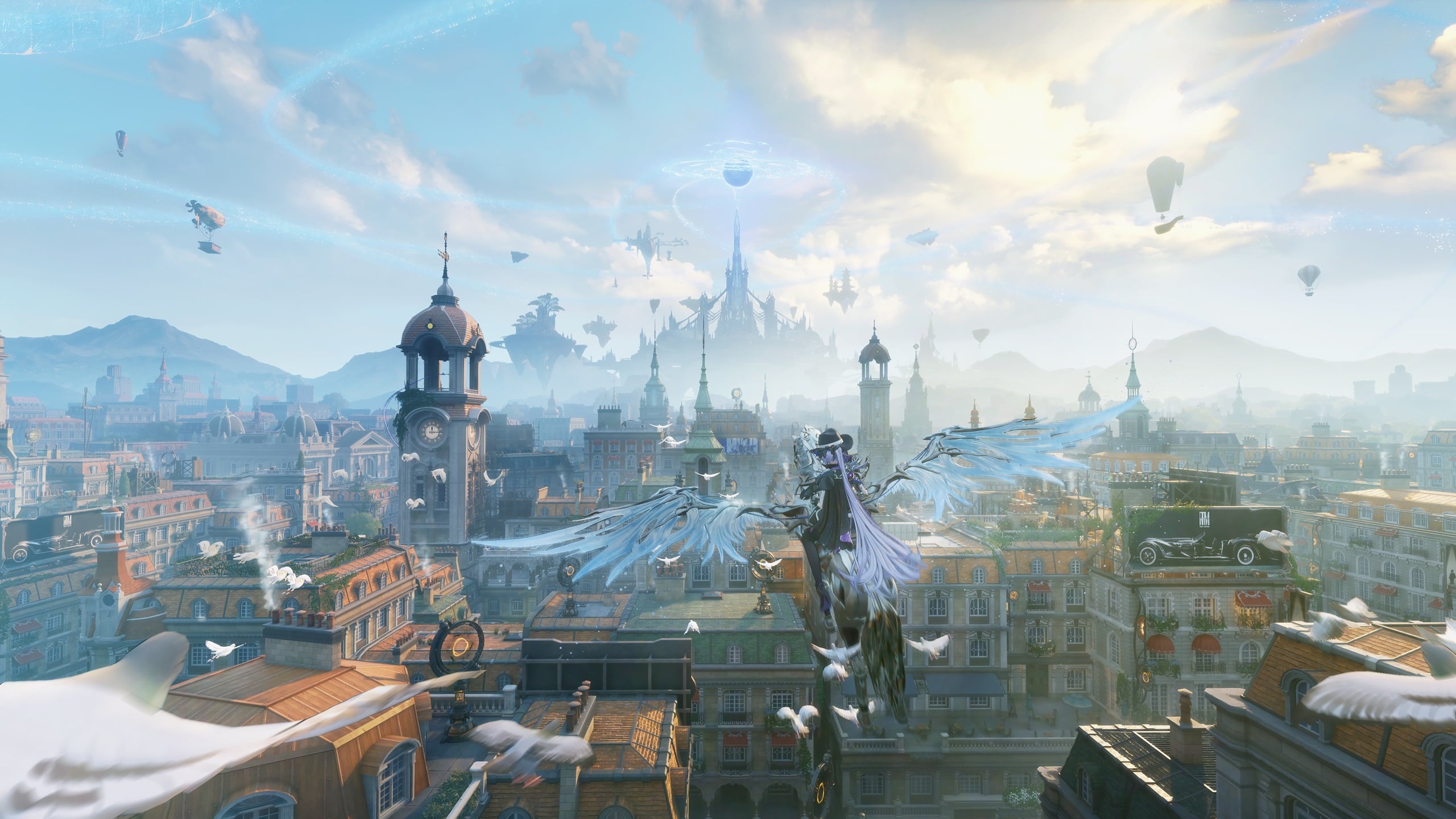
The signature mount is a mechanized horse called the Silverium Pegasus. It can gallop through streets, drift around corners, and fly through the air. Different variants exist at different rarity levels, each with its own speed, health and cooldown figures. The mount can be summoned at any time during open-world exploration. Official captures show it in two distinct forms: a grounded quadruped with no wings visible, galloping down a cobbled street, and a winged form seen in flight above the skyline.
The mount enters flight two ways: from launchpads placed around the city, and by jumping from a high point and calling it during the fall. Neither route needs a fixed station, so the air layer is reachable from most of the map once the mount is available.
Mount Controls
Captures of the test build put the mount's control list on screen. The actions below are as labelled in that build; inputs from an unfinished test client are liable to change.
Action | Input |
|---|---|
Move forward | W |
Rein in | S |
Accelerate | Shift |
Drift | Space |
Dismount | V |
Summon the mount while on foot | V |
Sprint while on foot | Shift |
Horse Racing
The second closed beta added horse racing as an activity in its own right, described by the publisher as sending the player tearing through the city streets, and offered as a break from casework rather than as part of it. No course list, reward table or ranking structure has been published.
Racing runs on the same mount and the same controls as ordinary travel, so nothing above changes for it. It is listed among the Dichotomy Beta additions rather than as a separate movement system.
Grappling Hook
A magical grappling hook that latches onto railings and surfaces. It is a zipline for fast horizontal and diagonal traversal between buildings and across districts. The grappling hook is essential for reaching clue locations that are only accessible from elevated positions.
Ascender and Descent Devices
Dedicated tools for vertical movement through the city's layered architecture. Ascenders carry players upward to higher districts; descent devices bring them down safely. These fill the role of elevators in the city's verticality-focused design.
On-Foot Movement
Standard movement includes running, sprinting, and climbing. The Detective is agile enough for parkour-style movement across rooftops and building facades.
On-foot parkour is also the traversal option that survives a stealth approach, since calling the mount is loud and visible.
Silver-Kinesis
Silver-Kinesis is the Detective's ability to draw objects toward them from a distance. It is not a movement tool in the way the grappling hook is, but it covers the same gap: reaching something that is out of arm's reach without repositioning for it. Its everyday use is opening chests, and it is also the input for several of the open-world puzzles, where objects have to be moved into position rather than simply collected. It fits the Detective's Gravitas attribute, which is described in combat terms as gravity manipulation. The wider open-world layer it belongs to is covered on Exploration.
City Verticality
Silvernia's architecture stacks districts vertically. The upper city contains opulent neighborhoods and corporate headquarters; the street level holds the festive cafes, shops, and bulletin boards used in Investigation; the lower wards run beneath through shadowed alleyways. Districts named in beta materials (Riverside Quarter, Felix Quarter on Morgue Street; Boutique Quarter on Four Crowns Street; South Church Quarter on Dayfair Way; see Silvernia) sit at different heights, making vertical traversal not optional but routine. Each traversal tool solves a specific transition problem.
Tool Comparison
Tool | Best For | Limitations |
|---|---|---|
Long-distance traversal across districts; air travel between vertically-separated areas | Cannot enter most interior spaces; requires open sky for flight | |
Grappling Hook | Reaching elevated clue locations during investigations; mid-range diagonal moves | Needs a valid latch point; not all surfaces are grappleable |
Ascender / Descent Devices | Vertical-only transitions between fixed district levels | Tied to placed installations rather than free movement |
On-foot parkour | Rooftop chases, narrow alley navigation, stealth approaches | Slowest option for long distances |
Investigation Use Cases
Several Investigation clue locations are only reachable via grappling hook or ascender. Crime-scene examinations sometimes require approaching from a roof angle (using the grappling hook to position above) before descending into the scene. The Detective's parkour ability lets them clear small gaps without tool assistance, which matters during stealth approaches when summoning the Pegasus would alert guards.
Mount Variants
The Silverium Pegasus has multiple variants with different rarity tiers and stat profiles (speed, health, cooldown timing). No per-variant list has been published, so the variants are documented only as a category rather than individually. See Silverium Pegasus for what is known about the mount itself. The flying mode is the most visually striking traversal option and is the primary marketing showcase for Silver Palace's vertical exploration design.
Combat Transitions
Traversal tools double as combat positioning aids. The grappling hook can pull the Detective toward an enemy for a closing attack, the descent device can stage a vertical drop onto a target, and the Pegasus can be dismounted mid-charge for a momentum-carried opening strike. The full combat use of these transitions was not exhaustively documented in the first test's materials, and the second test's combat description did not return to them.