

This article is incomplete
Some sections are missing or need additional details. Help improve it by contributing.
The core gameplay loop in SAND: Raiders of Sophie centers on deploying onto the surface of Sophie, scavenging for loot and resources, surviving encounters with other players and AI creatures called Upiors, and reaching an extraction point to return to the orbital station. Players can fight or attempt to talk their way out of confrontations with rival players. For a new-player walkthrough of this loop, see Getting Started.
Game Modes
Expeditions run in one of two modes. See Game Modes for the full breakdown.
Mode | Description |
|---|---|
Voyage Mode | Lower-stakes exploration with no time limit, letting players test Trampler builds and scavenge lower-tier items at their own pace |
Storm Dive | High-risk expeditions where an encroaching sandstorm shrinks the playable area until it reaches the map center; higher-tier loot is available but PvP encounters and the risk of losing your Trampler and loot are greatly increased |
Combat
Combat takes place in both first-person on foot and in vehicle-based Trampler engagements. Players use early 20th-century-style firearms during on-foot skirmishes, while Tramplers can be equipped with mounted artillery and weapons for larger-scale battles. The supernatural Upiors are hostile AI creatures that players must fight or avoid during expeditions. After a July 2026 update the Upiors can also crew mounted cannons, adding ranged fire to the threat they pose, though they abandon a cannon when a player closes in. A second type of AI threat, the Ironclads, drop into the expedition area and then begin tracking players who linger. They are worth engaging rather than simply outrunning: an August 2026 update made them the source of the fuel that reloads a repair kit.
On-foot movement is tied to what you carry and how you move. A July 2026 update made characters move more slowly while holding items such as weapons, grenades, artifacts, or tools, slowed strafing and moving backward, and added a movement penalty for repeated consecutive jumps.
Some of the strongest tools on the surface are scavenged rather than equipped. Deployable artifacts can be activated during a run to shield a position or blow one apart, and they can be destroyed in turn: an activated artifact carries 900 health, takes infantry and siege damage, and is destroyed outright by an EMP wave. The sphere shield is the exception on durability, sitting at 25,000 health, and the WOK bomb is the exception on damage type, ignoring infantry and siege fire but still falling to an EMP.
Trampler-versus-Trampler fighting rewards knowing the machine. The developers describe these battles as highly strategic, with success resting on destroying or disabling the integral parts of an enemy's vehicle rather than simply pouring damage into it, so a crew that understands where a rival's engines, weapons and command compartment sit has a real advantage.
Cannon fire against another machine is resolved shot by shot against whatever compartment it strikes, and the August 20, 2026 update added an on-screen readout naming which of four things happened.
Result | What Happens |
|---|---|
Hit | The shell lands, deals its damage and is destroyed |
Ricochet | The shell deals 20 percent of its damage and is deflected away from the compartment it struck. A deflected shell can still deal its full damage to whatever it meets next |
Penetrate | The shell deals 50 percent of its damage and keeps flying until it hits another obstacle, so one shot can total up to 150 percent of its damage |
Clean Through | The shell passes through a compartment that has already been destroyed, dealing it no damage and surviving the trip. The developers noted this had always been the behaviour and that only the readout is new |
The same update added three shell types alongside the existing calibres. These are Early Access tuning values and will move, but the roles they fill are clear enough.
Shell | Behaviour |
|---|---|
70mm armor-piercing shrapnel | Fired as a single projectile that punches through armor and bursts into shrapnel on the far side |
80mm subcaliber | Always penetrates, and can carry through several compartments in a row |
40mm low-heat | Halves the overheat build-up while firing autocannons |
Field repair changed in the same pass. A repair kit is no longer destroyed once its charges are spent; it can be refuelled instead. An empty kit can be bought from storage, a kit carried into an expedition starts with no fuel in it, and a kit brought back out is unloaded automatically, with the fuel left in it extracted as a separate item. The September 1, 2026 update then doubled how much fuel a kit holds, from three to six, doubled the small, medium and large fuel stacks carried on a run, raised the orbital-storage fuel stack from 24 to 60, and doubled the number of kits that stack in orbital storage.
Threat Marking
A crew that starts wrecking machines gets pointed at. The September 10, 2026 update added a Threat status: once a crew has destroyed enough rival Tramplers in a single expedition, every Trampler that crew owns is marked, and every other player in the session can see the marked machines. Capturing a rival Trampler marks the capturing crew's machines too. The threshold depends on the queue, and the mark is not permanent.
Rule | Detail |
|---|---|
Threshold in Solo | Destroy two Tramplers in one expedition |
Threshold in Duo, Small Crews and Large Crews | Destroy three Tramplers in one expedition |
Capture | A crew that captures another Trampler has all of its Tramplers marked |
Visibility | Every other player in the same session can see the marked Tramplers |
Clearing the mark | Lose every Trampler tied to the crew, extract, or use a radio in the municipality building |
The mark turns a strong crew into a target for everyone else on the server, so a squad that wants to keep farming quietly has to decide whether a third kill is worth being lit up for the rest of the run, or whether to break off and reach a municipality radio first.
Multiplayer
SAND: Raiders of Sophie supports both solo and cooperative multiplayer. You can play alone or in a crew of two to six players. Squads share a Trampler, pooling resources and dividing roles such as piloting, manning weapons, and managing storage. Solo play is fully supported and balanced independently of team play. Matchmaking is based on crew size, and the number of players on a server scales with it: 15 on solo servers and up to 45 on full six-player-team servers.
Characters and Progression
Your inventory and tech tree are tied to the character you create, and each character is locked to the region you choose at character creation, so progress does not carry across regions. Trampler blueprints are the exception: they are shared across all of your characters. If you lose every Trampler and all your resources, you can start over with a new character or join a team that still owns a Trampler to recover.
Communication
Crews talk to each other over proximity chat, which the developers have called the primary form of communication in the game. Asked in a July 2026 community question-and-answer session whether Tramplers would ever be able to signal each other over a radio, a CB set or a ping system, the team answered that there were no plans for any of them at the time, and said it would keep expanding what the Flare Gun could do instead.
That position did not hold for long. The update shipped on August 10, 2026 added an in-game ping system bound to the middle mouse button, about three weeks after that answer and well ahead of the horizon the feature had been listed under on the published roadmap. See Early Access for where pinging sat on that roadmap.
On-Foot Interface
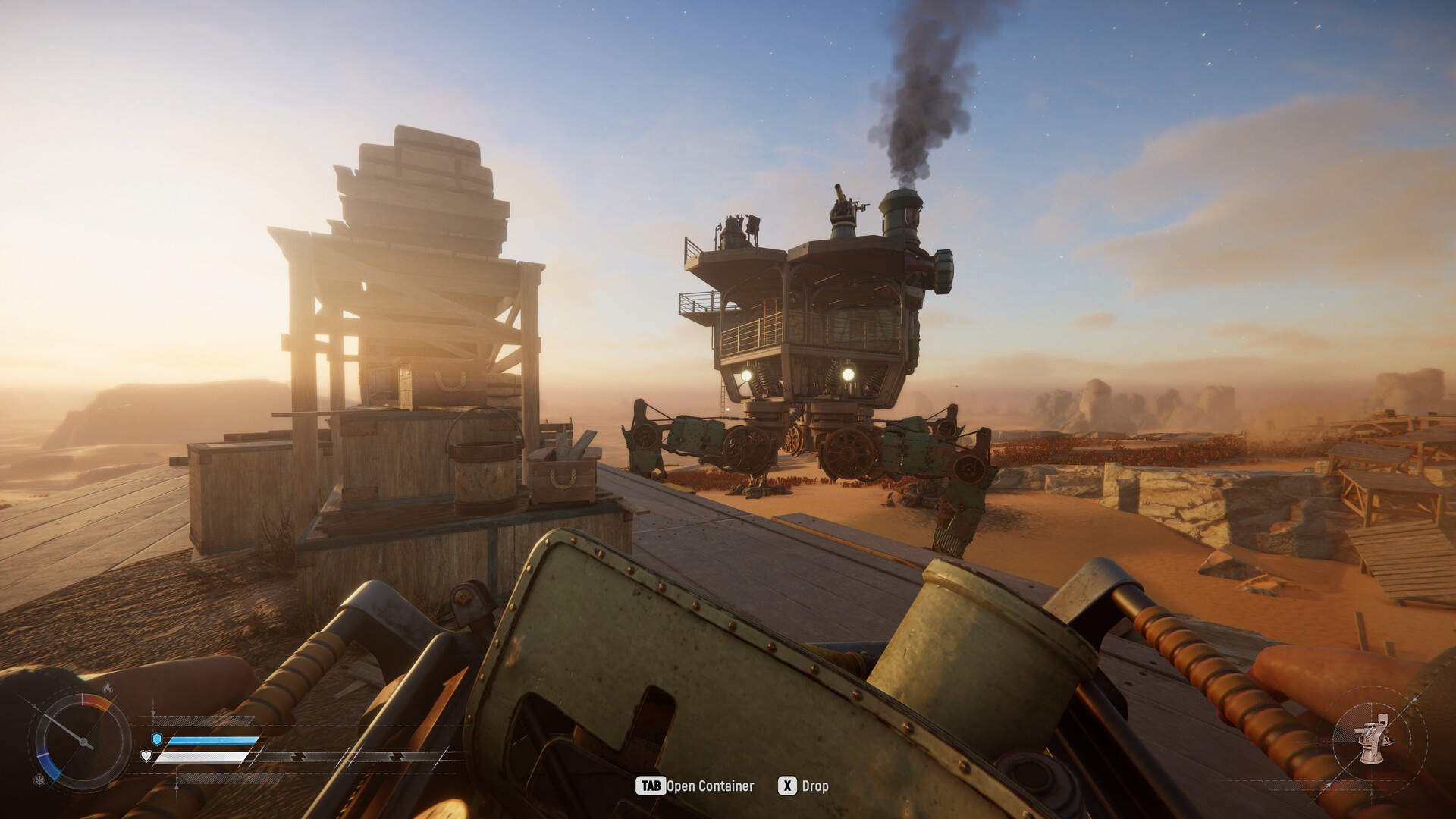
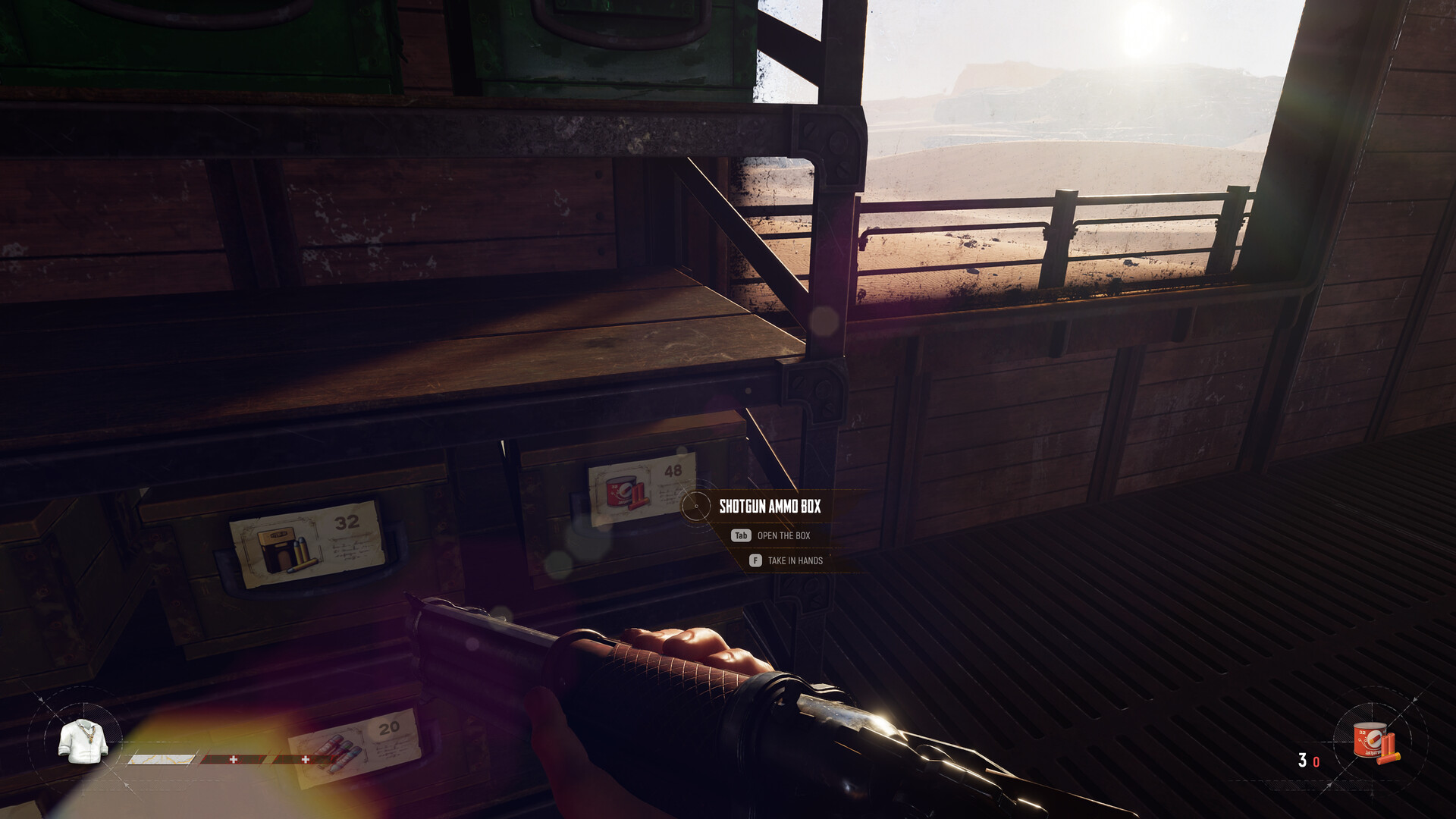
The on-foot display keeps the essentials in the corners. A circular gauge sits at bottom left, sweeping from a blue freezing arc up to a warm red one, next to bars for your health and protection and an icon for the clothing you have on. The bottom right carries the ammunition count for whatever is in your hands. Interactions surface as prompts on the object itself: a supply container on a deck offers to open or drop it, and a shotgun ammo box aboard a Trampler offers to open the box or take it in hands. Storage inside a machine is physical rather than abstract, with ammunition kept in drawers whose handwritten cards show the cartridge type and the count left in each one.
The September 1, 2026 update also reworked how items are dropped and hidden, let a held weapon go straight into storage without unequipping it, opened the side mouse buttons to binding, and split mouse sensitivity into six separate states. The game offers more than one weapon-handling scheme, and the developers refer to the schemes by the names Outlaw and Smuggler in their patch notes. The full breakdown is on Controls and Settings.
Online and Anti-Cheat
The game is always online and requires a broadband connection. It runs BattlEye anti-cheat and offers full controller support. More detail is on the Servers and Online page.
Extraction
Each expedition ends when players successfully locate an extraction point and escape to the orbital station with their Trampler and gathered loot. Dying during an expedition risks losing the loot carried on that run, though Trampler blueprints can be saved and rebuilt.
Twenty achievements track milestones across this loop, from destroying your first Trampler to capturing five in a single expedition. Eleven publish their conditions; the other nine stay hidden until earned.