

Exploration in Rewinding Cadence covers travel, traversal, town interaction, and the world's reaction to player behavior. The world is presented in an anime art style and viewed through a third-person camera, and most regions are designed to support both fast traversal and deliberate, stop-by-stop investigation.
World Design
The official world section is built as six region slots, and exactly one of them is open. Only Loren carries a name; the other five are present but locked, with no name attached to any of them. That is a deliberate reveal structure rather than an incomplete page, and it sets a rough expectation for how much of the continent is still unshown: five sixths of the slots the studio has laid out for itself. No release material names any of the five, and this wiki will not guess at them.
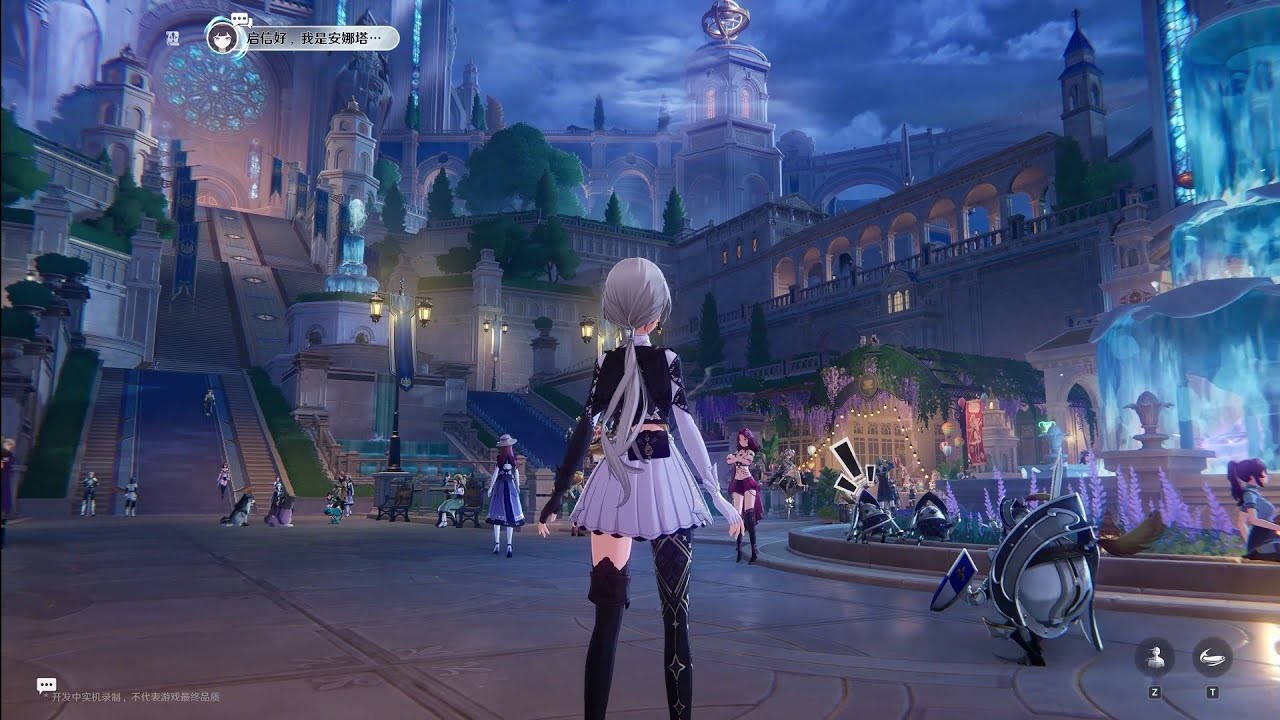
Trailers and beta footage show a mix of open countryside, dense urban centers, and architectural set pieces. The world is laid out as a connected continent rather than a hub-and-spoke structure of isolated zones. Travel between regions is part of the cycle's pacing, and players who want to extract maximum value from a loop tend to plan a route across it before they leave town. The studio has now published a region roster covering the setting's main city and one wilderness region, with named districts inside the city and a short description of what each one is for. That roster is the first canonical location list for the game.
The named locations published so far center on Loren City, the setting's cultural hub and the region with the strongest concentration of spirit energy, along with a wilderness region on its outskirts that is presented as dangerous rather than scenic. Each named district inside the city has its own function: a library and scholarly institution, an information-trading tavern, a commercial avenue, a travellers' camp, and an undercity fighting ring. The region page covers each in turn.
Traversal
Movement systems shown publicly include running, climbing, and gliding, with mounts available for long crossings. Gliding in particular is highlighted in published trailers as both a traversal tool and a moment-to-moment movement option that can chain with mount summons and combat exits. A typical loop's travel pattern combines short-range gliding with long-range mount riding to fit a multi-region quest into the day budget.
Mounts
Mounts are summonable rideable creatures used to cover large distances, shown across multiple official trailers in both rural and urban settings. Specific mount species, unlock paths, summoning rules, and any mount progression have not been listed in a central source yet, so this section will be expanded once verified.
Interactive NPCs
NPCs in Rewinding Cadence are not stationary set dressing. They walk routes, engage in conversation, run if threatened, and fight back if attacked. The world's everyday population is built so that aggression has consequences, and the consequences are visible. A villager who watches an attack will react. A guard who arrives during a fight will engage. A vendor who is robbed will close their stall and refuse business in the same cycle.
Star-Wanted System
Aggression in populated areas escalates the Star-Wanted system, a heat meter loosely modeled on the wanted-level systems in open-world crime games. Higher heat brings stronger response, blocked services, and pursuit by faction enforcers. The full mechanics live in their own article, and they are an exploration topic specifically because they are a consequence of how the player chooses to move through populated space.
Exploration Across Loops
Because most world state resets at the end of a cycle, exploration is also the cheapest form of investigation. A player can blow a single loop on scouting a region, taking notes on NPC routines, mapping the location of a hidden questgiver, and dying in the encounter that would have happened later, with all of that knowledge surviving into the next loop where it can be exploited. Players who treat early loops as exploration runs tend to outpace players who try to optimize for a final ending too early.
Skateboard Mobility
The First Playthrough Test (一周目测试) build confirmed a skateboard-based mobility system available from the start of the playable cut. The skateboard is a fast-travel-on-demand option rather than a separate unlock, and it has a stamina-consuming boost mode that lets the player accelerate further at the cost of a regenerating meter. Developers acknowledged in post-test communication that the skateboard's base speed may be rebalanced before the next public test, so the exact movement numbers should be treated as build-specific. See traversal for the full mobility set including mounts and gliding.
Why the Board Exists
The studio put the reasoning behind its traversal device in writing when the first public test opened, and it is unusually direct about the design problem. It describes a board system built for high-speed movement, strong manoeuvrability and very long endurance, covering sea, land and air, and states the purpose plainly: so that the player does not have to spend the run grinding across the map.
That is the traversal system answering the forty-two-day cycle. In a game where every day spent travelling is a day not spent on an objective, slow movement would not be a difficulty setting, it would be a tax on the whole structure. Making the board fast, long-range and available from the start removes that tax and keeps the loop's pressure on decisions rather than on distance.
Water and air travel are officially part of the device's remit rather than a community observation, which makes the world's edges reachable in principle. Whether every stretch of water and every altitude is actually traversable in the shipping build has not been demonstrated. See traversal for the movement layer in detail.
Social Stealth
Towns support more than shopping and conversation. The protagonist can enter a concealed state and use a listening technique to read the true thoughts of passers-by, which surfaces information that ordinary dialogue does not. A separate telekinetic technique lifts items at a distance.
Action | Chinese | What It Does |
|---|---|---|
Concealment | 灵匿 | A hidden state that lets the protagonist move and act without drawing attention. |
Listen to Hearts | 颂灵术·聆心 | Reads the genuine thoughts of nearby characters while concealed. |
Deft Hands | 巧手 | Lifts an item telekinetically rather than by hand. |
These are checks, not guarantees. Botching one can raise a region-wide alert against the protagonist, which is the escalation the Star-Wanted System describes. The same techniques are used in side content: one convention-build errand had the player recruit customers for a cafe by either passing a Deft Hands check to physically move a target, or passing a concealment check to read his mind and confront him with what he was thinking. Beating him up and dragging him there also worked, with a worse result.
Traversal Challenges
Timed traversal courses are scattered across the map and are run with the gliding device. Movement and combat are continuous, so a course can spill into a fight without a loading break. See Traversal for the movement toolkit itself.
Side content is logged separately from the main story. Named examples from the April 2026 test build include a maid cafe in Loren City and an investigation into a porridge seller in Rose Alley, both resolved through a mix of dialogue, scene investigation and dice checks, and both carrying more than one ending.
All figures on this page come from the First Playthrough Test build of April 2026 and the ChinaJoy demo build of August 2026, both of which carried an in-development disclaimer. Treat every number as provisional.