

Overview
The physics system is one of the defining features of Of Peaks and Tides. CyancookGames built a custom physics editor within Unreal Engine 5 to support the game's emphasis on environmental interaction. Nearly every object in Everland has physical properties that affect how it behaves under different conditions. Everything reacts and can become a resource; any item can be picked up and used.
Core Principle
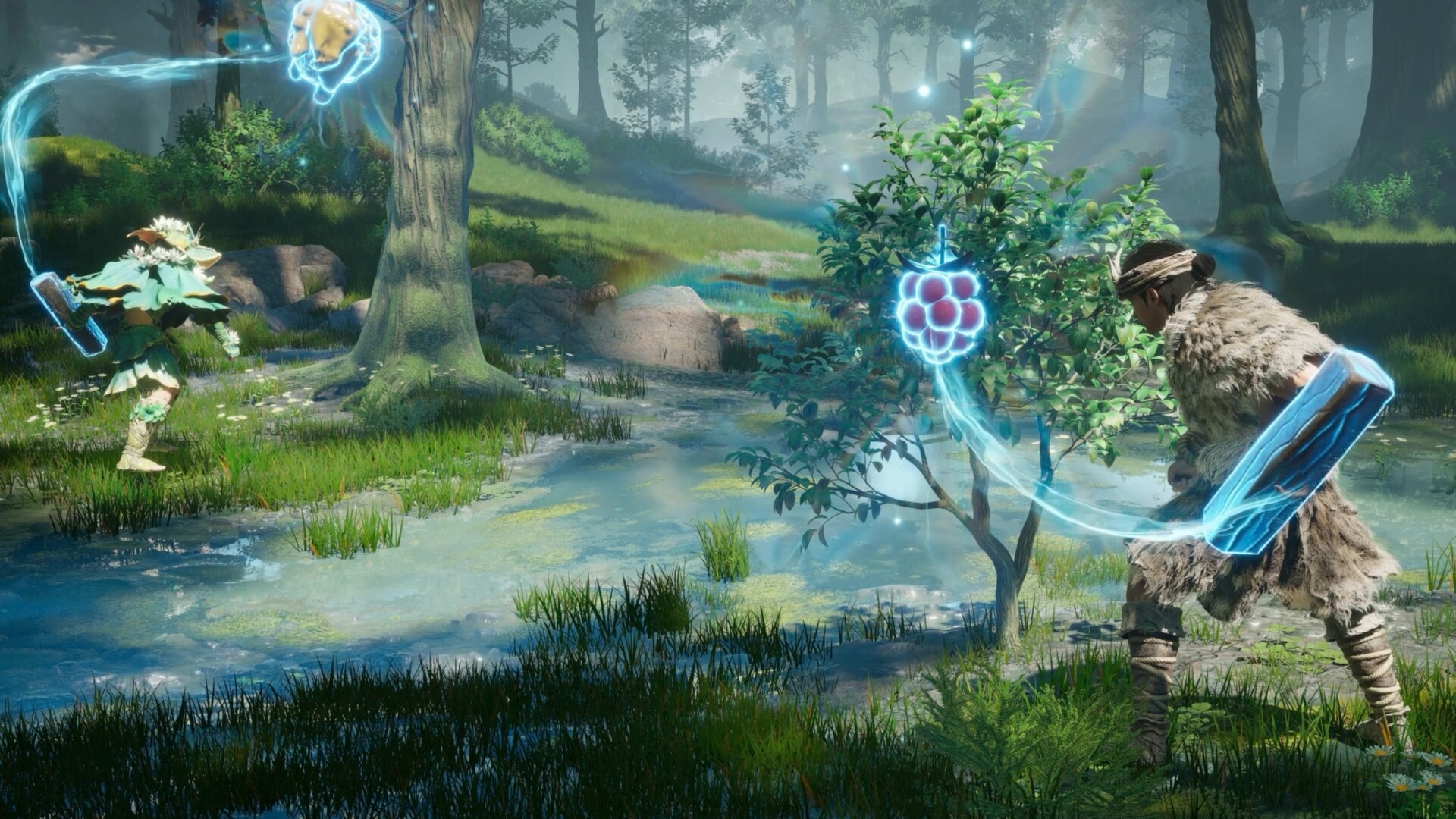
The physics system is built on the idea that every object in the world is interactive. Players can pick up and throw any item, including the risk of accidentally throwing their equipped weapon. Objects have real weight, material properties, and behavioral rules that govern their interactions with each other and with environmental forces.
Key Systems
System | How it works |
|---|---|
Fire propagation | Fire spreads across flammable materials at a rate determined by the material type and environmental conditions. Wind accelerates and redirects fire. Rain and water extinguish it. |
Weight-based damage | Heavier objects deal more damage when dropped or thrown. A boulder pushed off a cliff onto an enemy does far more damage than a hand-thrown rock. |
Wind interaction | Wind affects smoke, projectiles, glider flight paths, and light objects. During wind calamities, these effects are amplified dramatically. |
Tidal erosion | Water tides gradually carve new paths through terrain over time. Coastlines shift, caves open, and previously dry areas may flood. |
Structural integrity | Built structures obey gravity and weight distribution. Removing a support beam can collapse a section of a building. |
Ricochet effects | Cube-shaped rocks ricochet off bouncy plant-like obstacles, triggering cascading chain effects across the environment. |
Elemental Control
Players gain direct control over elemental forces through the physics system. This includes directing gusts of wind, calling down thunder to zap foes, controlling water to flood plains and redirect rivers, and using fire to torch forests or send burning debris at enemies. These abilities interact with the Seasons and Weather system and with calamities, amplifying or counteracting natural events.
Landscape Manipulation
The physics system allows for large-scale landscape changes. Players can create large pillars to serve as bridges across gaps, smash through boulders to open new pathways, and use crafted devices to reshape terrain. These changes are persistent and affect both navigation and combat options.
Observed Interactions
The behaviours below were demonstrated in the public hands-on build rather than described in marketing copy.
Interaction | Observed behaviour |
|---|---|
Rolling stone | A boulder accelerates as it rolls and releases the accumulated energy on contact, flattening walls, structures and enemies in its path. Aimed correctly it can strip a phase from a boss health bar. |
Heat and ignition | A lit torch or campfire raises the temperature of nearby objects and creatures. Past a threshold they catch fire, so heat is a state that builds rather than a binary. |
Cooking by accident | Raw meat left in a flame is cooked rather than destroyed, so the same fire that clears an obstacle also prepares food. |
Directed fire suppression | Water-filled bubbles can be pushed with a wind-producing piece of equipment to extinguish one specific fire instead of dousing an area. |
Spiked vegetation | Thorned vines blocking a route can be burned away rather than cut, which is faster and consumes no tool durability. |
Structural salvage | A collapsed building leaves usable timber on the ground, so demolition doubles as harvesting and removes a round of tree felling. See Crafting. |
Custom UE5 Editor
CyancookGames developed a proprietary physics editor that sits on top of Unreal Engine 5's built-in physics. This editor allows the team to define material properties, interaction rules, and environmental responses at a granular level. The result is a world where objects react to each other and to environmental forces in consistent, predictable ways.
Gameplay Integration
The physics system is not a separate feature; it is woven into every aspect of gameplay. Combat uses physics for knockback, projectile trajectories, and environmental kills. Crafting produces items whose behavior depends on material properties. Base Building requires understanding of structural integrity. Calamities interact with every physical object in the world simultaneously.
Performance
Running a complex physics simulation in an open world is computationally expensive. CyancookGames has discussed their use of spatial partitioning and level-of-detail physics to maintain performance. Objects far from the player use simplified physics calculations, while nearby objects receive full simulation. During calamities, the engine prioritizes physics calculations in the player's immediate area.
The Everything Reacts Principle
The game's official description frames the physics system in two short lines that double as the studio's design north star: "Everything reacts. Everything can be a resource." The phrasing is significant because it elevates physics from a feature checkbox to a system-wide rule: every object in Everland is expected to react under fire, water, weight, impact, growth, or weather, and every object can be picked up, thrown, planted, ignited, or used to redirect another object.
Throwable Objects
The Gamescom 2025 hands-on demo confirmed the consequences of that principle in combat. Players can pick up and throw any item, including the equipped melee weapon. One previewer accidentally threw their only weapon at a skeletal enemy and had to recover the stick before resuming the fight. The mechanic doubles as a deliberate combat option, since rocks, branches, and improvised projectiles are always available in the environment.