

Overview
Combat in Of Peaks and Tides is real-time and action-oriented. Players fight a variety of mythological creatures and hostile wildlife across Everland using melee weapons, ranged tools, and improvised environmental attacks. The system incorporates stamina management, dodge mechanics, and heavy use of the game's Physics System.
Design Philosophy
Combat in Of Peaks and Tides is designed to move beyond traditional stat-based systems. The developers emphasize terrain, tools, and unconventional strategies over raw damage numbers. There is no single correct solution to any encounter; the game encourages rule-breaking and creative approaches.
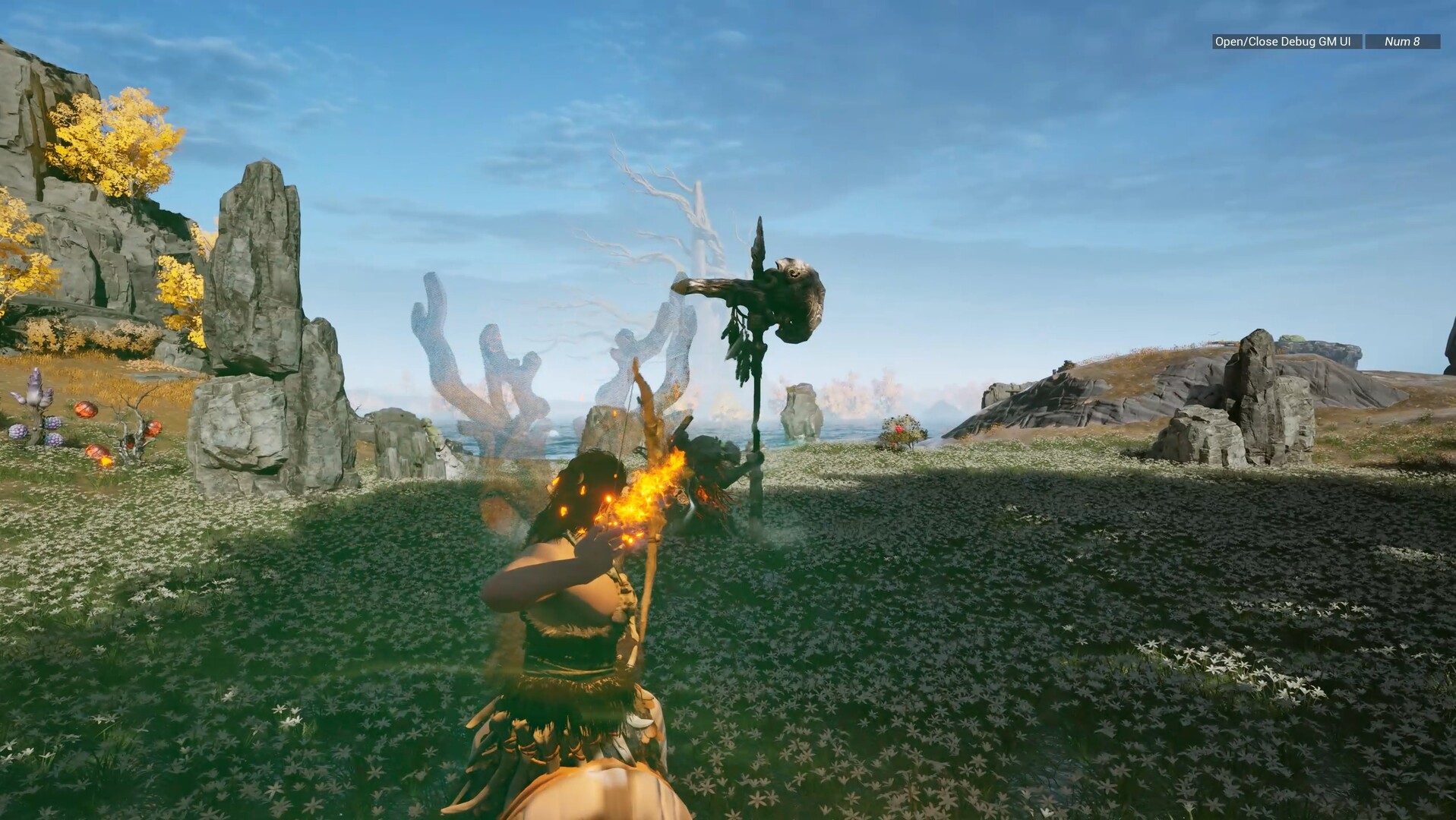
Players can turn enemies against each other, use native plant growth to pin enemies in place, and lead enemies into environmental hazards. During calamities, the environment itself becomes a weapon: lightning strikes can be baited into enemy groups, and high winds can deflect projectiles.
A Dozen Approaches by Design
The studio has put a number on the freedom it claims. Chenchao Lin, chief technology officer, has said that a player taking on a boss has more than ten distinct approaches available, and framed that as the payoff for introducing so many interactions between environment objects: a single material lying in the field can be synthesised into a new item or set off as a gimmick, and which of those happens is the player's call. The figure is stated as design intent, not as a measured count, and no list of them has been published.
The public builds bore the claim out at a smaller scale. The demo boss at gamescom 2025 had at least five unrelated solutions, and staff on the floor said they had no interest in restricting which one a player used. The Tokyo build repeated the pattern around a different arena.
Core Mechanics
Players have a stamina bar that depletes with attacks, dodges, and sprinting. Managing stamina is essential, as running out leaves the player vulnerable. Light attacks consume less stamina but deal lower damage, while heavy attacks and charged strikes drain the bar more quickly.
Dodge rolling provides invincibility frames, and positional awareness matters. Flanking enemies or attacking from elevation can change the outcome of a fight.
Traversal Abilities
Climbing is always available to the player and is a core part of both exploration and combat positioning. Gliding is earned by completing a flying trial minigame, where players fly through hoops across three stages. Upon completion, the player gains a permanent gliding ability.
Flying mounts acquired through Creature Taming provide aerial mobility. Bouncy fauna and large bubbles found throughout the world serve as additional traversal aids, launching players to high ground or across gaps.
Environmental Combat
The Physics System is deeply integrated into combat. Players can push boulders onto enemies, set grass on fire to create damage zones, knock enemies off cliffs, or use water currents to sweep smaller creatures away. Objects can be thrown as weapons, including the risk of accidentally throwing an equipped weapon.
Improvised Weapons
The crafting system allows players to create unconventional weapons by fusing items together. Tree trunks, rock slabs, and even broken siege equipment can be combined into makeshift weapons. Heavier objects deal more impact damage, following the physics engine's weight calculations.
Known Enemies
Enemy | Type | Behavior |
|---|---|---|
Boss (multi-phase) | A triple-tailed flying predator that reshapes the battlefield with wind currents and launches players into the air. Functions as an environment-driven boss rather than a pure damage check. | |
Elite | Blends precision archery with acrobatic melee combat. Equipped with a war bow and enchantment effects that pressure the player's positioning and timing. | |
Elite | A towering ape wielding a colossal tree-trunk club. Players can shoot, steal, or deflect objects the boss consumes or hurls (including fruits), turning its attacks into tactical opportunities. | |
Common | Severs and hurls its razor-edged tail at players before fleeing. Rewards awareness over brute force. |
Gamescom Demo Enemies
The playable Gamescom 2025 demo featured several additional enemy types: wolves that attack in packs, skeletal creatures found at camps with some posted on lookouts, and a flaming skeletal boss encountered on a beach area.
Co-Op Combat
In multiplayer sessions players fight together against enemies that scale in health and aggression with the size of the group. Coordinated strategies, such as one player luring enemies into traps set by another, are encouraged by the game's design.
How many players a session holds is not settled. The studio's chief technology officer described co-operative play for up to ten players working together against giant divine beasts, crafting and building alongside each other. A separate account of the same September 2025 showing reported up to four players in the shipping version, given second hand rather than as a direct statement. As of 2026-09-12 neither number appears on the Steam store page in either language or in any press release, and this wiki records both rather than choosing between them. What is settled is what the game is not: the technical director has said directly that it is not a massively multiplayer game. See Multiplayer.
Confirmed Enemy Roster
CyancookGames revealed four named enemies in February 2026, each built to demonstrate a different combat principle:
Enemy | Role | Combat Principle |
|---|---|---|
Multi-phase boss | Wind currents reshape the arena; positioning beats damage output | |
Elite | Interactive objects: deflect or steal fruit the boss consumes and hurls | |
Elite | Ranged-melee hybrid with enchanted gear that punishes static play | |
Common | Severable razor tail used as ranged attack and escape; rewards reactive play |
See the dedicated Enemies page for the broader bestiary, including the wolf packs, skeletal warriors, and flame-covered skeletal beach boss that appeared in the Gamescom 2025 demo.
Tactical Options
The game's official description frames combat as a menu of approaches rather than a single intended solution. Players choose among five broad tactics, often layering them together within a single encounter:
Approach | How It Works |
|---|---|
Charge head-on | Direct melee or ranged engagement using crafted weapons and stamina management. |
Leverage the environment | Use terrain, vegetation, and natural objects against enemies. The world responds to player actions, allowing flank routes and improvised cover. |
Set fire | Ignite vegetation or oil-soaked surfaces to deny ground or burn out enemy clusters. |
Flood the battlefield | Channel water to drown low-lying terrain, sweep loose objects, and slow heavier enemies. |
Lay traps | Build or place trap structures along expected enemy paths during the prep phase before a fight. |
Stir enemy infighting | Provoke faction or species conflict so hostile creatures attack each other instead of the player. |
Gamescom 2025 Combat Observations
Hands-on coverage from the Gamescom 2025 demo confirmed several practical combat mechanics. Almost any item the player picked up could be thrown as a weapon, including the player's own equipped melee weapon. A simple stick served as the initial weapon, with armor and shields findable inside enemy lairs. Food was used for health recovery. The demo featured wolves in a pack, skeletal mobs at a small lookout camp, and a flaming skeletal boss encountered on a beach, all described as challenging despite the early-build state of the build.
Weapon Movesets
Weapons in the hands-on build were not skins over a shared swing. Each one carried its own attack moveset and its own combat arts, so changing weapon changed the shape of an encounter rather than only its damage numbers. CyancookGames has described the underlying fighting layer as a fairly hardcore action role-playing base with a measure of souls-like weight to it, and has been explicit that this is one route through a fight rather than the intended one.
决意技, the Per-Weapon Arts
Each weapon carries its own named special attack, recorded as 決意技 in the Japanese-language build and 决意技 in simplified Chinese. Accounts of the September 2025 demo describe the arts as the thing that widens a player's style as they are mastered, rather than a flat damage bonus bolted to a weapon tier, which fits the wider design of treating a weapon change as a change of approach rather than of numbers.
As of 2026-09-12 no English name for the mechanic has been published, no individual art has been named, and nothing has been said about what resource or condition gates its use.
Routes Through the Demo Boss
The public demo deliberately built a single boss encounter that could be solved several unrelated ways. Studio staff at the show said they had no interest in restricting how players tackle it, and that every approach was a legitimate one.
Approach | How it worked in the build |
|---|---|
Direct combat | Collect the stronger weapons and equipment scattered around the island, use the save points, and win on execution with the ranged and melee kit. |
Rolling boulder | A boulder resting at the top of a slope could be pushed down at the right angle. It destroyed the wooden stronghold below and stripped an entire phase from the boss health bar. See Physics System. |
Weather manipulation | An interaction point forced the sky over to a rainstorm, filling a natural dam upslope. Blowing the dam open with an explosive fruit released a flood that killed the flame-wreathed boss outright. See Calamities. |
Disarming | A toad the player could pick up and carry used its tongue to pull a weapon out of an enemy grip, briefly including the boss weapon, handing it to the player to use. |
Unarmed | A kick was available at all times and was enough on its own to send an enemy off a ledge. |
Audio Feedback in Combat
Combat feel was the problem that pushed CyancookGames to rebuild its sound work. The studio has said its early sound effects were deliberately lightweight and technically functional, but internal playtests showed boss fights that looked intense without landing: hits lacked weight and the fights lacked rhythm and punch. The team's stated conclusion was that audio is a core part of how players read the world, and that good sound should communicate weight, danger, speed, and pressure well enough for a player to follow the flow of a fight without looking at the interface.
The counterweight is that the studio does not want the mix to dominate a player's attention, and it has said the balance between forceful feedback and a comfortable soundscape is still being tuned. Longer term it wants distinct weapon sounds driven by a weapon's shape and material, which would extend the improvised weapons idea into the audio layer. The full account is on the Audio and Music page.
The Tokyo Demo, September 2025
A second public build ran as a thirty-minute session on an island map with a different boss at the front of it. Enemies arrived in groups carrying axes and bows, their attacks landed heavily, and the attack-and-dodge exchange was repeatedly described as soulslike. The boss swung a giant axe hard enough to crack the ground and a few connecting hits were lethal. Accounts stress it was not a memorise-and-repeat fight: reading the terrain mattered more than learning the pattern.
Chests scattered across the map yielded weapons and armour carrying stat-boosting effects, so gearing up was a genuine alternative to solving the arena, and one account notes the build deliberately welcomed players who wanted to win on execution alone. Behind the boss ground stood a wooden dam wall wedged between two mountains. Observing it reported that enough force would break it and flood the arena. Nobody in the sessions on record managed to test that inside the time allowed, so the flood route at this particular arena is described but unconfirmed.
One account describes exploring the rest of the map, returning to that boss, and fighting it far more competently on the second attempt. The improvement is credited to knowing what the terrain could do rather than to any character growth, which matches the studio's framing of knowledge as the progression currency. The read itself is a named system: see Observe.
The studio's own figures put the difficulty in perspective. Twelve players killed the demo boss across the five days of gamescom 2025, and thirteen across the four days of the Tokyo show. Both counts are recorded on Offline Playtests 2026.
Environmental Interactions Recorded in the 2025 Demos
The list below is what hands-on accounts of the 2025 builds describe having actually done with the world, as distinct from the tactics the store text advertises. Most of these are ways to kill something; the last is a way to get somewhere.
Method | What happens |
|---|---|
Collapse a watchtower | Destroying the support pillars of a wooden tower brings the whole structure down, taking the enemy soldiers standing on it |
Fire arrows | A fire arrow sets a wooden tower alight and the fire spreads, burning the enemies on and around it |
Roll a boulder | A boulder pushed from the top of a slope destroys an enemy stronghold outright along with whatever is inside it |
Shoot down a beehive | A hive hanging above an enemy can be shot out of the tree so the bees turn on the enemy instead of the player |
The frog | Luring an enemy next to one of the neutral frogs lets its tongue strip the weapon out of the enemy's hand. The frog can also be picked up and aimed by the player. See Creatures |
Flying kick | A flying kick sends an enemy straight off a cliff. It is available at all times, including with no weapon drawn |
Bow ambush | Opening from cover with the bow before the group notices the player, which matters because they fight as a group |
Smash the footing | Destroying the ledge or platform an enemy is standing on drops it |
Mount charge | Riding a large charging animal straight through an enemy position scatters structures and occupants. Accounts disagree on the species, one calling it a rhino and another a giant boar, and this wiki does not pick between them. See Mounts and Traversal |
Bonfire updraft | Lighting a bonfire creates a rising column of air, used for height rather than for damage |