

Skyhigh Gardens
Skyhigh Gardens is an Eastern-inspired district of Nivalis suspended high above the main city, close to the clouds. Known for its hanging gardens, traditional torii gates, signature wooden bridges, and Japanese restaurants, the area is reachable only by flying taxi and offers some of the most wide views in the city.
On This Page
Skyhigh Gardens is one of the most distinctive districts in the city of Nivalis, a stretch of elevated gardens and Eastern-inspired architecture suspended high above the main urban sprawl and pressed up against the cloud line. The district is defined by well-tended hanging gardens, tall buildings that climb past the cloud layer, and a network of structures and bridges that knit its various sections together. Among the many neighborhoods of Nivalis, it is one of the most visually striking, and the views it offers its residents are some of the most striking in the entire city.
Overview
The atmosphere of Skyhigh Gardens is built on contrast. On one side, lush and tranquil gardens spill out across terraces and walkways; on the other, neon signs and busy businesses crowd the plazas. The district feels both peaceful and alive at the same time: a quiet stone path under a row of flowering branches can open, within a few steps, onto a commercial strip full of lanterns, shopfronts, and the steam of an open kitchen. Very few other parts of the city hold these two moods so close together, and the tension between them is what gives the district its identity.
Skyhigh Gardens is also one of the more exclusive areas of Nivalis in terms of access. It sits above the reach of the standard transit network, which means the district is not a place you wander into by accident. Reaching it is a deliberate trip, and that distance from the lower city helps preserve the calmer, more curated character of its streets. Residents who live here, and visitors who make the climb, tend to treat the district as a destination rather than a through-route.
Location in Nivalis
Within the vertical layout of the city, Skyhigh Gardens sits in the upper tier, at an altitude where the cloud layer becomes part of the scenery. Nivalis stretches from the ocean to the clouds, and Skyhigh Gardens occupies the portion of that vertical axis that most other districts only see from a distance. Tall towers rise around the gardens themselves, so the neighborhood reads as both a district and a kind of elevated terrace city, with walkways and bridges threading between the upper floors of separate buildings.
The position of the district influences almost everything about daily life inside it. Light reaches the gardens differently than it does the streets below. The sounds of lower traffic are muffled by altitude. And the weather patterns a visitor encounters on arrival often do not match what they just left behind at ground level, since conditions inside the cloud layer and above it behave on their own rules. This is part of why the district is treated as a visual and atmospheric break from the rest of the city rather than as a continuation of it.
Visual Style and Architecture
The Eastern-inspired design of Skyhigh Gardens can be felt at every step. The architecture draws heavily from Japanese aesthetics, with traditional torii gates framing walkways and entrances throughout the area. These gates are not isolated set pieces. They recur across the district, marking thresholds between garden zones and more commercial stretches, and they give the whole neighborhood a sense of moving from one considered space to another rather than a single unbroken street grid.
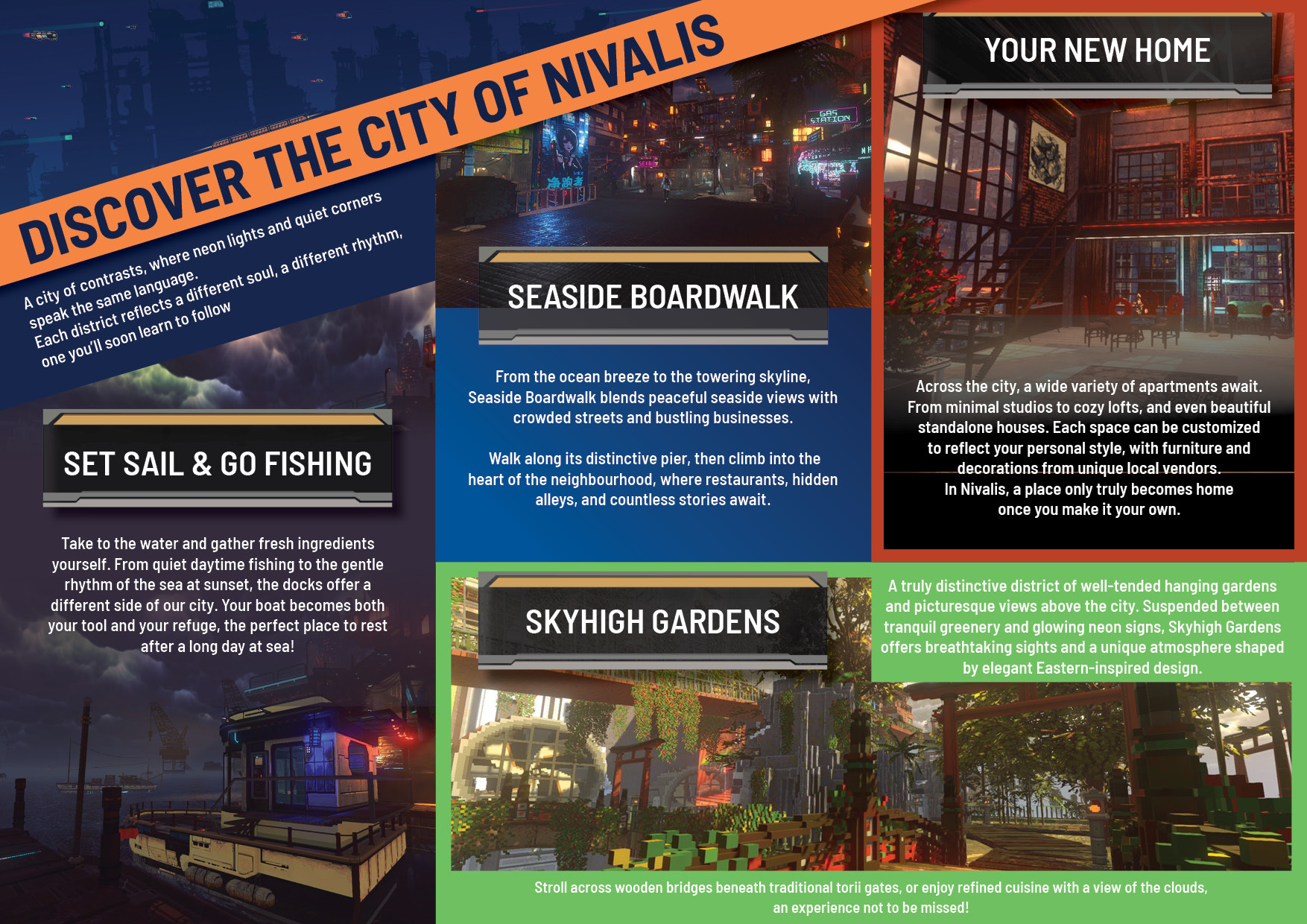
Signature wooden bridges connect different sections of the district and are one of the most recognizable features of Skyhigh Gardens. Each bridge acts as an elevated viewpoint as well as a path, and walking across one with the clouds visible around you and the city sprawling below is one of the more memorable visual experiences the game offers. Lanterns, pruned trees, and carefully framed sightlines of the lower city all push the design toward a traditional garden aesthetic. The buildings themselves lean on wooden trim, tiled roofs, and softer lighting than the harder neon rows found elsewhere in Nivalis.
The hanging gardens are the other half of the picture. Terraces, planters, and green walls are woven into almost every structure, so greenery is not confined to a single park but spread across the district's built environment. In a city otherwise dominated by metal, glass, and concrete, the presence of carefully tended plants high above the clouds is a deliberate statement about what living up there is supposed to feel like. Greenery here is an amenity, a status marker, and part of the district's character all at once.
Residents and Businesses
The district hosts a mix of residential towers and small businesses, and the commercial side of Skyhigh Gardens is tuned to the altitude. A Japanese restaurant operates inside the district, serving fresh sushi and steaming bowls of noodles with an open view of the clouds. Dining there is framed as a one-of-a-kind experience that no ground-level eatery can match, and the restaurant leans into its setting by positioning seating toward the sky and the bridges. Other businesses in the area follow the same pattern of treating the view as part of the product.
For players running their own food businesses, a visit to Skyhigh Gardens is a useful reference point. The restaurants here are pitched at the higher end of the city's dining scene, and the way they integrate the view, the garden setting, and the traditional architecture into the customer experience offers a benchmark for what a polished operation in Nivalis looks like. The district is also a natural setting for social activities: meeting an NPC on one of the bridges, sharing a meal above the clouds, or taking a slow walk through the gardens all fit naturally into the slower, relationship-focused side of the game's life sim loop.
Connection to Greenhouse Farming
The hanging gardens of the district are maintained, not wild, and they connect thematically to the broader practice of greenhouse farming in Nivalis. In a city where most produce has to be grown indoors or on controlled terraces, the kind of elevated planting seen across Skyhigh Gardens reads as a visible, upscale extension of the same logic that drives the city's rooftop greenhouses and vertical farms. Much of the greenery is ornamental here rather than productive, but the shared design language between a working greenhouse and a sky-level garden terrace is deliberate.
This connection also gives the district a quiet tie to the larger food economy of Nivalis. The kitchens in Skyhigh Gardens sit close to the kind of fresh, carefully cultivated ingredients that greenhouse operations supply. Restaurants up here can trade on that proximity, and the district's character as a place where plants thrive above the clouds reinforces the idea that high-end dining and controlled indoor agriculture are two sides of the same system.
Weather and Altitude Effects
Altitude shapes how weather and its effects register inside Skyhigh Gardens. The district sits near or at the cloud layer, which means fog, low-hanging mist, and broken cloud can pass directly through its walkways on the right day. Rain and overcast conditions read differently up here than they do on the streets below, since the district is often inside the cloud rather than under it. On clearer days, the gardens catch more direct sunlight than most of the lower city ever receives, and that shift in light is part of why the area reads as a separate, almost resort-like space inside Nivalis.
The bridges and terraces are built with this in mind. Sightlines open toward the horizon so residents can watch weather roll across the city below, and the gardens themselves benefit from the combination of altitude, filtered light, and controlled planting. For a visitor, stepping out of a flying taxi into Skyhigh Gardens during a cloud-covered evening versus a bright morning can feel like two entirely different places, and the district's designers use that variability as part of the draw.
Getting There
Skyhigh Gardens is not accessible on foot or by the standard subway system. To reach the gardens in the sky, players use the flying taxi service provided to Nivalis citizens, which is the only form of transportation that connects the district to the rest of the city. This makes Skyhigh Gardens one of the more exclusive areas of Nivalis: you cannot simply walk in from a neighboring district or ride the subway up to street level. Every trip to the gardens is a deliberate choice.
For most movement around the city, the subway remains more than enough, and traffic through the main transit hubs handles the bulk of daily commuting. But Skyhigh Gardens sits above the reach of the subway, so the flying taxi is the only option for reaching it. The ride itself is treated as part of the experience. Taxis carry passengers up through the layers of the city, past the commercial spires and residential blocks of the middle tier, and out above the cloud line before dropping them off at one of the district's landing pads. Arriving by air, with the gardens and bridges coming into view as the cab descends, is as much a part of the visit as anything that happens once you are on the ground.
Role in the Story and Wider City
Within the wider fiction of Nivalis, Skyhigh Gardens plays the role of the upscale, hard-to-reach counterweight to busier commercial districts like Meridian Market. Where the market is about volume, movement, and the grind of everyday trade, the gardens are about pause, presentation, and being somewhere that a visitor had to work to reach. This split fits the broader pattern of the city, in which altitude tracks closely with wealth and exclusivity: the higher up you live, the further you sit from the crowded base layers and the closer you are to districts curated for their views.
Skyhigh Gardens also interacts with the wider balance of power in the city. Nivalis is shaped by the influence of corporations and factions, and an elevated district with restricted access is exactly the kind of neighborhood that tends to attract corporate residents, high-paying customers, and private apartments owned by people who can afford the climb. Players who pursue apartment customization and housing options at the upper end of the market will find that the district's design language, garden amenities, and altitude all carry through into the kind of homes available here. Across the story, the gardens function as a place to celebrate a good day, meet a date, host an NPC, or simply step away from the lower city when its noise becomes too much, and the game's pacing makes space for all of those uses.
As a neighborhood, Skyhigh Gardens rewards players who take the time to explore rather than rushing through. The hanging gardens, the torii gates, the bridges, and the restaurants are laid out so that a slow walk uncovers more than a quick taxi drop-off would suggest. It is a district for lingering, and the game builds it to encourage exactly that kind of visit.