Loading...
Loading...
No Man's Sky Comparison
May 16, 2026 at 08:09 AM
Trimmed character-species list to seven trailer-confirmed species; added community-frame-analysis caveat
No Man's Sky and Light No Fire are both built on Hello Games' Procedural Generation technology, but they solve opposite problems. No Man's Sky created an infinite universe and asked players to explore it. Light No Fire creates a single planet and asks players to inhabit it.
Sean Murray described Light No Fire as "something very different, something maybe more ambitious" than No Man's Sky. The ambition is not in scale of quantity but scale of depth.
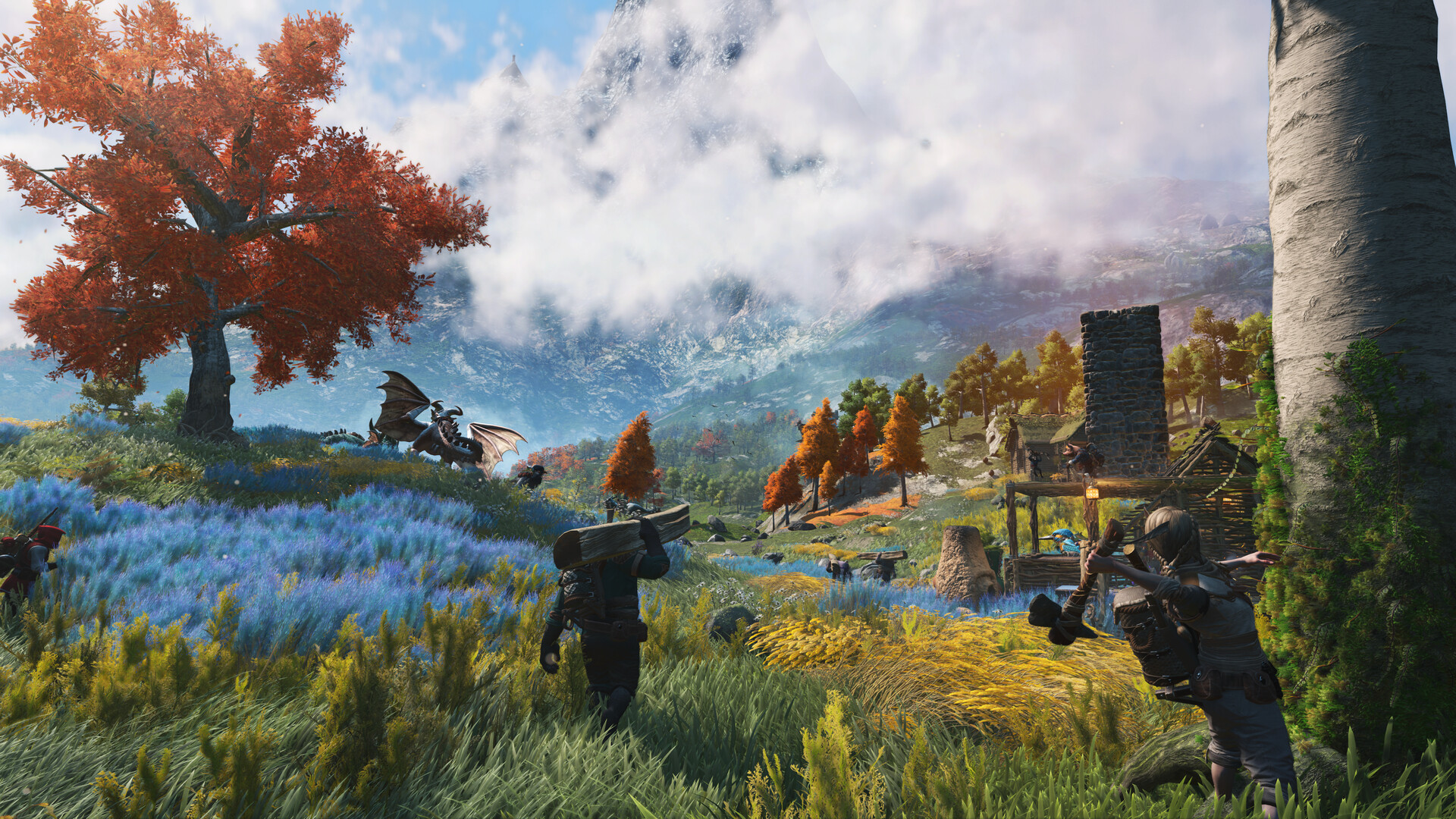
No Man's Sky is science fiction. Spaceships, laser weapons, alien trading posts, warp drives, space stations. Light No Fire is fantasy. Swords, bows, staves, magic, dragons, medieval-style construction. The two games occupy completely different genre spaces despite sharing core technology.
No Man's Sky: 18 quintillion planets across an infinite universe. Each planet has a single biome. Players hop between worlds using spaceships and warp drives.
Light No Fire: One planet, the size of Earth. Multiple biomes across continents, mountains, and oceans. Players stay on this planet permanently.
This is the fundamental difference. No Man's Sky's universe was vast but thin. You could visit a new planet every few minutes, but most felt similar after a while. Light No Fire's single planet needs to sustain long-term play, which means each square kilometer has to hold more detail and variety.
No Man's Sky added multiplayer post-launch with the NEXT update in 2018. Players exist in a shared universe but rarely encounter each other by accident because the space is so large. Light No Fire puts everyone on the same planet from the start. With a shared, persistent world, player encounters should be more frequent, and player-built structures form a communal landscape.
No Man's Sky: Spaceships for interplanetary travel, exocraft for ground exploration
Light No Fire: Dragons and flying mounts for aerial travel, ground mounts for land, large crewed boats for ocean crossings
No Man's Sky: Laser weapons, mining beams, sentinel encounters
Light No Fire: Melee weapons (swords, spears), ranged weapons (bows), magic, boss encounters with giant creatures
No Man's Sky has a human space explorer in a suit. You can customize the suit's appearance, but you are always a humanoid in a helmet. Light No Fire breaks from this entirely. The reveal trailer shows a wide range of playable characters, including anthropomorphic animal races.
Specific character types visible in the trailer include:
Human characters
Rabbit, fox, badger, bear, wolf, and otter characters
This is a much wider range of player expression than No Man's Sky offers. Whether each race has different stats or abilities, or whether the choice is purely cosmetic, has not been confirmed.
Several features visible in the Light No Fire trailer have no equivalent in No Man's Sky:
Item | Description |
|---|---|
Boss encounters | Gigantic boss battles against creatures that dwarf the player. No Man's Sky has large fauna but nothing designed as a boss fight. |
Skeleton and undead enemies | Supernatural threats visible in the trailer. No Man's Sky's enemies are sentinels and biological horrors, not undead. |
Ancient ruins and obelisks | Discoverable structures with apparent lore significance. No Man's Sky has ruins too, but Light No Fire's appear more closely tied to a structured mythology. |
Melee-focused combat | Swords, spears, bows, and magic replace laser weapons entirely. |
Both games benefit from a shared technology pipeline. The clearest example is the Voyagers update (August 2025), which added fully walkable, room-by-room ship construction to No Man's Sky. Murray confirmed this same system powers boat building in Light No Fire. Improvements in one game feed directly into the other.
No Man's Sky launched in 2016 with a rocky reception and rebuilt its reputation through years of free updates. Murray has said Light No Fire will follow the same post-launch model: "This is a game I would like to still be updating 10 years from now." The lesson from No Man's Sky was not to avoid ambition but to keep delivering after launch.