

This article is incomplete
Some sections are missing or need additional details. Help improve it by contributing.
HUNGER takes place during a dark alternate version of the Napoleonic era in early 19th-century Europe. War has already ravaged the continent when a bacterium of unknown origin begins to spread, twisting the land and transforming those it infects. The plague is called the Hunger. It moves with the speed and violence of rabies, and its effects are both swift and grotesque.
The Bacterium and the Hunger
The bacterium has altered the landscape of Europe at a fundamental level, producing infected creatures from those who could not survive or resist it. Survivors who managed to avoid full infection have become the Living, the player characters of the game. The infected, now twisted beyond recognition, have become the enemies that populate every Expedition.
The developers have woven a body of in-world writing around the plague. One such account, presented as excerpts from a text called De Bacterium and dated to the year 1815, frames the catastrophe as the result of the vast armies of the Napoleonic Wars allowing a long-dormant contagion to spread unchecked, with the fall of cities such as Brussels cited among its early disasters. These writings are presented as the surviving record of those who lived through the calamity.
The De Bacterium Chronicle
The studio has been publishing excerpts from the in-world writing that sits behind the game, and the largest body of it is a text called De Bacterium. Volume I carries the subtitle Being a True Account of the Bacterium and the Undoing of Men, and is set down in the year 1815 by an author who signs himself only as One Who Watches, Nameless. It is presented as a survivor trying to reconstruct what happened from parish books, army rolls, hospital notes and merchants' diaries, and it is written as historical fiction rather than as a rulebook.
Its opening problem is that nobody can say when the Bacterium first reached people. The collapse came fast enough to invite the comfortable idea of a single ship or a single patient, but the surviving records refuse that neat beginning. Scattered incidents appear across many years before the last campaigns of the Empire, each one small enough at the time to be written off as fever, drink, or a disorder of the humours.
Record | Date | What It Describes |
|---|---|---|
A merchant's diary in Nantes | Summer 1787 | A dockworker who fell into a violent fever, attacked a customs officer without provocation, and tried to bite those who came to help. The writer assumed a distemper carried in with the cargo |
Military papers preserved at Metz | 1792 | A dragoon who complained for days of pains in the head and spine, then struck at his comrades with what the adjutant called animal ferocity. He died in the infirmary of what was entered as malignant fever |
A parish book outside Poitiers | October 1794 | A farm labourer who, after days of what the priest called a black fever of the mind, seized a stable boy and tore at his throat with his teeth before the local guard shot him |
The city registers of Bordeaux | 1798 | A sailor brought ashore near the Chartrons quay from a vessel newly arrived from the West Indies, so violent that irons were needed to hold him despite wounds that should have left him insensible. He died before morning |
Surgical notes of the Hotel-Dieu in Lyon | March 1799 | A patient who kept thrashing, biting and struggling after injuries that, in the surgeon's words, ought to have extinguished all voluntary motion |
Read together rather than singly, the entries leave the uneasy impression that the Bacterium moved quietly among people for years before anyone recognised it. Some hold that the first stirrings reach back further still, hidden among the ordinary confusions of disease and madness in the closing years of the previous century. Others argue the older cases are only being drawn in now because later horrors force a search for a beginning that nobody saw at the time.
The chronicle's explanation for why the plague finally escaped containment is the scale of the wars themselves. Earlier outbreaks stayed local and were suppressed by the watch or by troops quartered nearby. By the first years of the nineteenth century a single French army could number a hundred thousand men, and the great campaigns assembled more than two hundred thousand, kept constantly in motion. Each army dragged a second multitude behind it: artificers, drivers, sutlers, servants, laundresses, wives, children, invalids, prisoners, impressed labourers, merchants and refugees, sometimes almost as numerous as the troops. Camps grew into crowded, ill-drained towns full of men already weakened by wounds and hunger, and sickness spread through them before it could be understood.
The fall of Brussels is the case the text returns to. The garrison there had been reduced and ill-supplied, its hospitals already crowded, and the first disorder among the soldiers was treated as nothing worse than fever and indiscipline after a hard campaign. By the time the nature of the affliction was clear, the townspeople had been exposed too, and the constant traffic through the gates carried it faster than anyone could restrain it. A second theory the author raises more quietly is that wartime rivalry broke the habit of warning one's neighbours: reports of sickness in an enemy's territory were as likely to be welcomed as feared, and conscription had already stripped the provinces of the men who might have enforced order.
A later volume, The Erosion of Conscience, turns from origins to conduct, arguing that familiarity with slaughter dulled the conscience rather than sharpening it. People who lived long in afflicted districts stopped being shocked by the opened body, and as the ordinary threshold of horror fell, violence among the living grew theatrical to compensate. The author records prisoners flayed rather than simply killed, bodies opened in imitation of the Hunger's own work, and cannibalism appearing not as starvation's last resort but as a deliberate trespass. His conclusion is that the cruelty of the Hunger did not stay with the creatures: it seeped outward until, in some places, the line between predator and victim wore disturbingly thin.
None of this is presented as gameplay. It is the written foundation the studio says every map, character, faction, weapon and creature is designed inside, which is why locations in the game have histories and enemies have origins rather than being placed arbitrarily.
The Last Strongholds
The few uninfected survivors have retreated to fortified bastions. The Chateau, HUNGER's central hub, is one of these last strongholds. Its visual design draws on the island monastery of Mont-Saint-Michel, presenting a crumbling but populated fortress where the remaining Living organize, trade, and plan their sorties into the ruined world outside. Beyond its walls, players explore forests, villages, monasteries, citadels, and mines.
Aesthetic
The visual style of HUNGER has been described by the developers as Renaissance Gothic, drawing on the paintings of Caravaggio and the atmosphere of Victorian and Renaissance-era art. This produces a world that blends historical grime with horror atmosphere, where Napoleonic-era weapons and uniforms coexist with supernatural dread.
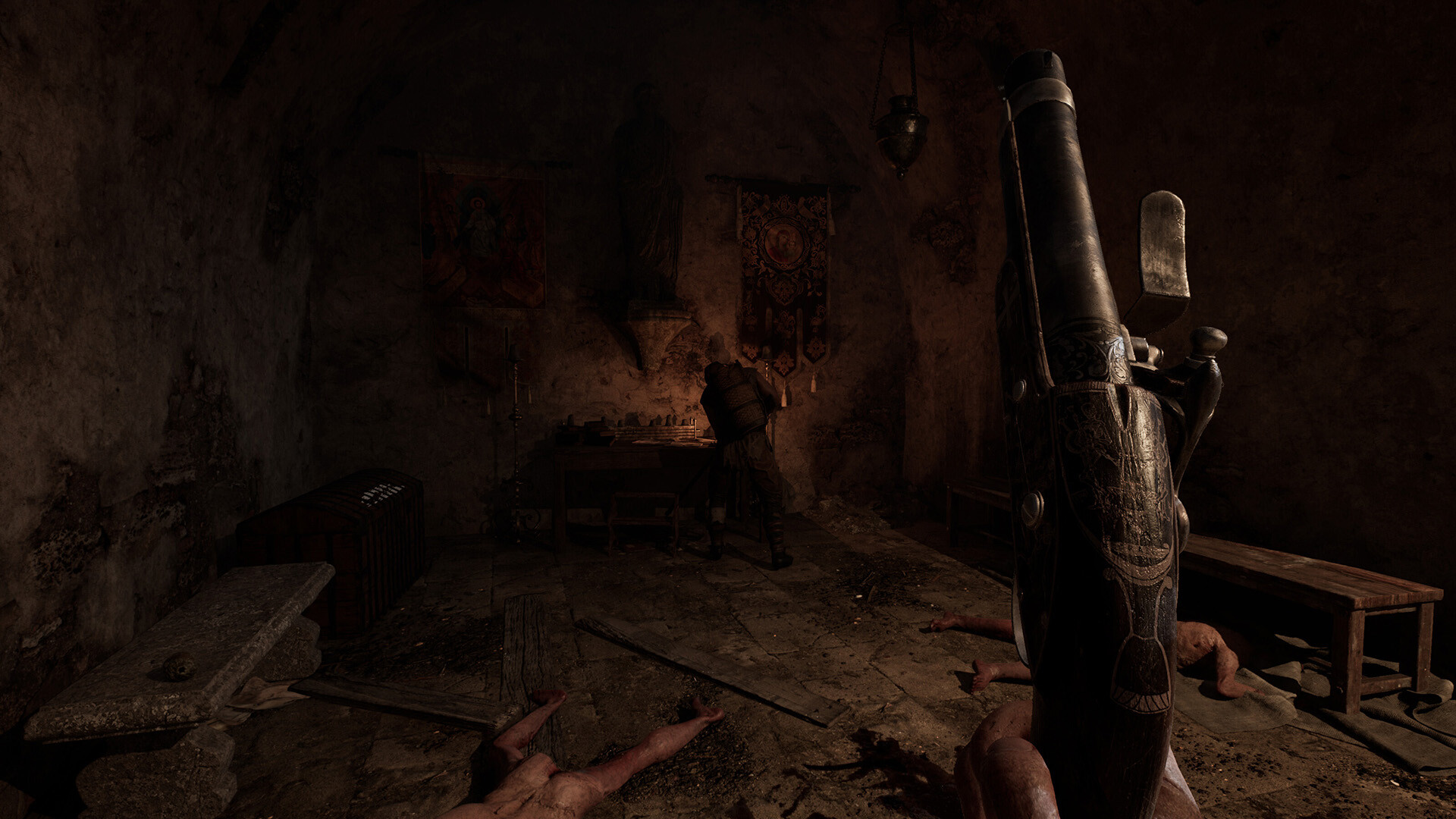
The studio has been more specific than the label suggests. Caravaggio is cited for chiaroscuro, described as the use of deep blacks to conceal everything that is not the action of a scene, and for the extreme violence of paintings such as his Judith beheading Holofernes. English Victorian painters including John Everett Millais are named as an influence on the characters, and Dutch masters of landscape painting on the environments. That combination is what produces scenes lit as though by a single lamp, where most of the frame is simply dark.