
Gameplay in Citystate Metropolis centers on planning a city and setting the conditions for it to grow. The player zones land, designs how buildings occupy their lots, builds roads and services, and manages the budget, while the simulation decides who moves in, what businesses open and how wealth is distributed. The developer describes the governor's job as creating the conditions for growth and development rather than running production lines.
Core loop
A city starts on a generated or custom map. The player lays out roads, zones land for housing, commerce and industry, and places service buildings. Buildings are generated procedurally to fit the zoned lots and the design rules the player sets. As the city grows, the player adjusts taxes and public spending, redesigns neighborhoods and expands services, watching how each decision affects housing costs, land value, congestion and the social mix of the population.
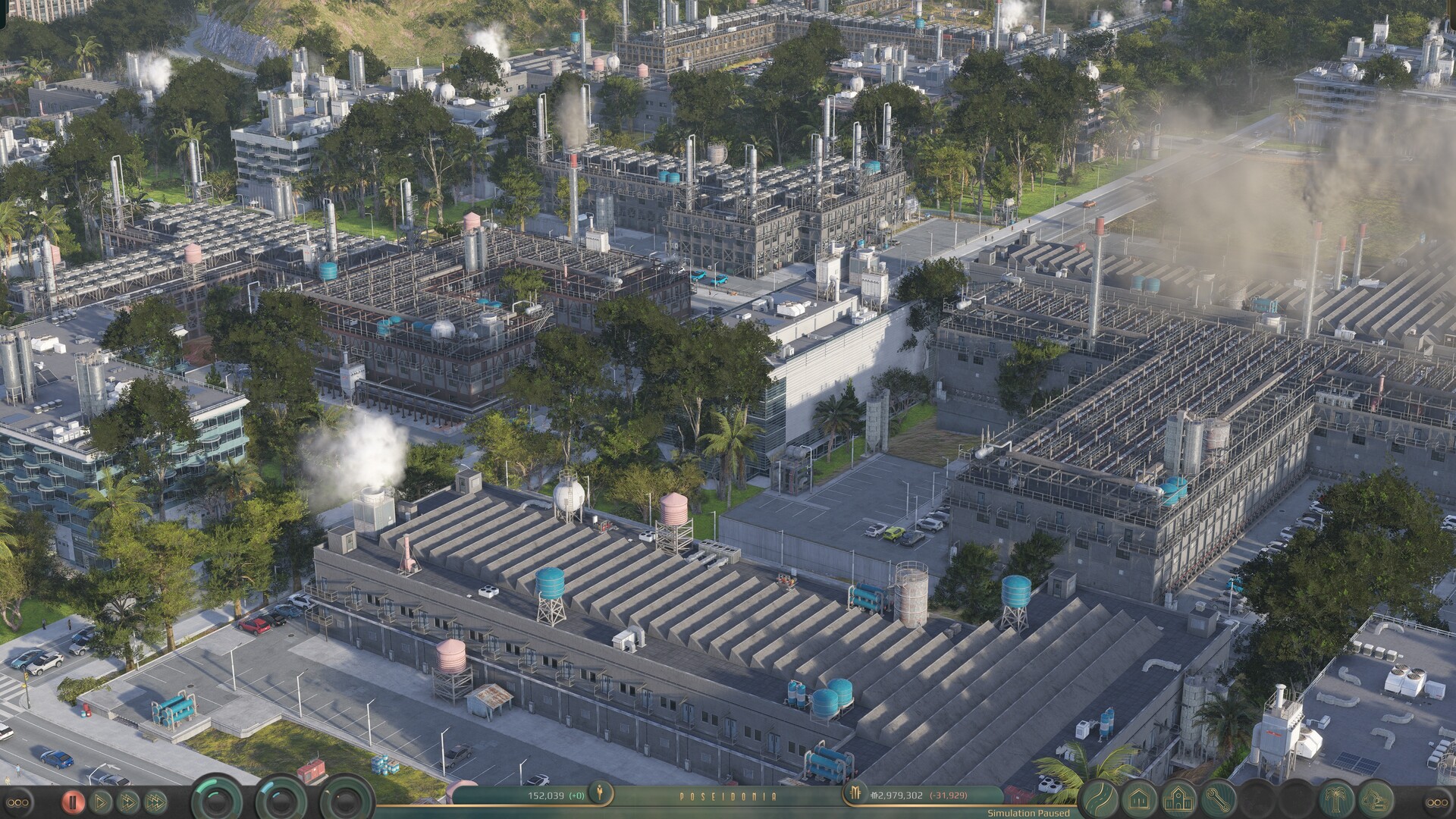
Shape or generate the terrain in the map editor.
Build a road network with the spline-based road tool.
Draw zones of any shape and choose building footprints, setbacks, floor counts and parking (see Zoning and Procedural Buildings).
Place and size schools, hospitals, police stations, power plants and other services.
Balance the budget through taxes and spending (see Economy and Budget).
Watch the simulation respond and adjust plans and regulations.
Three roles
The Architect
The creative side covers building design and city layout. The height, width, colors and shapes of residential, commercial, industrial and service buildings can be designed from the ground up. The store page also lists a choice of 40 road types and a park editor. The developer's stated design principle is to give players powerful creative tools that have real gameplay consequences, a balance he describes as creativity and constraints.
The Governor
The pragmatic side covers money and regulation. The budget has to balance and taxes have to be collected. The store page frames the central choice as cheap, unregulated development that speeds up growth versus restricted, gentrified development that raises tax revenue. A city might aim to be an eco-friendly haven, a capitalist powerhouse or a work of art, and each direction has costs.
The World Builder
The terrain side covers the map itself. The map editor can generate thousands of terrains by blending real-world elevation data with procedural generation. Dynamic water allows rivers and lakes, and forest density or terrain steepness can be adjusted across the whole map with a drag of the mouse.
Not a supply-chain game
The developer has repeatedly stressed that the game does not ask the player to manage resources or production chains. In the November 2026 announcement he wrote: "This is not a supply-chain management game." The economy is driven by free-market forces, and businesses (including their executives) are simulated. The player's role combines a politician, a civil engineer and an urban planner, and the job is to find a balance between public spending and low taxes and between aesthetics and the cost of living. He added that there is no single right answer and no perfect scenario.
Goals and play styles
There is no fixed win condition. The announcement lists several goals players can set for themselves:
Goal | What it means in practice |
|---|---|
Maximum population | Grow the largest city possible; the simulation is built to handle more than one million inhabitants |
Minimum congestion | Design a road and transit network that keeps commutes short |
Maximum human development | Improve education, income and social mobility across the population |
Highest GDP | Build the strongest economy |
Best aesthetics | Treat the city as a design project |
The announcement also says: "All buildings and tools are unlocked from the start." Players can min-max every statistic or play casually and build freely. In the developer's words, "Strong guardrails keep you from going bankrupt, but the nicest-looking buildings only show up in the best-run cities."
Difficulty and tone
Andy Sztark has said the economy is meant to be realistic and challenging. When asked in September 2025 whether the game would play more like a modern sandbox or an older simulation-driven city builder, he said that in gameplay and difficulty it would be closer to SimCity 4 than to Cities: Skylines, because it is not a planned-economy or production-line simulator. That is the developer's own description of his intent.
The game also deals openly with real-world urban problems. The announcement states: "It doesn't shy away from real-world topics." Inequality, economic segregation, social mobility and crime are part of the simulation, and the developer acknowledges that some players will read the game as political.
Pace and accessibility
The game is single-player and played at the player's own pace. The Steam store lists the following features:
Steam feature | Notes |
|---|---|
Single-player | No multiplayer has been announced as of November 2026 |
Steam Achievements | The store lists achievements; the list had not been published as of November 27, 2026 |
Includes level editor | Refers to the map and terrain editor |
Save Anytime | Progress can be saved at any point |
Mouse Only Option | The game can be played with a mouse alone |
Playable without Timed Input | No reaction-based inputs |
Playable at your own pace | No forced timers |
Camera Comfort | Camera options for comfort |
Custom Volume Controls | Separate volume settings |
Stereo Sound | Stereo audio |
Family Sharing | Can be shared through Steam Family Sharing |
What gameplay is missing at launch
As of November 2026, the first Early Access build will not have rail, subways, informal housing (slums), bicycles, fire stations, airports, seaports, farms, mining or other extraction industries, mixed-use buildings, natural disasters or a day and night cycle. See Planned Features for what the developer has said about each one.