
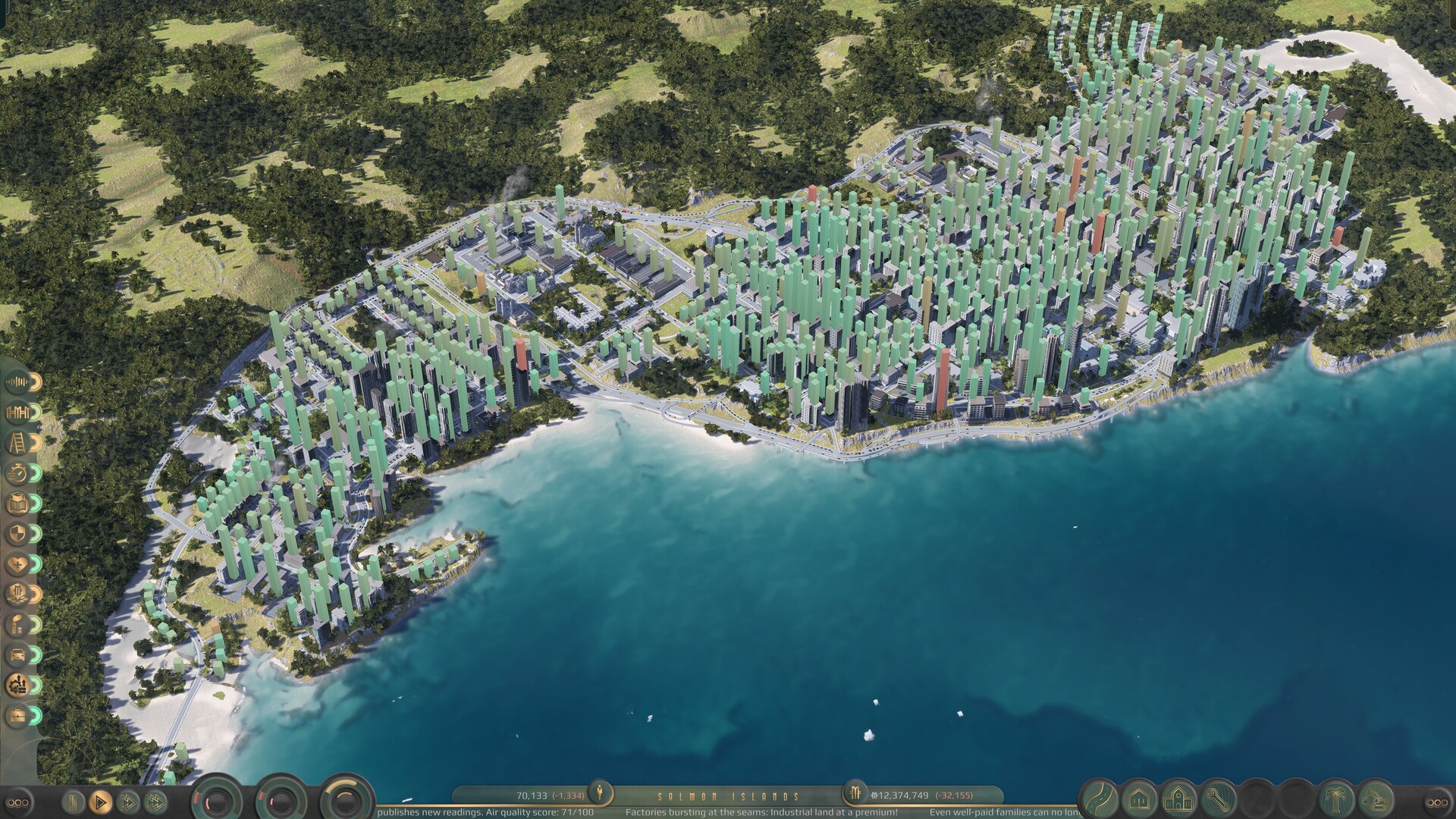
Citystate Metropolis uses a crowd-based simulation, which the store page contrasts with agent-based simulation. The model works at the level of households and buildings rather than individual people, which lets the game handle populations of more than one million while modeling how building rules and city policies affect the people who live there.
Crowd-based instead of agent-based
In an agent-based city builder, each citizen is simulated as an individual who travels around the city. Andy Sztark explained in February 2025 that Metropolis does not work that way. Citizens are not individually simulated and do not interact with the city by going from place to place on their own. The simulation, and more precisely the building a household lives in, dictates their movements, wealth, education and progression.
The official website describes the economic system as a blend of agent and crowd simulation. The two descriptions fit together: the people and vehicles on screen are agents that carry real simulation data, while the decisions are made at the household and building level.
Why this model
The developer gave three reasons for the approach:
Reason | Explanation |
|---|---|
Scale | Simulating at the household and building level lets the game handle at least one million citizens without capping the frame rate at 30 FPS |
Less micromanagement | It avoids the micromanagement that comes from tracking every individual |
Fewer exploits | It prevents the cheats and tricks that, in his view, a pure agent-based simulation inherently comes with |
He also argued that buildings are the right level for simulating a city's social dynamics and give more realistic results.
Population scale
The store page states the model can handle populations exceeding one million. In February 2025 the traffic system already supported hundreds of thousands of agents at once. In November 2026 the developer reported 40 FPS at 1080p on an older machine with a GTX 1060 running a city of 100,000. See System Requirements for more performance notes.
Social dynamics
Socioeconomic factors are a core part of the simulation. The store page says income disparity, gentrification, urban decay and other factors are front and center in the city's development, and that the city can model the consequences of building regulations and city policies on its inhabitants. The November 2026 announcement names inequality, economic segregation, social mobility and crime.
Factor | Where the developer has mentioned it |
|---|---|
Income disparity | Store page; February 2025 development update |
Gentrification | Store page |
Urban decay | Store page |
Economic or spatial segregation | February 2025 development update; November 2026 announcement |
Relationship between education and income | February 2025 development update |
Social mobility | Store page; November 2026 announcement |
Crime | November 2026 announcement |
Inequality | November 2026 announcement |
In the development update Sztark wrote that he does not believe a city builder can be called realistic without meaningfully addressing these issues, since games like this shape how people think about cities.
How player choices reach the population
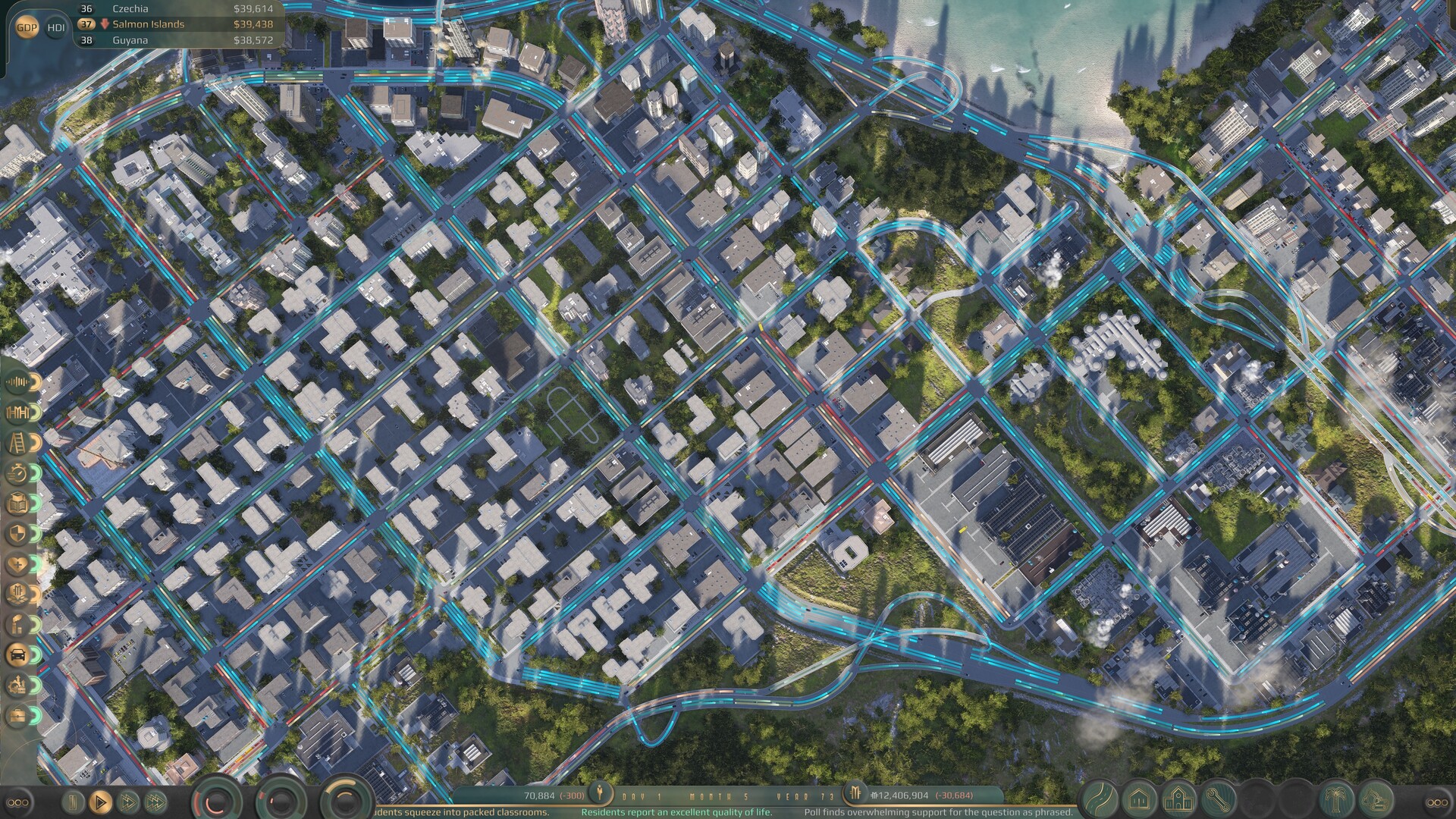
Most of the player's influence on the population comes through land use and building rules. Cheap, simple construction lowers housing costs and helps social mobility. Expensive, eco-friendly construction raises land value and attracts foreign investors. Taxes and public spending (see Economy and Budget) and the quality of services add further pressure. Congestion lowers productivity and income (see Roads and Traffic).
Informal housing
As of November 2026, slums are not in the first release. Informal housing is listed among the major features planned for the 1.0 release.