

Classes in ArcheAge Chronicles are built around weapons rather than a fixed rotation. A class picks up one of several weapon types, and each weapon opens its own set of skills and a distinct way to fight. The developers have described this as a system meant to offer depth while staying easy to pick up, and it replaces the tab-target skillset stacking used in the original ArcheAge.
Classes Shown So Far
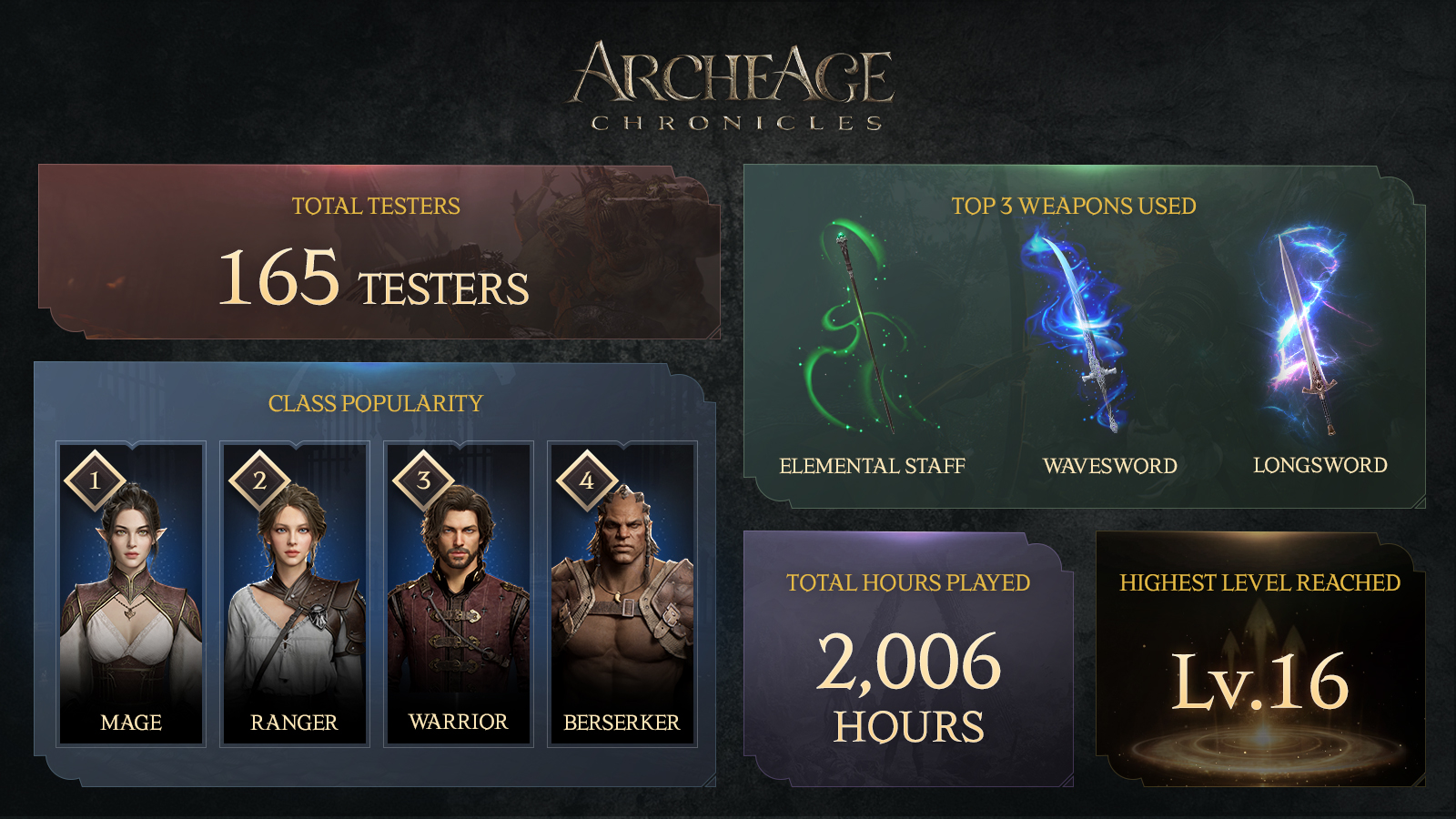
Four classes were playable in the closed focus group test held in June 2026. XLGAMES published a summary of that test on 3 July 2026 that ranked them by how often testers picked them:
Rank | Class | Status |
|---|---|---|
1 | Mage | Named and pictured in the focus group test summary. No skill list published yet. |
2 | Ranger | Fully detailed on 30 July 2026: motto, lore, two weapons, ten named skills. |
3 | Fully detailed on 10 July 2026: motto, lore, two weapons, three paths, ten named skills. | |
4 | Berserker | Named and pictured in the focus group test summary. No skill list published yet. |
The ranking reflects popularity inside one test build. It is not a statement that four is the final roster, and no total class count has been published.
Weapons
Weapon names have arrived from two directions: the focus group test summary, which listed the three most-used weapons in that build, and the Warrior introduction, which named the two weapons that class can carry.
Weapon | How It Was Confirmed | Notes |
|---|---|---|
Elemental Staff | Most-used weapon in the June 2026 focus group test | Ranked first among the three weapons listed. No class attribution was given. |
Wavesword | Second most-used weapon in the June 2026 focus group test | A curved blade in the test summary artwork. No class attribution was given. |
Longsword | Third most-used weapon in the focus group test, and one of the two Warrior weapons | Supports two Warrior paths: a parry-driven precision path and a health-spending path of blood. |
Greatsword | Named in the Warrior class introduction | Builds a resource called Resolve while absorbing hits, then spends it on heavy swings. |
Hatchet | Named in the Ranger class introduction | A melee option for the Ranger Class. Its published skills run on lightning and on evading into striking range. |
Longbow | Named in the Ranger class introduction | The Ranger's ranged option, built on marking a target, holding range, and finishing with a single aimed shot. |
Beyond those four, the developers have described the broader weapon families in general terms: melee options including swords and axes, and ranged options including bows and crossbows. Individual named weapons have also appeared, such as Pantheon's Punishment, described as a sacred weapon carried by Pantheon's inquisitors against those who impersonate the gods.
How Paths Work
Two class introductions have described the path model so far, the Warrior Class in July and the Ranger Class at the end of the same month. Rather than choosing a subclass once and living with it, a character's identity comes from which weapon is equipped and which path that weapon supports. The Warrior's longsword carries two paths that play very differently and its greatsword carries one; the Ranger's two weapons are presented as two separate play identities under a single class name. Two players on the same class can therefore feel almost nothing alike.
Combat itself runs without default targeting. An optional lock-on helps keep a target in focus, but aiming, spacing and timing are the player's job. See Combat System for the mechanics every class shares, and Character Creation for how class choice sits alongside race selection.
Not Yet Confirmed
Mage and Berserker have names, portraits and a popularity ranking, and nothing else. No motto, weapon list, skill list, resource, or lore tie has been published for either, and there is no announced schedule for further class introductions. The total number of classes at launch, how paths unlock over a character's progression, whether a character can change class or path, and whether a dedicated healing role exists have all gone undescribed. The level ceiling reached in the focus group test was 16, which is a test-build limit rather than a launch cap.
Two things were re-checked on 12 September 2026 and neither had moved. The roster is still four, with no fifth class named anywhere. And none of the four names appears in storefront copy at all: Warrior, Berserker, Mage and Ranger are absent from the Steam listing, its full announcement feed in English and Korean, the PlayStation Store and Microsoft Store records, and the official site in both languages. The class layer rests on the studio’s class introductions and on Korean coverage of them rather than on the storefronts, so an audit that checks only store pages will find nothing and should not conclude that the classes are unsourced. The September 2026 Network Test did not disclose which classes are playable in its build.