

Combat system
Combat in A Whisper of Fall: Jinyiwei is built around three interconnected resources displayed on the HUD: 命 (Life), 真气 (True Qi), and 息 (Inner Breath). Early hands-on coverage described the system as one of the most complex combat designs in any non-indie release in recent memory. The system pushes players toward aggressive, parry-heavy play. Passive defense drains resources and eventually leaves the player unable to dodge or heal.
Core Resources
命 (Life/HP) is standard health. When it hits zero, the player dies. Health can be restored through the Gather Qi (集气) mechanic, which consumes True Qi and requires an uninterrupted channeling animation. Getting hit during the channel cancels it.
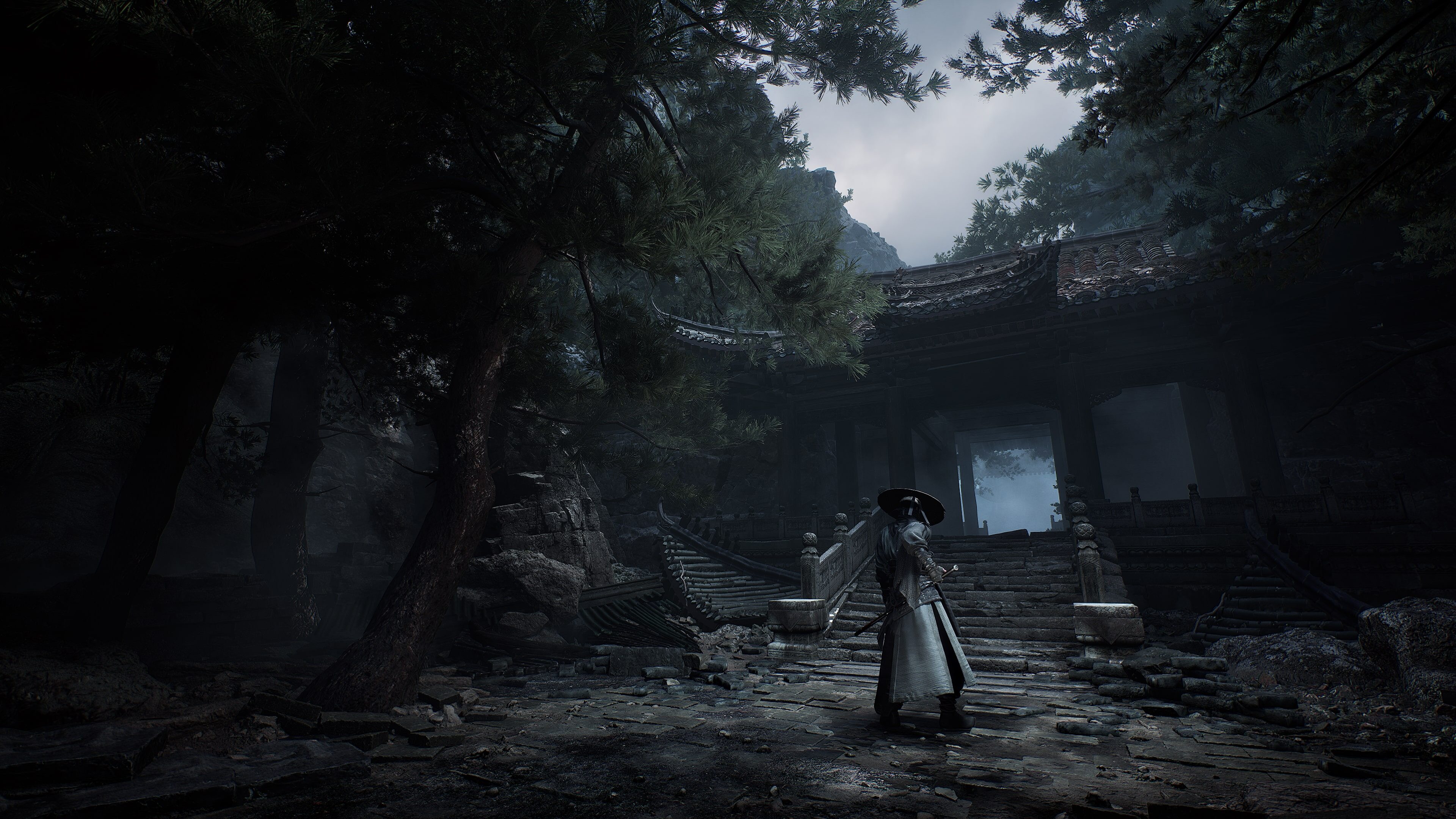
真气 (True Qi) is the central resource. It increases when the player lands hits or performs successful parries (rebounds). It decreases when the player takes damage or has attacks blocked by enemies. At 100%, it unlocks a devastating finishing technique (终结技). At 0%, the player becomes vulnerable to enemy execution attacks.
息 (Inner Breath) is consumed only by dodges. Its maximum capacity mirrors the current True Qi level at all times. If True Qi drops to 50%Inner Breath capacity is halved. This creates a cascading spiral: taking damage lowers True Qi, which shrinks the dodge resource, which makes it harder to avoid the next hit.
Actions
Action | Description |
|---|---|
Block | Absorbs incoming damage. Safe but does not build True Qi, leaving the player stuck if they only block. |
Rebound (parry) | A precisely timed block that deflects the attack and staggers the enemy. A successful rebound restores True Qi and triggers a metallic collision audio cue. Rebounds are the fastest way to build True Qi and break enemy posture. |
Dodge | Evasive movement that consumes Inner Breath. Perfect dodges produce an ink-splash visual effect (墨水特效), referencing Chinese ink wash painting. |
Execution (处决) | When an enemy's posture is fully broken, or their True Qi is depleted, the player can perform a finishing move for massive damage. |
Finishing technique (终结技) | Available when True Qi reaches 100%. Described as dealing "extremely massive power" (极其巨大的威力). Consumes the entire True Qi bar. |
Posture System
Enemies have their own True Qi bar that functions like a posture gauge. It depletes as the enemy takes damage and receives parries. When an enemy's True Qi is fully drained, they become vulnerable to execution attacks. The system applies symmetrically. Both the player and enemies operate under the same resource rules.
Vulnerability Damage
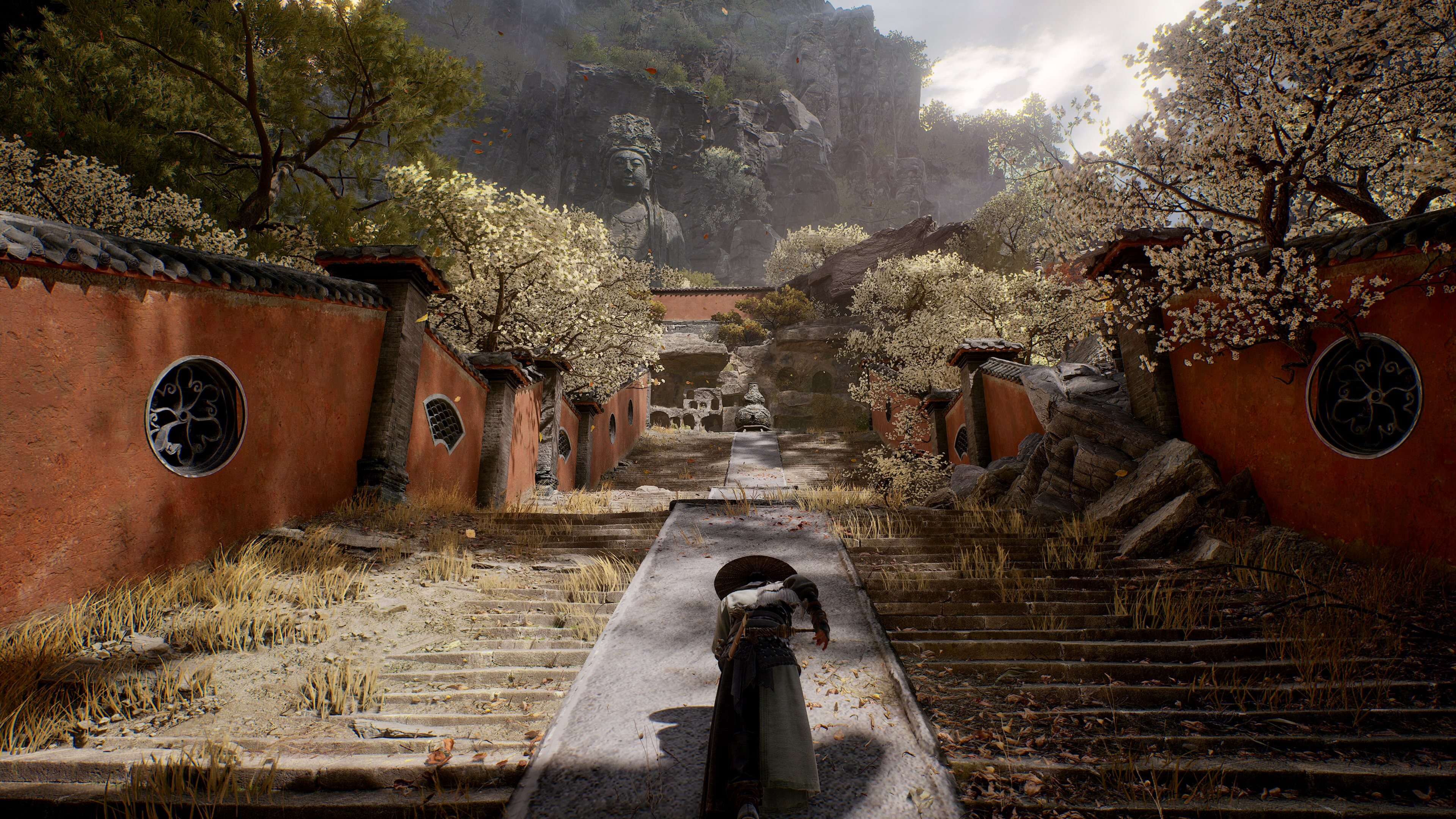
The combat system includes 破绽伤害 (Vulnerability Damage) bonus damage dealt when attacking an enemy during their recovery frames or after a whiffed attack. Hands-on coverage suggested players should think about move frame data like in a fighting game (像格斗游戏那样思考动作的帧数), considering startup frames, active damage windows, and invulnerability frames. The producer has described the design as raising the player's knowledge requirement while lowering the manual-execution requirement: the parry (blade-deflect) timing window is roughly 20 frames, about 0.33 seconds, a deliberately generous window so that reading an attack matters more than frame-perfect reflexes.
Martial arts styles
Rather than a simple light/heavy attack system, combat uses martial arts styles (武学) distinct combo trees that can be equipped per weapon and swapped in real time during combat. Each style generates two or more derived follow-up attacks. Players can equip multiple styles simultaneously and switch between them mid-combo.
Weapons
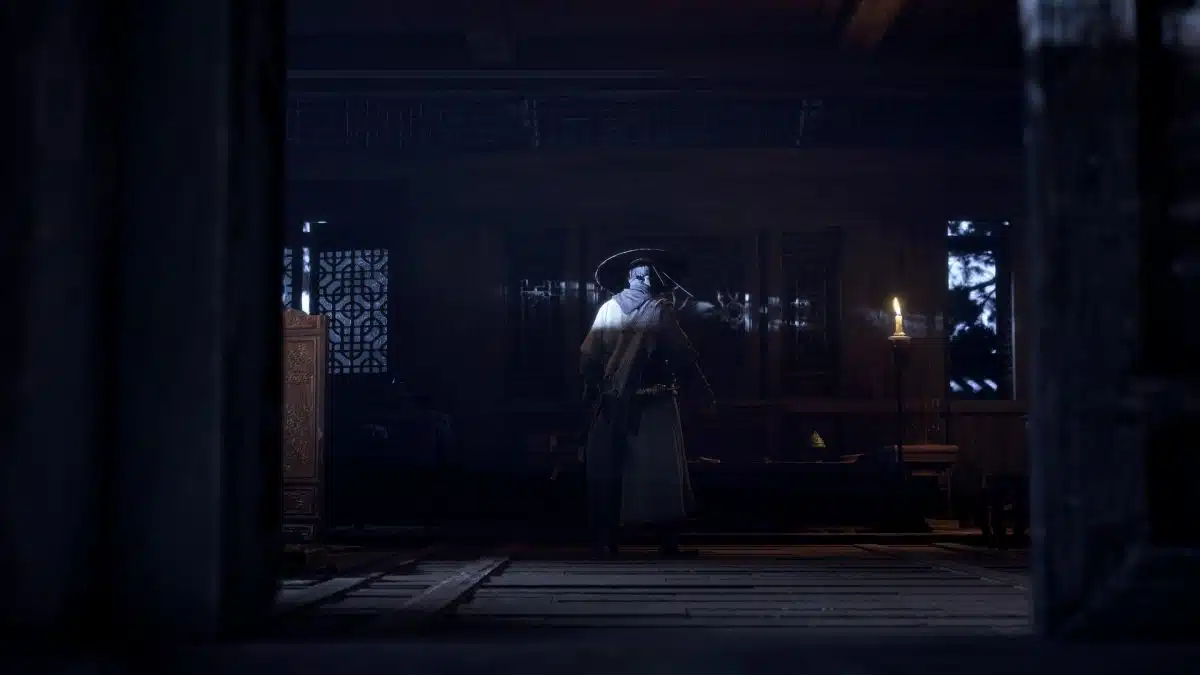
Three confirmed weapon typesblades (刀, slower with heavy dual-handed finishers), swords (剑, lighter and more mobile), and spears (枪). Dual blades (双刀) have also appeared in footage. Weapon choice affects attack speed, damage, mobility, and how efficiently True Qi builds.
Light Kung Fu
Two interchangeable light kung fu (轻功) movement systems can be equipped, enabling wall-running, aerial combat, and vertical repositioning during fights. These are separate from the martial arts style loadout.
Posture and the Broken State
Enemies carry a posture gauge that fills as the player lands attacks, parries, and turns parries into guard breaks. Filling it drops the enemy into a broken state the game calls 散功, leaving a wide opening. The finisher is bound to its own trigger, and this is where the loop punishes habit: hitting a broken enemy with an ordinary attack lets them recover instead, so a player who reflexively presses the normal attack button loses the window they just spent a whole exchange building.
Control Layer
The public build shown in July 2026 laid the systems out as a tutorial sequence. Ordinary attacks and internal-energy use sit on separate face buttons, with internal energy feeding the True Qi gauge. Guard and dodge sit on the shoulder buttons, and a normal attack pressed during a dodge converts the evasion straight into a counter. Holding the guard button with a face button produces the technique belonging to the currently equipped
martial arts style, and a separate modifier swaps schools mid-fight. Pressing guard just before an attack lands parries it; pushing the stick in a direction immediately afterwards converts the parry into a guard break that feeds the posture gauge.
Published Frame Data
The game exposes startup, active, and recovery frames for every action in its own menus, together with properties such as super armour, invincibility, pull effects, and the windows in which an action can be cancelled. The team has described these tables as the game's version of a martial arts manual, and hands-on coverage has compared learning them to studying a fighting game's move list.
Functions Carried by the Techniques
One structural choice separates this from most action RPGs of its kind. Dodging, deflecting and breaking an opponent's poise are not three dedicated buttons with fixed outcomes; those functions are distributed across the martial techniques themselves, which the game groups under the single word 招式. A technique from one school evades and counters in the same motion, while a technique from another spends time charging and pays it back as a poise break. The practical result is that the answer to a given attack depends on which martial arts style is equipped rather than on a universal defensive input, and switching schools mid-fight changes not just the damage but the set of defensive options available.
August 2026 Demo Structure
A PS5-specific build assembled for a Shanghai convention at the start of August 2026 ran the combat loop end to end across five stages. The first two covered the tutorial and ordinary guards. The third and fourth were mid-boss bouts against Li Nu and Cao Zhong. The fifth was Deng Yang and his second form. Like the July build, it excluded story, exploration and the deduction layer, so it is a record of the fighting systems only. Both on-site reports noted the build held frame rate without stutter for the full session.
Two details of the resource loop came out of that build. Getting behind an opponent strips a large amount of their True Qi, which makes flanking a resource attack rather than only a positioning one. And a full bar does more than unlock the ultimate: while it is full, techniques stop drawing on it at all, turning the top of the gauge into a window of free offence rather than a single stored hit. Ordinary guards in that build blocked and countered on their own initiative, so the loop applies to trash encounters and not only to bosses.
Current State of the Build
Impressions from the two 2026 convention builds converge on the same reading. The move-to-move flow, the pacing of the exchanges and the readability of enemy wind-ups all draw praise, as does the quality of the real-time cutscenes and the vertical layering of the arenas. The most repeated criticism is the weight of the hits themselves: contact reads as light, successful blocks do not always announce themselves clearly enough for a player to decide whether to press or retreat, and a few transitions between moves still look stiff. None of this is a design complaint about the systems; it is feedback on presentation in a pre-release build, and the team has not yet said what will change.