

Overview
Witchbrook is Chucklefish's magical life-sim and social RPG, co-developed with Robotality and releasing in 2026 on Steam, Nintendo Switch, Nintendo Switch 2, and Xbox. Play a witch-in-training studying at Witchbrook College in the seaside city of Mossport, with single-player and four-player online co-op, a customisable cottage and garden, and ten launch languages.
On This Page
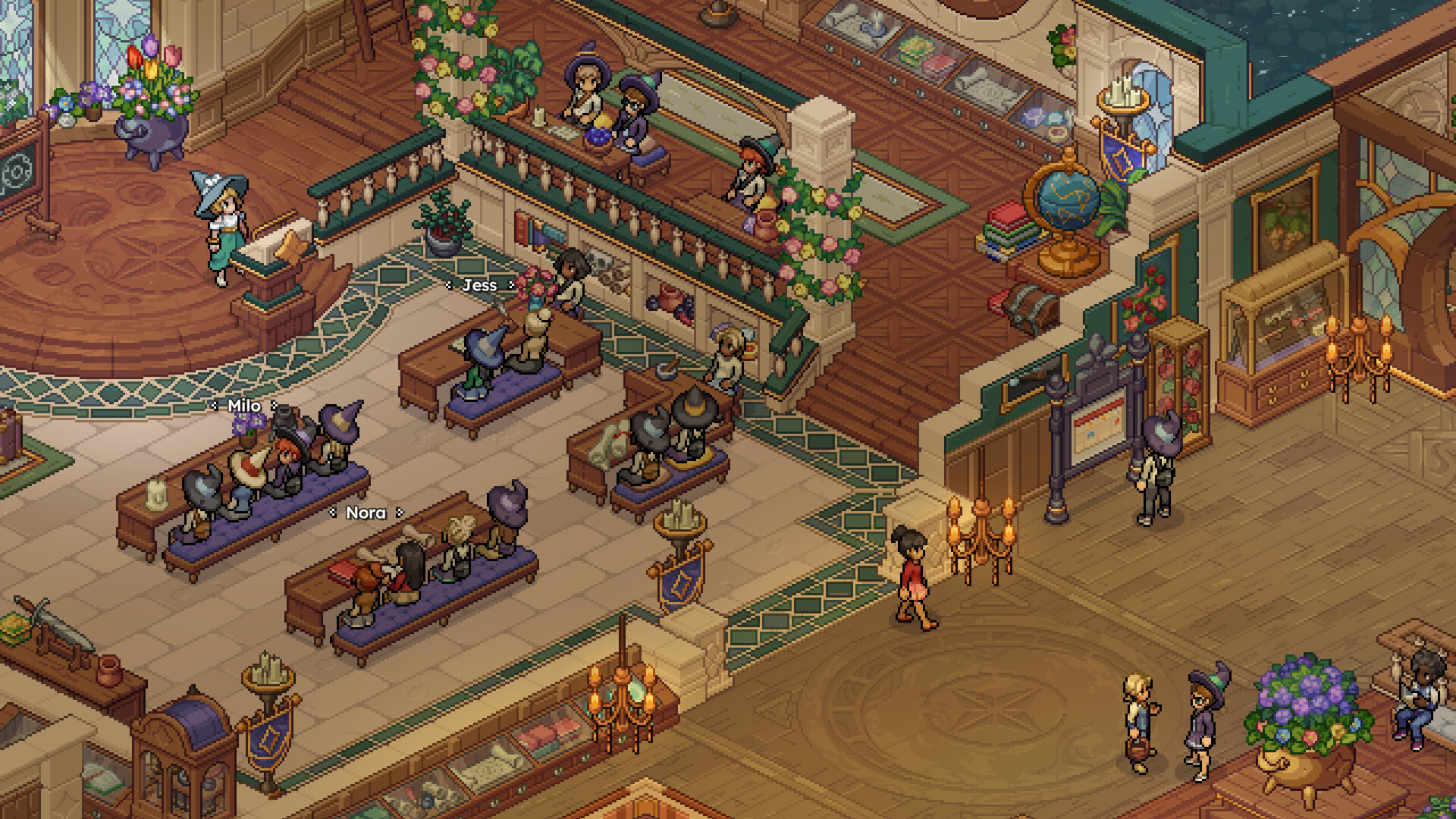
Witchbrook is an upcoming life-sim and social RPG co-developed by Chucklefish and Robotality, and published by Chucklefish. The game casts the player as an aspiring witch enrolled at Witchbrook College, in the seaside city of Mossport. Gameplay blends magical academia with cozy small-town simulation: attend lectures, master multiple schools of magic, build friendships and romances, customize a cottage, and help the townspeople with their magical needs across a continuous four-season calendar.
Witchbrook is launching in 2026 on Steam, Nintendo Switch, Nintendo Switch 2, and Xbox. It supports solo play and four-player online cooperative multiplayer, with the entire academic year playable together from first enrolment through graduation. For the fuller breakdown of supported systems, editions, and language options, see Platforms and Release. Newcomers starting a first run should see Getting Started.
Setting
Witchbrook is set entirely in and around Mossport, a pastel seaside city on the coast. Mossport houses Witchbrook College, a bustling high street of shops and cafes, the golden beaches of Parasol Sands, the wooded trails of Shadhollow Forest, and the farmland at Meadowlark Farm. The city takes architectural cues from the bridges of Cambridge and the French countryside around the Dordogne, stitched together as a warm, lived-in place where magic is a normal part of daily life rather than a closed-off fantasy enclave.
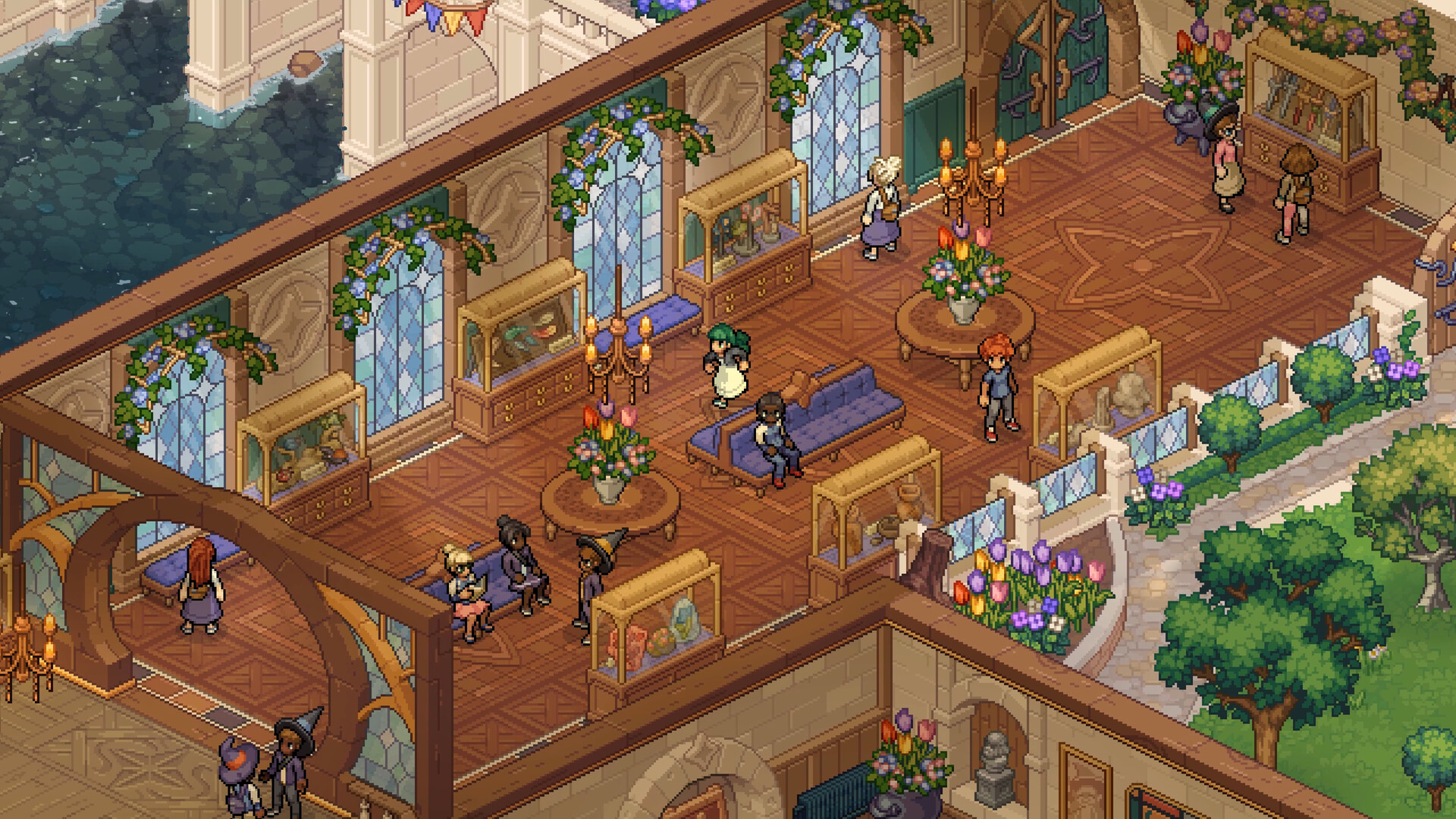
The world runs on a full day-night cycle and a four-season calendar. Weather shifts between sun, rain, and snow; daylight hours stretch in summer and shrink in winter; and the entire population of Mossport reacts to both. Residents change their wardrobes with the season, open umbrellas in the rain, and pull on scarves and mittens when the cold arrives. Shopkeepers redress their windows for festivals, and the town's bus stops and lampposts pick up fairy lights and garlands in winter. Mossport and its college are presented as two halves of the same place, with the student village bleeding into the surrounding neighbourhoods and ordinary residents routinely calling on young witches for help.
Protagonist and Premise
The player takes the role of a newly enrolled first-year student at Witchbrook College, a young witch setting down roots in Mossport for the length of their studies. Appearance, hair, clothing, and accessories are customizable from the opening of the game, and the player's personal residence, Shadbrook Cottage, is theirs to renovate along with its attached garden. The premise is built around the familiar structure of a school year: classes are scheduled, homework is due, exams mark the end of each semester, and the seasons turn as the student progresses through the curriculum.
Alongside coursework, the player is expected to build a life in town. That means forming a coven of close friends among fellow students, pursuing friendships and rivalries with the wider cast of datable characters, and eventually settling into a romance through the romance system. Confirmed named classmates include Hana Sato and Eli Ivers, who sit inside a broader cast of dateable and non-dateable residents spread across Mossport's shops, harbour, and campus.
Two figures anchor the witch's new life from the start. A greedy cottage familiar named Fable helps fund her studies by setting her up with a witch business, delivering goods and services to the residents of Mossport by moped or, once licensed, by broom. And her coven of fellow students is led by Professor Carlyle, who teaches each member a new spell for every exam they pass. As relationships with covenmates deepen, the player is invited into their personal stories, which play out like short visual novels across a wide range of tones.
Key Gameplay Systems
Witchbrook layers together a handful of interconnected systems. The table below summarises the pillars of play that Chucklefish has confirmed so far and the parts of the game they touch.
System | What It Covers |
|---|---|
Academic Calendar | Scheduled classes, homework, and semester exams that structure each in-game year. Advancing through the academic year unlocks new spells, recipes, and later schools of magic. |
Schools of Magic | Multiple specialisations the player can study, including Alchemy, Divination, and the Arcane Arts, each with its own class, tools, and applications in town. |
Civic Witchcraft | Using magical skills in town through civic witchcraft jobs and home consultations, where townspeople hire students for small problems matched to each discipline. |
Relationships and Romance | Friendships, rivalries, and romantic arcs with classmates and townspeople. Includes the core romance system for settling into a long-term partner over the year. |
Cottage and Garden | Renovating Shadbrook Cottage, furnishing interiors, and turning the attached garden into a thriving habitat for plants and wildlife. |
Customization | Personalising the witch's appearance with clothing, hair, and accessories, with seasonal layers that respond to the weather and town events. |
Traversal | Moving through Mossport on foot, by broom, or by moped, with bicycles and a scheduled bus service rounding out the transport options. |
Co-Op Multiplayer | Sharing the full academic year with up to three friends through online co-op multiplayer for a four-player total. |
Crafting goods in class and selling or delivering them to townsfolk for income, with business relationships unlocking perks and Sunday market stalls offering weekly trade. | |
Knowledge Collection | A personal record of everything the witch has learned. Exam marks draw on how much knowledge she has banked in the categories an exam tests, and entries fill in through study and hands-on experience. |
Wellbeing | A daily-tallied measure raised by rest and small joys and lowered by overwork or upsetting friends, feeding into income, deals, gifts, and exam performance. |
Schools of Magic
Witchbrook's curriculum is built around multiple specialisations that the player chooses between and combines over the course of their studies. Each school is taught as its own class at the college, with its own dedicated space, tools, and kinds of work to take into town. Chucklefish has confirmed three disciplines in detail so far.
School | Focus |
|---|---|
Brewing remedies, potions, and tonics from local flora. Alchemy work feeds directly into civic jobs like treating townspeople afflicted by minor maladies. | |
Reading tarot cards during the day and communing with cosmic constellations at night. Divination work pairs with jobs that put the student in the role of a personal psychic for Mossport residents. | |
Rituals, advanced spellwork, and demons. Arcane Arts is gated as a later specialisation, unlocked once the player clears the first and second semester exams. |
Each specialisation is designed to open up different kinds of play in town. A divination-leaning witch gravitates toward residents who want readings and forecasts; an alchemist leans into shopkeepers and neighbours needing potions for day-to-day problems. The systems are not mutually exclusive, and a single student can study across more than one school while building their weekly timetable.
Civic Witchcraft and Community
The bridge between classwork and the rest of town is civic witchcraft, the system that turns magical study into paid work for the people of Mossport. The most direct expression of this is home consultations: townspeople post requests matched to specific schools, and the student travels to their home to resolve the problem using the appropriate discipline. This connects the academic side of the game to the social one, because every consultation is a chance to deepen a relationship with an NPC as well as earn money.
Civic witchcraft also gives the city its texture. Mossport is not a passive backdrop; it is populated by a large named cast plus broader archetype residents who all have their own homes, schedules, and reactions to the season. The town's small daily problems feed back into the college experience as practical applications of what the student is learning in class, keeping the loop between classroom and community tight.
Relationships and Romance
Relationships in Witchbrook span the whole cast of Mossport, not only the player's immediate classmates. The coven, a tight inner circle of fellow young witches, acts as the first and most persistent group of friends; exchanging secrets, sharing adventures, and competing to be top of the class are all framed around that coven. Beyond the coven, a broader roster of datable characters sits across the town, including shopkeepers and townspeople as well as students.
The romance system allows for friendships, rivalries, and long-term romantic partnerships. Relationships develop through time spent together, shared activities, consultations, and the rhythms of the school year, and they carry forward through seasonal festivals and the college's own milestones.
Customization and Cottage Life
The player's personal space is Shadbrook Cottage, a cosy woodland home on the outskirts of Mossport with an attached garden. The cottage can be renovated and redecorated to match the player's taste, and the garden can be turned into a thriving habitat full of plants and wildlife. Cottage life sits alongside classwork as a daily activity, providing a quiet counterpoint to the bustle of the college and the high street.
Personal customization extends beyond the home. Clothing, hair, and accessories are all editable from the start, with pieces sourced from shops across the high street, including the waterfront boutique Calico. Seasonal layers respond to the current weather: warmer tops in summer, heavier coats and scarves in winter, and festival-specific outfits for seasonal events like the Spring Festival at Meadowlark Farm.
Traversal and World
Mossport is a single connected world rather than a collection of loading screens, and the player has three layered ways to move through it. Walking is the default for the high street and the college quad, where classes, shops, and short errands all sit within easy distance. Brooms handle longer distances and scenic flights, passing over buildings and neighbourhoods at altitude and doubling as the basis for broom races between students. Mopeds give a grounded alternative for players who prefer the streets.
Method | Use Case |
|---|---|
On Foot | The default for the high street, the college grounds, and the student village. Best for shop visits, chatting with residents, and short errands. |
Broom | Flight over buildings and neighbourhoods, suited to longer trips, scenic traversal, and friendly broom races. |
Moped | A street-level ride for players who prefer to stay grounded. Practical for deliveries and errands that follow the roads. |
Bicycle and Bus | Bicycles appear around the student village, and a scheduled bus service runs through the city as part of its traffic simulation. |
Underneath the player's own movement is a broader city simulation. Cars follow British road rules, signal their turns, and yield to pedestrians; the bus keeps to a fixed route that any resident or visitor can ride; and NPCs continue their lives whether or not the player is watching. Chucklefish has described the city as running on a dual-fidelity simulation, with fine detail near the player and a lower-fidelity tracking layer for the rest of town, so residents move through their days rather than being teleported into place when the player returns.
Single-Player and Co-Op
Witchbrook can be played as a complete single-player life-sim or shared with friends through online co-op multiplayer for up to four players. The full academic year is supported in co-op, with classes, consultations, and social events all playable together. Co-Op is not framed as a separate mode on top of the main game; the same world, the same cast, and the same progression are available regardless of whether the save has one witch or four.
Each player still has their own student identity and their own relationships with the rest of the cast, so a coven of four friends can pursue different schools, different romances, and different civic jobs while sharing the same town. The multiplayer layer is designed around cooperation rather than competition, with only the lighter on-campus rivalries, such as studying to top of the class, giving the coven something to good-naturedly fight over.
Development History
Witchbrook has had an unusually long pre-release life. The project was first teased in 2016 and surfaced publicly under the working title Project Spellbound in 2017 before being formally announced as Witchbrook in 2018. Its original prototype used a 2D top-down art style and was built in the Rust programming language, both of which were eventually dropped. Chucklefish later moved the project to its in-house C++ engine, Halley, and revealed the current isometric pixel-art style in 2020 alongside the launch of the official Witchbrook site.
The game's schedule was interrupted mid-development when Chucklefish redirected its staffing toward the Wargroove turn-based strategy series. Witchbrook was effectively paused during that stretch and restarted from scratch in 2020, with the new engine and the new art direction. From 2020 onward, work resumed in parallel with other projects at the studio, and production shifted fully onto Witchbrook in 2024. Robotality joined as co-developer during this period to round out the project's team.
A first-look gameplay trailer and initial release window landed in March 2025, originally targeting a winter 2025 launch. In late 2025 the release was pushed into 2026 so the team could continue refining the world and its simulation. An ongoing series of developer blogs at the official site has since unpacked individual systems in detail, including the town's dual-fidelity simulation, seasonal wardrobes, and magical specialisations.
Platforms and Release
Witchbrook is planned to launch simultaneously on PC via Steam, Nintendo Switch, Nintendo Switch 2, and Xbox in 2026. No specific release date inside the 2026 window has been announced yet. Language support at launch is set to cover English, French, German, Spanish, Brazilian Portuguese, Japanese, Simplified Chinese, Traditional Chinese, Korean, and Russian. For the most recent confirmed platform list, input options, and update history, see Platforms and Release.
The Xbox version is confirmed as a day-one Game Pass title. Cross-save and a full cross-play matrix have not been publicly detailed. The Xbox store listing does carry cross-platform co-op and cross-gen multiplayer capability badges, but the developer has not named which storefronts connect to each other, so mixed-platform sessions should be treated as unconfirmed until Chucklefish communicates them directly. New players who want a walkthrough of the very first in-game days once the game is available should start with Getting Started.
Additional Confirmed Cast
Beyond Hana Sato and Eli Ivers, two more covenmates are confirmed as dateable. Cormac Fitzroy is a gifted painter who would rather capture Mossport on canvas than sit through another lecture, most often found at The Briny Brush, the gallery and art-supply shop near Parasol Sands. Pip Marin is a witch-mechanic running her own garage by the docklands, with a colourful and slightly chaotic personality that fits her work mixing magic with mechanical tinkering. The studio has continued to confirm new candidates through the run-up to launch rather than on a single announcement day.
Side Hobbies and Free Time
Alongside the academic timetable, Witchbrook supports a roster of side hobbies that any student can pick up in their off hours. Foraging in the woodland, fishing along the winding river, and growing magical crops at Shadbrook Cottage all run on the seasonal calendar, while photography is supported by branded Snippy Snaps vending machines around Mossport that dispense the camera film a witch needs to actually take pictures. Selling crafts at the Sunday Market, hunting strange mushrooms, and dropping into the town's pub-style and cafe-style storefronts all sit alongside the main coursework as legitimate ways to spend a free afternoon.
Confirmed Weather Conditions
Weather in Mossport runs on a simulated cycle that residents and shopkeepers visibly react to. Confirmed conditions include rain, snow, and the gradual fall of pink flower petals that drift through the streets in spring as the bloom progresses. Residents pull on scarves and mittens in winter, open umbrellas in the rain, and shed layers as the warmer seasons return, and the town's window dressing shifts to match: candy canes and baubles in winter at Calico, Olive's, Caffeina, and Harbour Home, fairy lights and red bows on bus stops, and lighter pastel layouts as spring tilts toward summer.