

Alchemy
Alchemy is one of the starter academic disciplines at Witchbrook College. Students use local flora, and sometimes fauna, to craft herbal teas, topical salves, candles and progressively more complex potions for the residents of Mossport, with ingredients foraged in the wild or grown in the cottage garden.
On This Page
Alchemy is one of the starting academic disciplines at Witchbrook College. Classes focus on using local flora, and sometimes fauna, to craft remedies for everyday ailments. Students begin with herbal teas and topical salves, then work their way up over the academic year to complex cures brewed as full potions. Alchemy sits alongside divination and arcane arts as part of the core Witchbrook curriculum, and it is one of the most practical disciplines for players who want to turn schoolwork into a livelihood.
Overview
Chucklefish has described alchemy as a core crafting pillar in Witchbrook. The discipline is built around a simple premise: a young witch enrolled at Witchbrook College learns to make small, useful things that help the ordinary citizens of Mossport. A cup of tea to settle a nervous shopkeeper's stomach. A salve for a fisherman's sore back. A more ambitious brew for a problem that the town's non-magical neighbors cannot handle on their own. Every step sits under the same hands-on philosophy the developers use for the rest of the game: the witch finds a client, sources ingredients in person, consults the course books and older tomes, brews the cure, and hand-delivers the finished remedy.
Because the results of alchemy are tangible and useful, the products a student makes are not just coursework. They are also trade goods, gifts, and a central way to earn coin. That practical edge is why many Witchbrook players treat alchemy as the subject most tightly braided into the life-sim loop.
Classes at Witchbrook College
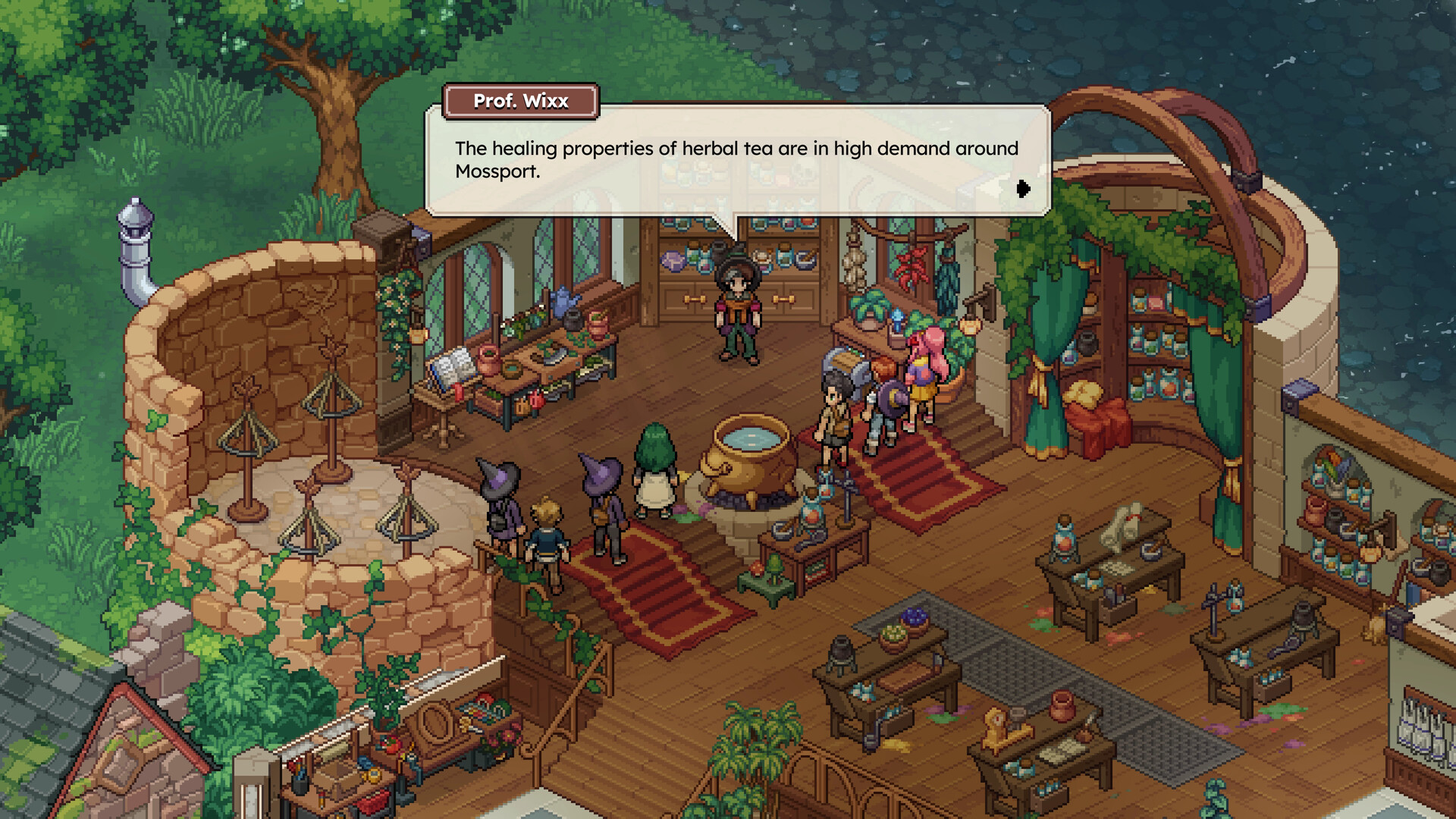
Alchemy is one of the disciplines a witch is introduced to at the start of their studies. Lessons take place on campus in the Alchemy Lab, a medieval-style building with wattle and daub walls, exposed timber beams, and wooden shutters. The lab sits within the wider Cambridge-inspired architecture of the College, with sandstone buildings, stained glass, and hidden magical emblems dotted around the grounds.
Within a standard week, alchemy classwork teaches the craft in steady layers. Early classes introduce the humble end of the spectrum: tisanes and balms that treat the kinds of pesky, everyday ailments that bring a Mossport resident into the apothecary in the first place. Later in the school calendar the material grows more ambitious, and students move on to brewing proper potions with more complicated effects. The College reserves its heaviest magical content for the arcane arts track, which only unlocks once a student has cleared the first and second semester exams, so alchemy remains the cozier of Witchbrook's crafting disciplines throughout most of the academic calendar.
The earliest alchemy lessons cover more than drinks and balms. Alongside herbal teas and salves, beginning students also learn to craft incense, another low-tier good that feeds the same loop of consulting residents, brewing a remedy, and delivering the finished product. Because these goods sell and satisfy business orders, a student's alchemy bench doubles as the engine of her witch business and a regular supply for the Sunday market stall.
Core Crafts
The alchemy curriculum is organised around three overlapping tiers of product. Each tier builds on the last, and a witch returns to the earlier tiers often, since there is still strong demand in town for a simple cup of tea or a pot of salve long after she has learned how to brew something stronger.
Craft | Difficulty | Typical Purpose |
|---|---|---|
Herbal teas | Beginner | Everyday comfort, settling nerves, easing minor aches, pairing with a consultation or a social visit |
Topical salves | Beginner to intermediate | Soothing sore muscles, treating scrapes and bruises, fast relief that does not need to be ingested |
Potions | Intermediate to advanced | Complex cures for specific problems, harder to brew but more valuable and more versatile |
Within each tier there is room for a wide variety of recipes, since Witchbrook's alchemy pulls from Mossport's full catalogue of native plants and creatures. A tea made from coastal herbs feels different from one made with forest ingredients, and a salve tuned to a farmer's needs looks different from one made for a fisherman's chapped hands.
Ingredients and Sourcing
A finished alchemical product is only as good as the ingredients that went into it, and the Witchbrook curriculum is explicit that students are expected to source their own materials. That turns alchemy into a gentle excuse to go out into the world. A witch who needs chamomile for a calming brew heads into the meadows outside town. A salve that calls for a sea-going ingredient sends her down to the coast. The kind of fauna an alchemy recipe sometimes calls for is found in the wilder corners of the map rather than in the College greenhouses.
Ingredients do not all have to be gathered in the field. Planters in the witch's own garden can be filled with seasonal herbs, which cuts down foraging time and keeps a stock on hand for potions, teas, salves and candles; a greenhouse unlocked on the cottage grounds lets herbs be grown out of season. See Cottage and Garden for how those planters and outbuildings work.
In practice the sourcing loop tends to run through the same checkpoints each time.
Read the recipe. Ancient tomes, course notes, and client conversations all supply leads on what to brew. A good witch takes the time to understand what a cure actually needs before rushing outside to gather.
Forage or hunt locally. Mossport and its outskirts produce different flora and fauna depending on location and season. Each ingredient has a natural home, and learning the map is as important as learning the recipe.
Buy what cannot be gathered. Some materials are easier to purchase from Mossport vendors than to collect by hand, particularly when a deadline with a client is tight or the weather will not cooperate.
Prepare the ingredient. Clean, dry, cut, or otherwise ready the raw material so it behaves when it hits the cauldron or the mortar. Poor prep leads to weaker results.
Brew or blend. Use the Alchemy Lab (or, for simpler recipes, a home setup) to finish the product. Follow the recipe carefully; complex potions reward patience.
Deliver in person. Witchbrook is a hand-delivery game. Walking the finished tea, salve, or potion to the client is a full part of the craft rather than an afterthought.
Progression From Simple to Complex
Alchemy in Witchbrook is pitched as a slow climb from modest remedies to serious potions. The game's developers have said the discipline starts with herbal teas and topical salves for pesky everyday ailments, then moves over time toward complex cures brewed as full potions. That arc matters because it lets a player dip into alchemy as a new witch without being overwhelmed, and it also keeps the discipline rewarding late into the school year when a more experienced student is tackling harder material.
Stage | What the Witch Is Making | What the Witch Is Learning |
|---|---|---|
Early semester | Herbal teas for calming the nerves, settling the stomach, warming a traveler | Identifying local plants, basic preparation, simple infusion technique |
Mid semester | Topical salves for aches, scrapes, and surface ailments | Blending multiple ingredients, balancing potencies, understanding dosage |
Later study | Full potions for complex problems that touch the body and the mind at once | Reading denser tomes, timing brews, combining materials that do not normally mix |
Because the College positions alchemy as a practical subject rather than a purely academic one, a witch's progression shows up most clearly in what she can actually produce for paying clients. A student who is still working on teas will take on lighter jobs; a student who has reached proper potion work can take commissions that were impossible earlier in the year.
Applying Alchemy in Consultations and Community Work
Alchemy products are central to civic witchcraft, the practical vocation that turns classroom magic into paid services for the residents of Mossport. A remedy brewed in the Alchemy Lab can go straight out the door with the witch and into a client's hands the same day.
Where a divination-focused witch spends her evenings running home consultations with tarot cards and star charts, an alchemy-focused witch leans on her brewing skills. The two approaches are not exclusive: a thoughtful witch may sit with a client for a reading and leave behind a calming tea, pairing an insight with a comfort. Even so, alchemy's clearest role in civic witchcraft is as the tangible output a witch hands over at the end of a job.
Selling in Mossport. Teas, salves, and potions can be sold to residents who place orders, or offered through market-style channels elsewhere in town.
Gifting to townsfolk. A well-chosen remedy is a thoughtful present for a shopkeeper, classmate, or neighbor and nudges friendships forward.
Pairing with consultations. An alchemist can round out a divination reading with a soothing drink or a useful salve to leave with the client.
Seasonal needs. Different times of year surface different ailments. Colder months reward warming teas and balms that complement the woolen scarves sold at Calico Fresh Threads; sunnier months favor lighter, cooling concoctions.
Relationship to Herbology and Arcane Arts
Alchemy is not the only place in Witchbrook where plants matter. The wider study of herbology and botany sits inside the arcane arts track rather than inside alchemy itself. That split matters for students planning a specialisation: alchemy teaches how to transform ingredients into finished remedies, while the botany side of arcane arts teaches the deeper lore of the plants themselves. A serious alchemist benefits from both, because a witch who understands what an herb is, where it grows, and what it means in ritual work will brew more thoughtful remedies than one who only knows the recipe.
Divination sits further away. A divination student uses tarot decks and celestial study to answer questions, and her craft does not consume ingredients. Alchemy and divination often work together in the field, though, because a good consultation sometimes ends with a remedy tucked into the client's hand before the witch leaves.
School | What It Covers | Where It Overlaps With Alchemy |
|---|---|---|
Alchemy | Teas, salves, and potions made from local flora and fauna | The core crafting discipline itself |
Tarot reading and constellation study | Consultations commonly pair a reading with a calming tea or salve | |
Rituals, demons, and the deeper botany and herbology of plants | Understanding an ingredient's lore makes for stronger recipes |
Tools and Lab Space
The Alchemy Lab is the spiritual home of the discipline. Its medieval-inspired interior gives the subject its look: timber beams overhead, shutters half-open onto the College grounds, worktables set with mortars, pestles, glass vials, and a cauldron sized for student-scale brews. Lessons take place here, but the lab is also where a witch returns between jobs to turn the day's foraging into finished product.
Not every remedy demands the full lab. Simpler teas can be prepared almost anywhere a witch can boil water, and basic salves need little more than a clean surface and a few ingredients. The lab's real advantage is for the harder end of the curriculum: complex potions that call for heat control, precise timing, and the kind of equipment a student cannot reasonably carry home. As a witch's ambitions grow over the course of the school year, she finds herself spending more time at the College benches and less time improvising from her room.
Taken as a whole, alchemy at Witchbrook is meant to feel like craft rather than chemistry. It rewards a witch who listens to her clients, walks the landscape to source her materials, takes the time to learn her plants, and brings a patient hand to the cauldron. The output is useful, the demand is steady, and the discipline sits comfortably at the heart of everything a young witch does outside of class.