

Arcane Arts is the advanced school of magic taught at Witchbrook College. The developers have publicly described it as the realm of rituals and demons, the one discipline that does not open up until a student has proven themselves in the first year of study. Where Alchemy teaches herbal teas, salves, and progressively more complex potions, and Divination teaches tarot and constellation work, Arcane Arts pushes the witch fantasy into darker, heavier territory, and it is the only school with an explicit academic gate keeping first-semester students out.
Overview
Witchbrook's curriculum is built out of discrete schools of magic, each taught in its own dedicated space on campus. Arcane Arts sits at the top of that curriculum as the advanced option, not because it is strictly more powerful than Alchemy or Divination, but because its subject matter is heavier and its working methods demand a grounding in the other schools first. The studio has framed Arcane Arts as the vocation for players who want to push beyond the cozier remedies-and-readings side of witchhood and engage with ritual magic directly.
Two specific subject areas have been confirmed by the developers: rituals and demons. That short phrase does a lot of work. Ritual magic in Witchbrook is structured, ceremonial spellwork with a clear procedure and a clear goal, and the demon side implies that at the upper end of the curriculum the witch is expected to interact with entities rather than just ingredients or cards. The exact shape of these interactions has not been fully detailed in public, but Arcane Arts is consistently presented as the school where that sort of work happens.
What Arcane Arts Covers
The confirmed scope of the discipline is narrower and more focused than Alchemy or Divination, which both branch into several sub-practices. Arcane Arts, at least as it has been publicly described, centers on two closely related skill families that are taught alongside each other rather than as separate tracks.
Topic | What It Involves | Confirmed Detail Level |
|---|---|---|
Rituals | Structured ceremonial spellwork performed in the Arcane Arts classroom. The developers have directly named a Rituals class that takes place in this space. | Named subject with a dedicated class |
Demons | Interactions with demonic or otherworldly entities. The studio has described the discipline as covering this area, though moment-to-moment gameplay specifics are still under wraps ahead of launch. | Named subject area, specifics TBD |
Further spells | The developers have stated that students will discover more classes and new spells as academic progress continues, and Arcane Arts is the natural home for the more advanced ones. | Confirmed as a growth path, not itemised |
Because the game is pre-release at the time of writing, the full list of rituals, named demons, and specific Arcane Arts spells has not been published. What has been confirmed is the shape of the curriculum, not yet its complete contents. Anything listed on this page beyond the rituals-and-demons framing should be treated as structural context rather than a full catalogue.
Rituals
The Rituals class is the one named piece of Arcane Arts coursework the developers have explicitly attached to a physical classroom on campus. Rituals in Witchbrook are presented as formal procedures: a witch prepares the space, follows a sequence of steps, and channels magic toward a defined outcome. This is a distinct mode of practice from brewing a potion in the Alchemy Lab or reading tarot at the College Observatory, and it is a distinct mode of practice from casual everyday cantrips.
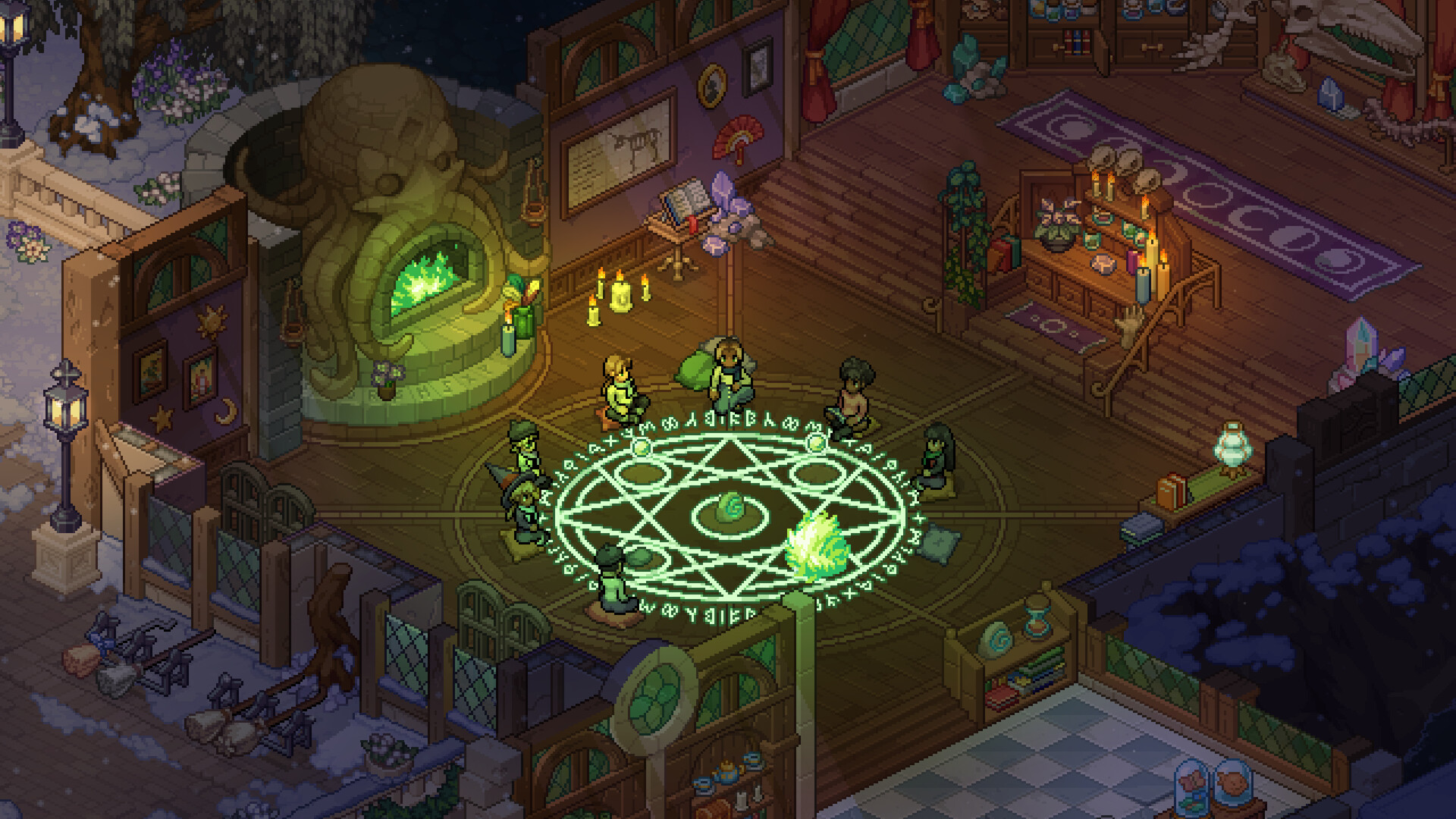
Because rituals are ceremonial rather than improvisational, they fit naturally with the studio's stated education philosophy. The developers have said that practical magic requires a hands-on approach, with students consulting clients face-to-face, sourcing their own ingredients, scouring ancient tomes, crafting the cures, and hand-delivering the goods. That same hands-on framing applies to ritual work: a successful ritual is one the witch has prepared for, not one she stumbles into, and the Arcane Arts classroom is where that preparation is taught.
Summoning and Demonic Work
The demonic side of Arcane Arts is the part the studio has been most careful about describing ahead of release. The school has been explicitly labelled as the realm of demons, and the 2025 gameplay-reveal marketing has referenced participating in mysterious rituals as one of the magical-arts pillars players can lean into alongside brewing potions and consulting the stars. How summoning, binding, pacts, or other demon-adjacent mechanics actually play out in moment-to-moment gameplay has not been fully detailed yet.
What is clear is the tonal positioning. Witchbrook is overwhelmingly a cozy life-sim, and Arcane Arts is the one academic track that deliberately introduces a less cozy, more serious layer of witchhood. Players who want to stick to tarot readings and potion brewing can do so; players who want to engage with the darker side of the witch fantasy have Arcane Arts as their dedicated path. The academic gate on the discipline reinforces that framing: this is material the College withholds until the student has proven they can handle the earlier curriculum.
Location at Witchbrook College
The Arcane Arts classroom is one of the older, more atmospheric buildings on campus. The developers have described the main academic buildings, including the Library, Observatory, and Quad, as bright sandstone masonry in the grand style of a historic university, with statues, ornate pilasters, stained glass windows, and conical metal roofs. The surrounding buildings, including the Alchemy Lab, Arcane Arts classroom, and College Shop, are instead built in a Medieval style with wattle and daub walls, timber beams, and wooden shutters, and some of them incorporate the oldest elements of the campus, including crumbling red brick towers and archways.
That contrast is deliberate. The grand sandstone buildings house the disciplines with a lighter public face: divination at the Observatory, general study at the Library, civic events in the Quad. The older, heavier Medieval structures house the schools whose work is either messy or serious: Alchemy's brewing benches, the College Shop's trade, and Arcane Arts' ritual space. Walking into the Arcane Arts classroom is meant to feel different from attending a tarot lecture at the Observatory, and the architectural styling is one of the ways the game communicates that shift in register.
Entry Requirements and Academic Gate
Arcane Arts is the only confirmed school of magic with a hard prerequisite. The developers have stated plainly that the Arcane Arts are taught only to witches who can prove their knowledge and pass their semester 1 and 2 exams. Students who cut those exams, fail them, or never sit them cannot enrol in the advanced classroom, regardless of how much in-world time has passed.
That gate sits on top of Witchbrook's academic calendar. Each semester in the game includes mid-terms and final exams that test the witch's knowledge and magical ability, and those results feed directly into character progression. In practical play terms, passing the first two semesters' worth of exams is the clearest in-game focus on the Arcane Arts track: until that bar is cleared, the discipline simply is not on the timetable.
Gate | What It Requires | Effect on Arcane Arts Access |
|---|---|---|
Semester 1 exam | Successful completion, as confirmed by the developers | Required; no Arcane Arts access before this is cleared |
Semester 2 exam | Successful completion, as confirmed by the developers | Required in combination with semester 1; unlocks access once both are passed |
Ongoing performance | Continued engagement with the school's classes once unlocked | Drives discovery of further classes and new spells as the student progresses |
Because the gate is tied to in-game academic performance rather than to real-world playtime, a witch who rushes through Alchemy and Divination homework but skips revision can still find themselves locked out of Arcane Arts in their second year. The College treats the advanced track as earned, not granted.
Applying Arcane Arts in Gameplay
Arcane Arts feeds into Witchbrook's life-sim loop in a different way from its sister schools. Alchemy produces physical goods (potions, teas, salves) that can be sold, gifted, or applied to solve problems around Mossport. Divination produces readings, most visibly through Home Consultations, where a witch visits a resident and advises them on travel, finances, love, or other personal questions. Arcane Arts, by contrast, is the track that deals with ceremonies and entities, and the public framing has consistently pitched it as the more dramatic, less transactional side of witch life.
That does not mean Arcane Arts is disconnected from day-to-day play. The studio has tied all three schools into the broader vocation of Civic Witchcraft, the practical use of College training to help the people of Mossport. Where alchemy-focused witches might become the town's go-to potion supplier and divination-focused witches its most trusted readers, an Arcane Arts specialist is positioned to handle situations that call specifically for ritual work. The finer mechanical details (whether rituals take in-game hours, whether they consume reagents, whether demon interactions affect reputation) have not been publicly itemised ahead of launch, but the school is framed as a legitimate career path inside the same civic system that supports the other two.
Arcane Arts also interacts with the longer arc of the Academic Year. Because it only unlocks after the first-year exams, a player's choices during the opening semesters shape whether the second year opens up around the advanced track or stays centered on Alchemy and Divination. A witch who invests heavily in exam revision in year one earns access to ritual magic in year two; a witch who coasts through her first year has a narrower menu of classes to pick from when the second year begins.
Connection to the Other Schools of Magic
Witchbrook's magic is not split into rival factions. The three publicly confirmed schools, Alchemy, Divination, and Arcane Arts, are presented as complementary parts of a single curriculum, and a witch is expected to have some exposure to each over the course of her studies. Arcane Arts' distinctive features are its academic gate and the weight of its subject matter, not a rejection of the other schools.
School | What It Teaches | Relationship to Arcane Arts |
|---|---|---|
Herbal teas, topical salves, and progressively more complex potions, all crafted hands-on at the Alchemy Lab | Shares the same Medieval-style side of campus; the grounding in ingredients and preparation supports later ritual work | |
Tarot card reading by day and communication with the constellations by night, taught at the College Observatory | Provides the interpretive and perceptive training that a ritual practitioner draws on when reading a ceremony's outcome | |
Arcane Arts | Rituals and demons, taught in the Arcane Arts classroom once the student has passed the first-year exams | The advanced track that builds on the other two rather than replacing them |
The developers have also noted that students will discover more classes to learn new spells as their academic studies progress, meaning the three confirmed schools are the starting shape of the curriculum rather than its final form. Arcane Arts in particular is likely to expand as the team reveals more of its ritual and demon-adjacent content in the run-up to launch. Until then, the discipline is best understood through its published framing: a dedicated, gated, Medieval-styled school for witches who have earned the right to study the heavier side of magic, and one of the three pillars on which Witchbrook's academic system is built.
Summary: Arcane Arts is Witchbrook's advanced school of magic, focused on rituals and demons, taught in a Medieval-style classroom on the older side of campus, and unlocked only for students who pass the semester 1 and 2 exams. It sits alongside Alchemy and Divination as one of the three publicly confirmed disciplines, and it is the track to pick when a witch wants to move past cozy remedies and readings into ritual practice and entity-adjacent work.