
Loading...
Loading...
Civic Witchcraft
May 27, 2026 at 10:32 PM
Cleanup: repaired malformed content node
Civic witchcraft is the name Chucklefish uses for the practical, community-facing side of magic in Witchbrook. It describes the way a student of Witchbrook College takes the spells, recipes, readings, and rituals they are learning in class and puts them to work for the non-magical residents of Mossport. Rather than treating magic as an abstract school subject or a power fantasy, the game treats it as a vocation: a witch exists to help people, and civic witchcraft is the framework that turns classroom theory into daily service around town.
The concept was introduced at length in the third issue of The Witchbrook Oracle, the in-game newsletter that doubles as a real dev blog. In that issue, editor Eli Ivers frames civic witchcraft as the next step after formal education. Classes teach the what and the how; civic witchcraft asks the witch to look around at the town, notice what needs doing, and actually do it. The developers have described the intent as turning magic into a real service to townspeople, and have pointed to community-minded witches in fiction as the touchstone that shaped the loop.
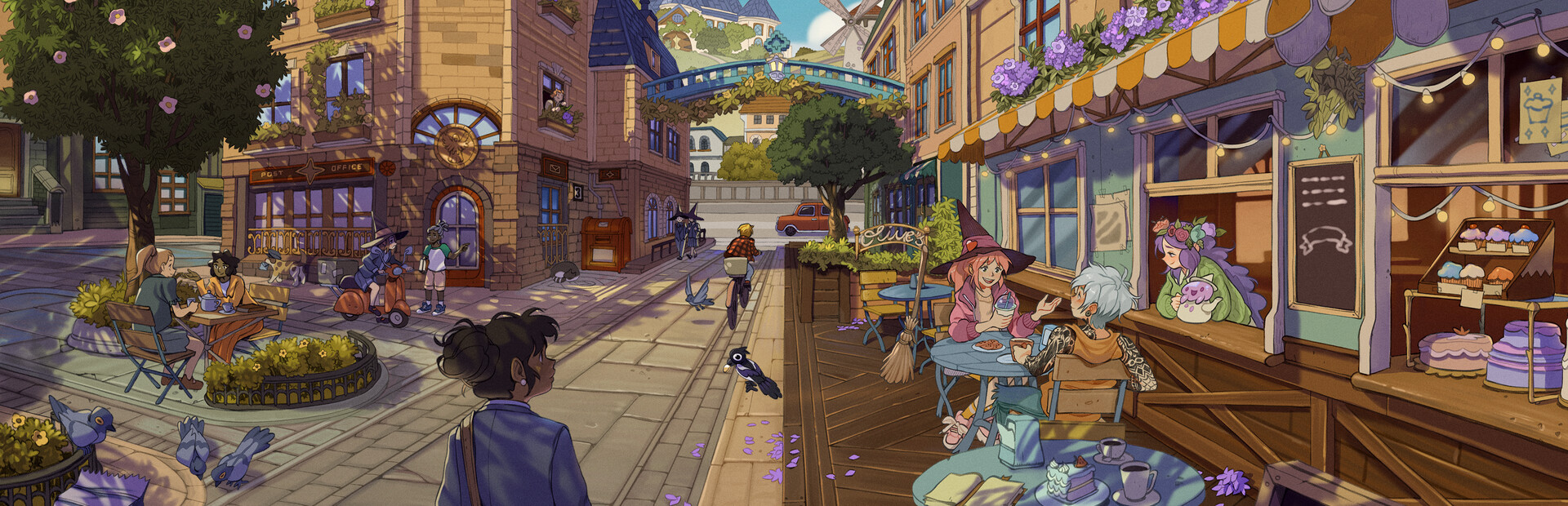
The result is a gameplay loop that sits alongside coursework at the college and romance in town. A witch wakes up, attends classes in the morning, and then in the afternoon or evening puts those lessons into practice across Mossport. The list of civic jobs is deliberately wide. Some are intimate and conversational, some are physical and public, some are entrepreneurial. The shared thread is that every one of them starts with a resident of Mossport who needs something and a student with the training to help.
Civic witchcraft is an umbrella term rather than a single mechanic. It encompasses every situation where a student witch applies their craft to the benefit of the town. Because Mossport is home to both magical and non-magical residents, and because most citizens cannot perform magic for themselves, there is steady demand for trained students to step in. The specific forms that this work takes are varied, and the Oracle has repeatedly stressed that the practice takes all kinds: there is no single correct way to be a civic witch.
Personal advising. Private readings and consultations at a resident's home, where the witch helps the client think through a question using the tools of divination.
Everyday problem solving. Brewing alchemy remedies for a tired bus driver, a grieving neighbor, or a shopkeeper with a persistent ache, and delivering those remedies to the person who needs them.
Infrastructure and maintenance. Using magic to handle small repairs around town, from leaky fountains to patchwork on a garden wall, jobs no one else has the time or the skill to finish.
Deliveries and errands. Running letters and parcels through Mossport for the post office or for neighbors who need a hand, a flavor of the loop the developers have tied explicitly to witches as delivery-service characters.
Commerce and craft. Selling homemade goods at the Sunday Market, whether that is jam from the witch's own kitchen, potions from the alchemy lab, or small charms picked up at school.
Styling and presentation. Helping a shop present itself well, staging window displays, or working alongside a shopkeeper who wants to lift the mood of the store. This is the angle Hana Sato has been held up as an example of, through her work at the Calico clothing shop.
Events and festivals. Helping organize and run the seasonal events that Mossport's calendar is built around, another way classroom skills make their way out into the public life of the town.
The Oracle has offered a spectrum of specific examples to illustrate how broad civic witchcraft is meant to feel. The table below groups the confirmed activities by the kind of work involved and the kind of student each one tends to attract.

Activity | Setting | What the Witch Brings | Why Residents Need It |
|---|---|---|---|
A client's house | Divination training, patience, an ability to listen | Personal questions about travel, finances, love, and other matters that benefit from a calm outside perspective | |
Postal deliveries | Streets and alleys of Mossport | Navigation, stamina, reliable scheduling | Letters and parcels that need to move quickly across a walkable seaside town |
Weekend cleanup | Public squares after market days | A willingness to work when others are resting, basic practical magic | Keeping shared spaces presentable when the rush has gone and no one else is around to tidy |
Small repairs | Fountains, benches, minor fixtures | Practical problem solving, applied classwork | Infrastructure that is too small to warrant a professional repair but still annoys the neighborhood |
Sunday Market stall | Mossport's weekly market | A craft or recipe worth selling and the discipline to staff a stall | Residents who enjoy buying handmade goods from people they know by name |
Window displays and styling | Shops like Calico on the boardwalk | Visual taste, confidence helping others feel good about themselves | Retailers who want their storefront to feel alive and customers who come in looking for a change |
Seasonal event help | Promenade, market, and other public spaces | Whatever the calendar needs on the day, from decoration to crowd care | Community traditions that take a village of volunteers to run well |
No single witch is expected to work across every one of these tracks. The Oracle makes a point of saying that civic witchcraft rewards diversity of style, and the practice is easier to sustain if the student chooses a few activities that fit their strengths and grows into them over the course of the academic year.
Home consultations are the most fleshed-out expression of civic witchcraft that Chucklefish has shown in detail, and they are the easiest way to see how the general idea works in practice. In a consultation, a witch travels to a resident's home, sits down with them, and uses divination (usually tarot, later expanded with constellation study) to help the client think through a personal question. The scene is quiet, scripted, and deliberately intimate, and it exists inside the wider frame of civic witchcraft rather than as a standalone minigame.
The developers have explicitly confirmed that consultations are a specific kind of civic witchcraft. That framing matters because it prevents readings from feeling like a detached commercial service. A consultation is not just a paid performance; it is one of the ways a trainee witch earns their place in the town, and it sits on the same spectrum as delivering a parcel, sweeping a square, or brewing a cup of tea for a tired neighbor. Players who want to focus on consultations are still practicing the same vocation as players who prefer market stalls or repair work; the differences are stylistic rather than categorical.
Academic coursework is where a witch acquires the tools that civic witchcraft asks them to use. The three confirmed schools of magic at Witchbrook College each feed into the civic side of the game in their own way, and students with different class schedules tend to gravitate toward different community activities.
School | What It Teaches | Civic Applications |
|---|---|---|
Herbal teas, topical salves, and progressively more complex potions | Brewing remedies for residents, stocking a market stall, filling private commissions for tired, sore, or worried clients | |
Tarot reading during the day and celestial study at night | Home consultations, festival fortune-telling, and any work that involves helping a resident think through a choice | |
Rituals and more advanced magical work that opens up after exams | The less domestic side of civic life, including ritual help at seasonal events and the kinds of problems that need more than a tea or a reading |
The connection runs in both directions. Classes provide the techniques, and civic witchcraft is the reason those techniques stay sharp between exams. A witch who only studies and never leaves the college tends to fall behind, because civic practice is where lessons get repeated, varied, and rooted in memory. The same student also learns things in town that cannot be taught in a lecture hall, from how to pace a conversation with a client to how to recover gracefully when a spell does not land the way it did in the lab.
Civic witchcraft is not only its own reward. The work pays in coin, in material goods, and in reputation across Mossport. Coin comes directly from paid jobs, market sales, and private consultations. Goods come from clients who prefer to trade in kind, slipping the witch a loaf of bread or a new cutting for their herb garden instead of cash. Reputation is the slowest of the three to accumulate and the most lasting: a witch who is reliably kind and reliably competent becomes someone the town thinks of first when a new problem appears.
The reputational layer ties civic witchcraft to almost every other system in the game. A good reputation brings in more job requests, opens doors to friendship and romance with datable residents, and gives a witch standing to participate in community events on better terms. It also feeds back into school life: classmates notice when a student is doing well in town, and professors sometimes weave a witch's public work into the way they evaluate performance in class. Poor reputation is possible too, and the game is forgiving but not infinite. Letting clients down, skipping promised visits, or misusing magic in public will gradually narrow the jobs a witch is offered.
Civic witchcraft only exists because residents of Mossport actually want the help. The Oracle and the dev blogs have introduced several recurring figures who illustrate the kinds of people a student witch can expect to work with over the course of a school year.
Resident | Situation | Kind of Help They Seek |
|---|---|---|
Editor of the town's newsletter and the in-universe voice championing civic witchcraft | Writing, networking, and celebrating the students who take the vocation seriously | |
Covenmate and part-time stylist at the Calico shop on the boardwalk | Window displays, personal styling sessions, and customer care that leans on magical presentation | |
Bob the bus driver | A townsperson struggling with chronic fatigue that is interfering with his work | A remedial tea brewed from forest herbs that the witch gathers, prepares in the alchemy lab, and delivers |
Mossport shopkeepers | Owners of small businesses along the promenade and market | Reliable crafts and remedies for their regular customers, plus occasional magical help during busy seasons |
Market regulars | Residents who shop weekly at the Sunday Market | Homemade goods that the witch personally stands behind, from jams to charms to small potions |
The cast above is not exhaustive. Civic witchcraft is designed so that almost any resident can become a client, because almost any resident has something in their life that a thoughtful witch could improve. That is the final piece of the loop: the town is full of people, each of them has a routine, and the student's job across four years of school is to notice those routines, understand what is missing, and bring a spell or a reading or a loaf of bread to fill the gap.
