

SILENT HILL: Townfall is presented in first person with no traditional heads-up display, in a wide cinematic frame, on a palette built around red and black. The look was researched on location in Scotland rather than assembled from concept art alone.
Aspect | Detail |
|---|---|
Frame | 2.35:1 by default, with black bars top and bottom. A fullscreen toggle in settings switches it to 16:9. |
Palette | Red and black. The ordinary town is fog and grey; the Otherworld is lit in oppressive red. |
Interface | No conventional HUD. Information is held in the world instead, on the CRTV and on a paper map. |
Engine | Unreal Engine 5, with Nanite carrying the density of the environments. |
The Frame
The game runs in a 2.35:1 aspect ratio by default, which puts letterboxing at the top and bottom of the screen and gives it a cinematic shape. It is not fixed: previewers reported a fullscreen toggle in the settings menu, switching the game to a conventional 16:9 presentation without the bars.
Palette
Red and black dominate. Asked about the choice, Jon McKellan gave a two-part answer: partly that they are a striking pair of colours, and partly that "as you progress through the game, players will discover that these two colors hold a deeply symbolic and vital significance for our protagonist, Simon." The ordinary town is fog and grey; the Otherworld is bathed in oppressive red light, and ray tracing is used on both.
Interface
There is no conventional on-screen HUD. Information reaches the player through objects held in the world instead: the CRTV is raised into view, the map is a pamphlet Simon is doodling on, and the peek renders as a lean rather than as an overlay. Simon's inner monologue is unspoken and written on screen in his own handwriting, with lines as short as "there's no answer."
The studio's earlier work was built on interactive retro interfaces and VHS-style aesthetics, and McKellan has called analog technology his visual calling card, which is where a lot of this comes from.
Environmental Storytelling
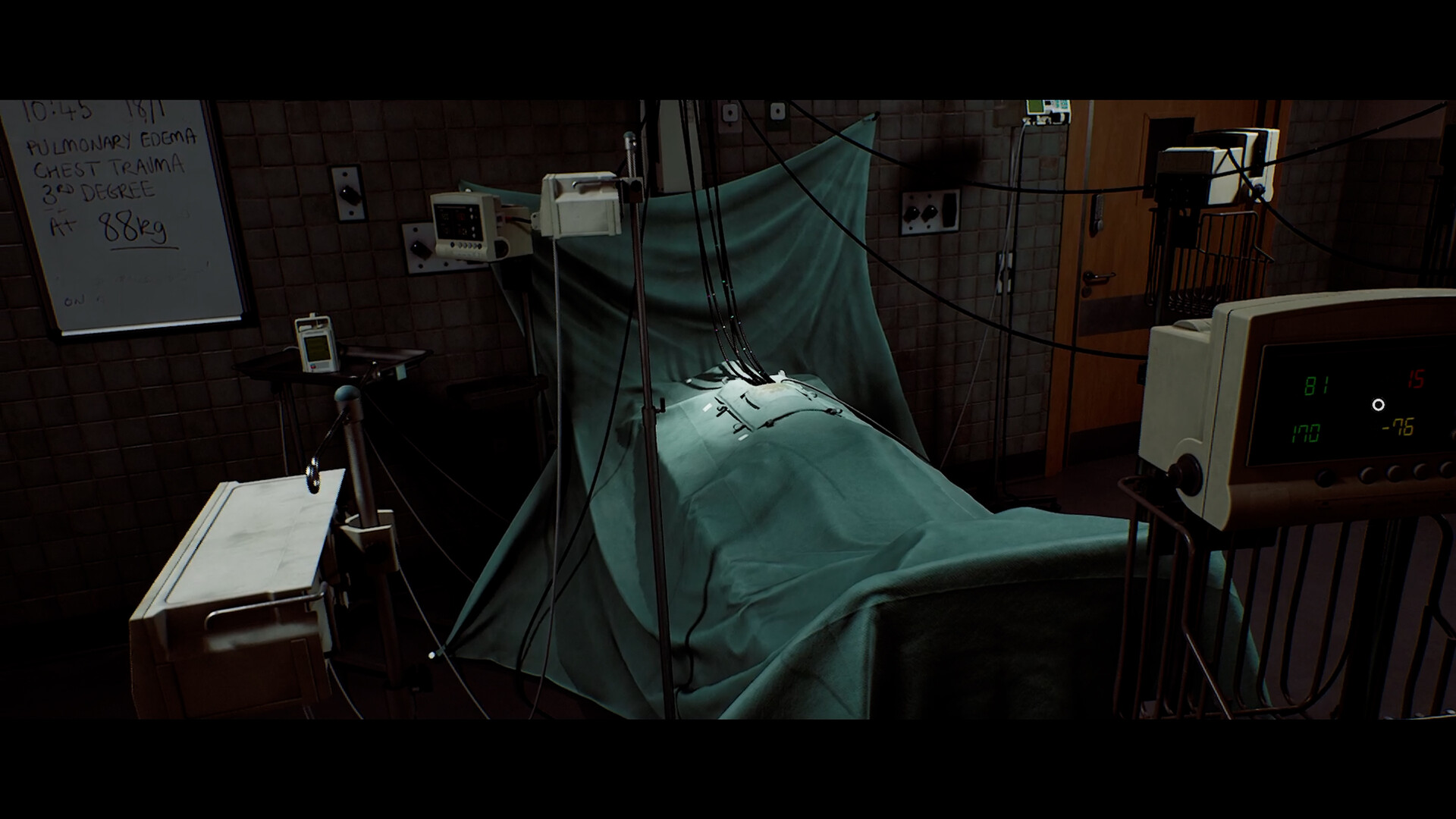
With no HUD to carry exposition, a lot of what the player is meant to pick up sits in the set dressing instead. One interior shown so far is a clinical room: a bed made up under a surgical drape, monitors for vital signs, an IV pole standing at the bedside, and a whiteboard on the wall filled in by hand. Nobody has said whose room it is, and nothing in it is labelled or explained for the player. It is built to be read rather than narrated, which is the same instinct behind putting information into the player's hands rather than onto a HUD.
Why First Person
Graeme McKellan has explained the decision as a horror one rather than a technical one. A first-person view has a more limited field of view, so things happen off-screen that the player is not aware of, "and as we know in horror, what happens off-screen is sometimes more scary than what happens right in front of you." The peek mechanic exists to give some of that control back.
The CRTV is the other half of the answer. McKellan has said the device could not work from any other perspective, and that the first-person view was an indispensable foundation for building mechanics around it. One knock-on effect: interiors are reportedly built at a 1:1 scale, a choice made possible by there being no third-person camera to accommodate. Encounter design under the same constraint is on Combat and Stealth.
Engine
Townfall runs on Unreal Engine 5. A Screen Burn developer states it on camera in Konami's own studio documentary, describing how "Unreal allows us with Nanite to just sort of layer on loads of meshes and textures on top of each other." Nanite is the practical reason a street can carry, in the same developer's words, "layers upon layers upon layers of life and history," mimicking several hundred years of a town accumulating.
On PlayStation 5 the lighting is ray traced. A September 16, 2026 post co-written by the producer and the director describes ray-traced lighting painting the scenes in soft ambient light from the fog, reacting to the flashlight and to flashing alarm lights, and carrying the change from blue-grey fog to the red of the Otherworld. Platform specifics are on PS5 Features.
Location Research
Screen Burn visited and photographed real coastal towns in Scotland to recreate their look and feel. The harbour town of St Monans, on the east coast, was the first place the team built for the game and is the direct reference for the St. Amelia pier. St Monans is a real place used as a reference; it is not a location Simon visits.
Art director Paul Abbott has described the environment in personal terms. "Because I've grown up in towns like this, in a small fishing town that's kind of similar to St. Amelia," he has said. "It's a beautifully epic, gray, drizzly environment, and we're bringing that to the game."
Abbott spoke on camera during Konami's own February 2026 broadcast, which is where that account comes from. The broadcast and every other official video are listed on Trailers and Media. More of what Jon McKellan has said about the look of the place is on his own page.
The trips were about more than reference photography. "It's the smell and the wind and the sound of the place, all of that together is what you're trying to recreate," McKellan has said. "You're not just trying to recreate the visuals, you're trying to recreate the vibe, and there's no better way of doing it than spending time there." The team walked several piers to compare their shapes, and one artist noted that in the finished game the benches sit exactly where they do in the real town.
Making the Signals Look Real
The analog footage that plays on the CRTV was produced physically rather than filtered. The team recorded in-engine footage, played it out through real analog hardware, and re-imported the result, which is what gives the scrubbing and tuning their texture. The studio has separately described using and abusing old televisions to get the effect right.
One practical note from the press build: some interiors are dark enough that a previewer suggested raising gamma. That is one person's impression of a pre-release build rather than a published recommendation.