

Sea of Remnants is structured around repeated voyages rather than a single continuous journey. The development team describes the core experience as a Set Sail, Explore, Extract, Return loop that leans on roguelike elements to keep the open world changing. You leave Orbtopia with a crew and a ship, work your way through open water and islands, take what you can carry, and come back to spend it and prepare for the next departure.
The Voyage Loop
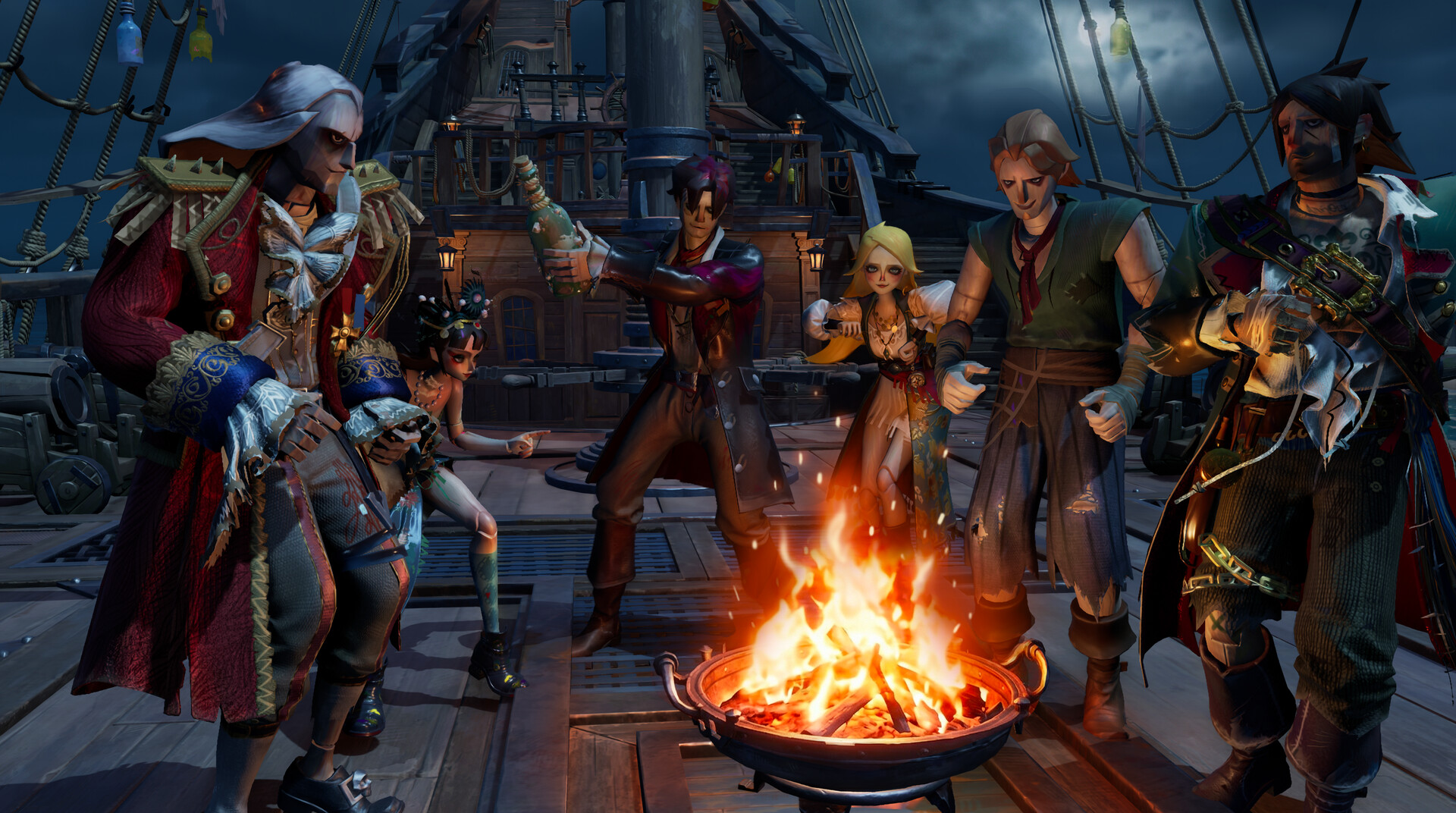
Each cycle has four stated stages, and the design intent is that the world looks different each time you go round it.
Stage | What happens |
|---|---|
Set Sail | Assemble a crew, fit out a ship, and pick a heading. Crew classes and builds can be reconfigured between voyages. |
Explore | Roam open water, follow the horizon, and land on whatever islands you find. Weather and sea conditions are dynamic. |
Extract | Take treasure, materials and new companions out of encounters, ruins and monster lairs. |
Return | Bring it all back to Orbtopia, repair the ship, upgrade gear, spend the proceeds, and set up the next run. |
The roguelike framing means the loop is meant to be replayed with different configurations rather than optimised once. First party copy describes it as giving a revolving fresh perspective on the same world, and ties it to the game's themes of oblivion and reconstruction.
Crew Building
Crew is the primary progression system. Companions are recruited from rival factions rather than hired from a single pool, and more than 400 companions have been described as planned. Between voyages you can rebuild the roster's classes and builds, and crew members can be trained in professions that unlock skills. Skills are meant to interact, so the stated goal is a team whose abilities compound rather than a team of individually strong members. See Crewmates.
Ship Building
Ships are assembled rather than selected. First party descriptions consistently use the words custom parts, cannons and modular upgrades, and the fleet trailer presents six named groups with distinct identities. A captain is expected to end up with a fleet rather than a single hull. See Ships and Fleets.
Choice and Consequence
Choice is presented as the system that ties everything else together. Acting on impulse or sparing an enemy, staying in port or chasing profit, all of it is described as rippling outward. The stated effects are concrete:
Rival factions react to what you do, shifting political dynamics and redrawing power structures.
Orbtopia's cityscape evolves in response to your decisions.
Key figures can be befriended, provoked or removed.
Storylines and alliances across the sea can be altered by comparatively small actions.
The design goal stated at reveal is that no two captains share the same story. A later description put it more bluntly: this is not a game about what you take from the ocean, it is a game about who you go back for.
Combat
Island encounters are turn-based, fought with the crew you brought and the professions you trained them in. Naval encounters were originally described as real-time fleet battles. A 2026 showcase described turn-based encounters on land and sea without restating the naval layer, so the present structure of ship-to-ship fighting is not settled. Full detail is on Combat, and the creatures you fight are covered on Sea Monsters.
Life in Port
A substantial part of the game happens without leaving harbour. Orbtopia carries repair and upgrade services alongside a long list of diversions, and the developers have gone as far as calling slacking off the true profession of the city's pirates. See Minigames and Orbtopia.
Systems Seen in Demo Builds
A 90 minute hands-on with a demo build shown in June 2026 surfaced several systems that have not been described in detail in first party announcements. These are recorded here as observations from a work in progress build rather than as final systems.
A resource that can be spent to power up attacks within the current turn.
A dice roll element that can pay out a bonus action when the right number comes up.
Character recruitment presented in a form resembling a gacha.
Ship building, a crew favour system, and homestead creation.
A collection catalogue tracking hundreds of items across categories labelled Encounters, Insights, Oddities and Maintenance.
A dense minigame spread including mahjong, drinking, roulette, racing, fishing and cooking.
The same hands-on noted that the demo build had mismatched English voice and subtitle scripts and partially translated menus. The team subsequently said that localisation and voice-over were a major focus of the following development period, which is consistent with those being known build issues rather than shipping behaviour.
Presentation and Simulation
The world is described as being built on real ocean physics, creature behaviours and environmental systems, with storms that arrive without warning and seas that never present the same conditions twice. Presentation runs the other way: stylised animation, comic book flourishes, on-screen onomatopoeia and deliberate glitch effects over wooden puppet characters.
Not Yet Confirmed
Whether naval battles are real-time or turn-based in the current build.
The list of professions crew members can be trained in.
How recruitment works mechanically, and how it is monetised.
What the collection catalogue categories seen in a demo build actually track.
How crew favour and homestead creation work.
How far Orbtopia's evolution goes, and which choices drive it.
Whether any part of the game is co-operative or competitive. The store listing describes it as single-player with online interactivity.