

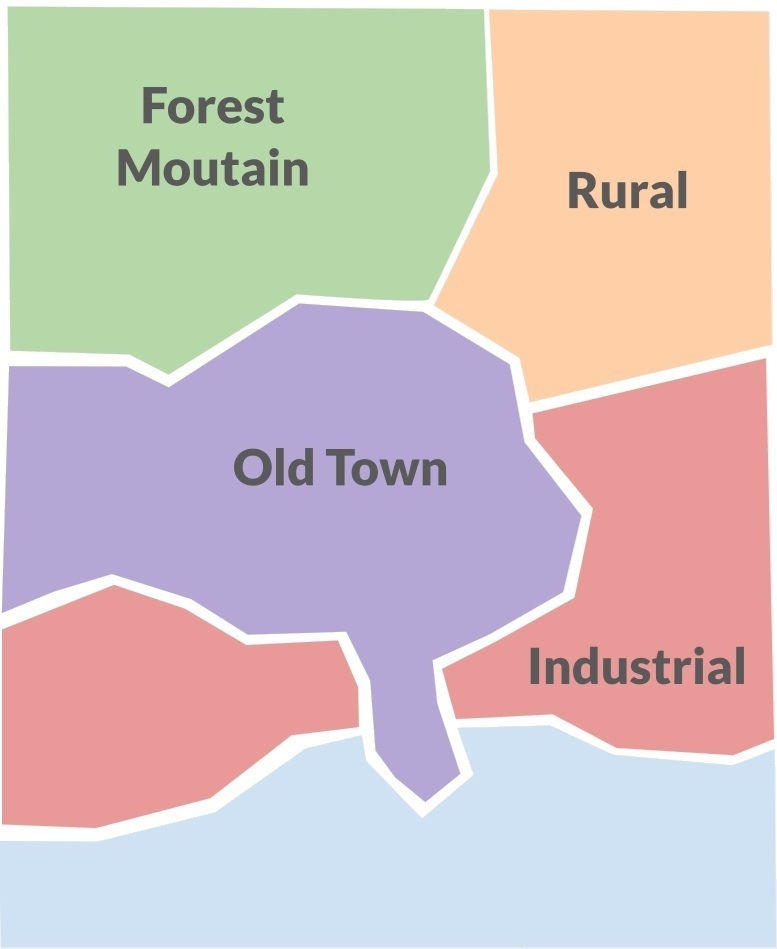
The Paralives launch town, named Melino, is divided into four named districts (Old Town, Industrial, Mountain, and Countryside), each with its own architectural style, backstory, and atmosphere. Together they form an open world that players can explore freely without loading screens between lots. The town contains approximately 80 lots across 18 lot types in total, including residential properties, public parks, shops, and workplaces, distributed across the districts described below. See Open World and Town for the broader open-world framing.
The four districts are officially named Old Town, Industrial, Mountain, and Countryside. Many players and community guides also refer to the Mountain district as Forest and the Countryside district as Farm, reflecting the forested slopes of the mountain and the agricultural feel of the rural lots. These are alternate names for the same two districts; this article uses the official Mountain and Countryside labels throughout, with the Forest and Farm aliases noted where helpful.
This article reflects the Day 1 launch build, including the April 7, 2026 new-building sneak peek and the April 6, 2026 town-events update that confirmed which districts host scheduled events. For the per-venue catalog inside each district, see Town Venues.
Districts at a Glance
District | Confirmed Landmarks | Confirmed Events | Notes |
|---|---|---|---|
Old Town | Castle, Old Town plaza, stone townhouses, L'Armoire, Market Antiques | Sunday marketplace event with oddities and painter stalls | Densely populated, European-inspired, historical heart of the town |
Industrial | Edwards and Co. Factory, brick lofts, renovated factories | Edge of town-wide events including Buried Treasure | Mixed decay-and-renovation aesthetic; gritty urban character |
Mountain | Park mountaintop, hiking trails, scenic rest stop with binoculars, chasm | Astronomy Club on Monday / Wednesday / Friday; Park Yoga on Sunday / Tuesday / Thursday | Outdoor exploration district; reachable by hiking trail, road, or train |
Countryside | Large rural lots, open landscape | Edge of town-wide events including Buried Treasure | Spacious district for sprawling builds and quiet living |
Old Town
Old Town is the historical heart of the launch town. It uses a European-inspired architectural style, with stone townhouses lining narrow streets. At its center stands a small castle that was built when the city was first established many centuries ago. Old Town's design draws inspiration from the kind of fortified-port aesthetic associated with Quebec City's historical core, with cobblestone alleys, period stonework, and a compact street layout.
Old Town is well suited for players who enjoy an urban lifestyle. Shops, restaurants, and social venues sit within walking distance of residential lots, and the tight spacing between buildings creates a cozy, community-focused atmosphere. The Old Town plaza in particular hosts the Sunday marketplace, which puts an event hub a few minutes' walk from most Old Town homes. L'Armoire and Market Antiques both anchor the plaza in the launch build.
Beyond the plaza-anchored L'Armoire and Market Antiques, Old Town also hosts the largest cluster of named commercial and civic venues in the launch build. Confirmed Old Town venues include Bloom, Headlines, the Museum, SuperGamezPlus Inc., Creme Cafe, The Story Nook, and Chez Maurice. The April 7, 2026 building sneak peek added a further commercial building to the same broader plaza-adjacent footprint, increasing the venue density. Several of these venues spill across district edges in practice, so Parafolk regularly walk between Old Town and the neighboring districts during the workday.
Newspaper headlines from The New Paper regularly reference these venues and the events they host, and the Old Town plaza area is also the densest hot zone for the weekly Buried Treasure hunt.
Industrial District
The Industrial district represents a later era in the town's history, when the settlement went through an industrial expansion. This area is characterized by brick factories and houses, giving it a grittier, more utilitarian look compared to Old Town's stone elegance. Since the industrial era ended, some buildings have been abandoned and others have been renovated into modern lofts; that mix gives the district a distinctive character that blends history with present-day living.
The most prominent landmark in the Industrial district is the Edwards and Co. Factory, an abandoned shoe-manufacturing facility. Nature has crept across the building, with boarded windows, graffiti on the walls and water towers, and plants growing up to the roof. The factory is one of the largest visible builds in the launch town and serves as the visual centerpiece of the Industrial district.
Mountain District
The Mountain district is separated from the rest of the town by a massive chasm, making it the most geographically isolated area. Players can access the mountain by three routes: hiking trails through the gorge below, a long road that stretches across the chasm, and a train track that connects the mountain to the main town. The combination of distinct access routes makes the Mountain district feel intentionally remote, rewarding the trip to the top.
The Mountain district features three confirmed hiking trails that let Parafolk explore the natural landscape on foot. At the peak, a rest stop equipped with binoculars offers panoramic views of the sea and the town below. This scenic viewpoint is also the home of the Astronomy Club event on Monday, Wednesday, and Friday nights, where Parafolk can develop the Science skill, see Skills and Knowledge.
Countryside
The Countryside district is the most spacious part of the town, featuring large lots and abundant empty space. It is the ideal location for players who enjoy building or prefer a quieter, rural lifestyle away from the busier urban districts. Unlike Old Town and the Industrial district, where buildings are tightly packed, the Countryside offers room to spread out. Lots here are significantly larger, giving builders more freedom to construct sprawling homes, gardens, or other creative builds.
The Countryside is well suited for players who want to live on the outskirts of the town with plenty of space for customization and quiet living. Newspaper opportunities sometimes route Parafolk back to Old Town for event participation, but most Countryside households can self-organize their day without leaving the district.
District Comparison
District | Style | Density | Key Feature |
|---|---|---|---|
Old Town | European stone architecture | High | Historic castle and narrow streets |
Industrial | Brick factories and lofts | Medium | Edwards and Co. Factory; mix of decay and renovation |
Mountain | Natural landscape | Low | Chasm crossing, hiking trails, scenic rest stop, Astronomy Club |
Countryside | Rural open land | Very low | Large lots with ample build space |
District-to-Venue Map
The full venue catalog lives in Town Venues. The summary below shows which districts each major venue sits in:
Old Town: L'Armoire (plaza), Market Antiques (plaza), Bloom, Headlines, the Museum, SuperGamezPlus Inc., Creme Cafe, The Story Nook, Chez Maurice, the Premium Gym, the Town Hall and Library, the Community Center, La Tavola di Nonna, The Cellar Door, Susan's General Store, the Pharmacy, the Beach, and the Lighthouse
Industrial: Edwards and Co. Factory (landmark), the Hospital, and Chez Maurice
Mountain: hiking trails, scenic rest stop, Astronomy Club gathering point
Countryside: large residential lots
Districts and Town Events
Each scheduled town event has a confirmed district association. The buried-treasure hunt is the broadest, covering town and the castle exterior. Park Yoga and the Astronomy Club both run in the Mountain district. The Sunday marketplace runs in the Old Town plaza. See Town Events for the full schedule and event details.
Event | Schedule | Primary District |
|---|---|---|
Park Yoga | Sunday, Tuesday, Thursday | Mountain / park area |
Marketplace | Sunday | Old Town plaza |
Astronomy Club | Monday, Wednesday, Friday | Mountain mountaintop |
Buried Treasure Hunt | Thursday | Town wide plus castle exterior |
Town Design Philosophy
The launch town was designed to feel lived-in and historically grounded. Each district tells a piece of the town's story, from its medieval founding (Old Town) through its industrial expansion (Industrial) to its natural surroundings (Mountain) and agricultural roots (Countryside). The open-world design means Parafolk can walk, drive (once vehicles ship post-launch), or take the bus between districts without encountering loading screens.
Civic life ties the districts together through Mayor Gloomberg, newspaper commentary that spans all districts, and scheduled events that draw Parafolk out of their home district several times per week. The result is a town that rewards regular exploration without requiring players to travel for the sake of travel.
Future District Expansion
Town editing tools that let players modify district boundaries or add new districts are confirmed post-launch in the Roadmap and Planned Features plan. The launch build's district layout is fixed; town editing arrives as a free update during Early Access. Until then, the four-district map above is the canonical layout.
Confirmed Named Venues by District (Launch Build)
The Day-0 launch build of Melino contains approximately 80 lots across 18 lot types, spread across the four districts. The following named venues and landmarks are confirmed in the Early Access build as of May 25, 2026; players can rename, demolish, or relocate venues via the in-game town editor.
Old Town
The densely-populated, European-inspired heart of Melino. Stone townhouses line narrow streets and most of the city's civic venues sit within walking distance of each other.
Venue | Type |
|---|---|
Bloom | Florist / community shop |
Headlines | Newsstand / community shop |
The Museum (with gift shop) | Civic venue |
SuperGamezPlus Inc. | Specialty shop |
Creme Cafe | Cafe |
The Story Nook | Restaurant |
Train station | Public transit terminal (PL130 line) |
Small castle | Historical landmark |
Industrial
A modern, utilitarian district built around brick apartment blocks, factories, paved roads, and the elevated rail line. Most professional rabbit-hole careers report to offices and administrative buildings here. Some abandoned industrial buildings have been converted into modern lofts (Maggie's loft is the named example referenced in The New Paper).
Venue | Type |
|---|---|
Chez Maurice | Fast-food restaurant |
Edwards & Co. Factory | Industrial workplace |
Maggie's loft | Converted industrial loft, residential |
Mountain (Forest)
Separated from the rest of Melino by a large chasm. Three hiking trails are accessible for exploration, each leading to a different elevation. The Mountain district is the launch build's wilderness anchor, fewer lots, more landscape.
Countryside (Farm)
The largest lots in the launch build sit here. The Countryside district is the most spacious part of Melino, with abundant empty space, and the studio has framed it as the ideal sandbox for players who prefer to build extensively or pursue a quieter rural lifestyle.
Public Transit
Bus stops on the PL130 line connect every district, and the train station in Old Town anchors longer-range travel. Parafolks can travel between districts via the public transit network with no loading screens; the network is documented in detail in Bus Stops and Transportation.
Landmarks
The town silhouette includes a lighthouse and beach (at the town edge), the Old Town castle, the Museum, and the Industrial district's elevated railway tracks. Mayor Gloomberg's office is referenced in the in-game newspaper The New Paper.
Office Buildings in the Industrial District
Several generic office buildings sit in the Industrial district and act as the rabbit-hole destinations for white-collar careers. They cannot be entered or interacted with, and the map view does not label them with the employer's name, so the link between a building and the company a Para works for is only visible from the job listing.
Documented examples include a brick building with train tracks running through its roof, which serves the Music Production Studio; a grey two-story building signed Lumen Lights, notable for the solar panels and wind turbines on its roof and a job-posting board by the entrance stairs, which serves Parallel Studios; and a four-story wood-panelled building with red umbrellas on its third-floor terrace, which serves Mapple Web Inc. The town fire station and the abandoned Edwards & Co. Factory are also classified as office buildings on the map even though neither hosts a career.
Office buildings with no assigned workplace currently have no function, which fits the studio's stated approach of leaving lots empty so new content can be dropped into the existing town later.