

Overview
Vehicle requisition in Neverness to Everness allows players to commandeer vehicles from the streets of Hethereau. As an Appraiser working for the Bureau of Anomaly Control, the player has official authority that can be leveraged when acquiring transportation. However, how the player chooses to requisition a vehicle determines whether the encounter remains lawful or triggers the crime and wanted system.
Vehicle requisition provides a quick way to obtain transportation when the player's own vehicles are not nearby, but it comes with trade-offs that make the decision meaningful. The system has drawn comparisons to the carjacking mechanics in the Grand Theft Auto series, though NTE adds its own twist with the badge flash option and a fully realized detention center experience for captured players.
Requisition Methods
There are two distinct ways to requisition a vehicle from a civilian NPC, each with different consequences.
Peaceful Requisition (Badge Flash)
The player can approach a parked or occupied vehicle and present their Appraiser badge to the NPC driver. Most civilians recognize the authority of the Bureau of Anomaly Control and will surrender their vehicle without resistance. This method does not trigger any wanted level increase and leaves the player's reputation intact.
However, not all NPCs are cooperative. Some civilians will refuse the badge flash and deny the requisition request. When this happens, the player must either walk away and find another vehicle or escalate to forcible requisition. The refusal rate appears to vary by NPC personality and the district the player is in, though the exact factors are not fully documented.
Forcible Requisition (Robbery)
If an NPC refuses to surrender their vehicle, the player can forcibly take it. This action is classified as robbery by the game's punishment system and immediately triggers a wanted level increase. Forcible requisition can also be initiated without first attempting a peaceful approach; the player can simply attack an NPC near their vehicle to commandeer it.
During forcible requisition, a brief animation plays showing the player character pulling the NPC from the vehicle. Nearby pedestrians will react by fleeing or dodging out of the way. Importantly, NPCs cannot be killed in Neverness to Everness; they will always dodge or flee from harm rather than being eliminated. This design choice means that forcible requisition is about intimidation and disruption rather than lethal violence, though it still carries full criminal consequences.
Method | NPC Cooperation | Wanted Level | Notes |
|---|---|---|---|
Badge Flash | Most NPCs comply | None | Some NPCs will refuse |
Forcible Requisition | Not required | Immediate increase | Classified as robbery |
Consequences and the Punishment System
Forcible vehicle requisition triggers the game's crime and wanted system, which the developers refer to as the "punishment system." The consequences escalate based on the player's wanted star level, which increases through additional criminal actions such as attacking civilians, running over pedestrians, or stealing from shops.
Wanted Level | Response | Details |
|---|---|---|
1 Star | Local police pursuit | Officers begin pursuing the player. Evasion is possible by driving away quickly or hiding in alleys. |
2 Stars | Aggressive police response | Additional law enforcement units join the chase. Officers become more aggressive in their pursuit tactics and may attempt to block roads. |
3 Stars | Full deployment with drones | Serious enforcement forces are deployed. Drones appear overhead and attack the player with bombs, making evasion significantly harder. Roadblocks are set up at major intersections. |
The Detention Center
If the player is captured by law enforcement, they are sent to the detention center. Rather than a simple loading screen or time skip, the detention center is a fully realized gameplay space with its own activities and systems.
Inside the detention center, the player must serve their sentence or find a way out. There are several options available:
Community Service: The player can work off their debt through activities within the detention center, including a power-washing simulator where the player cleans surfaces around the facility.
Pay Bail: Players with enough currency can pay bail for early release. The fine amount scales with the severity of the crimes committed, meaning a three-star wanted level results in a significantly higher bail than a single-star offense.
Serve Time: The player can simply wait out their sentence. During this time, the detention center operates on its own daily schedule with traders, a doctor, and other detained NPCs to interact with.
Breakout: Players can attempt to escape the detention center entirely. A successful breakout avoids the fine but carries additional risk if the escape attempt fails.
The detention center also features unique rewards that are only available to incarcerated players, including a prison outfit cosmetic for the player character. This gives some players an incentive to get captured at least once.
NPC Behavior During Requisition
NPCs in Hethereau react dynamically to vehicle requisition attempts. Pedestrians near a forcible requisition will flee or dodge out of the way. The willingness of NPC drivers to cooperate with a badge flash varies. Factors that may influence NPC compliance are not fully documented, but some NPCs consistently refuse, pushing players toward the forcible option if they want that particular vehicle.
NPCs also react to the aftermath. If the player causes significant disruption during a forcible requisition (crashing into objects, hitting other vehicles), nearby civilians may call for police, accelerating the wanted level increase. Conversely, a clean badge flash leaves the street calm, and nearby NPCs carry on with their routines as if nothing happened.
Vehicle Types Available for Requisition
A diverse selection of civilian vehicles can be found on the streets of Hethereau. The type of vehicle available for requisition depends on the district and time of day. Wealthier districts tend to have higher-end vehicles, while industrial areas feature more utility and commercial options.
Vehicle Category | Description | Notes |
|---|---|---|
Sedans | Standard civilian cars with balanced handling and speed. | Most common on city streets |
Sports Cars | High-performance vehicles with superior speed and drifting capability. | Less common; found in wealthier districts |
Muscle Cars | Powerful vehicles with strong acceleration and a heavier feel. | Good for ramming through obstacles |
Compact Cars | Small, nimble vehicles ideal for navigating tight city streets. | Easy to maneuver in alleys |
SUVs | Larger vehicles with more weight and stability but slower top speed. | More durable in collisions |
Trucks and Utility Vehicles | Commercial vehicles found in industrial areas. | Slow but sturdy |
Motorcycles | Two-wheeled vehicles offering high speed and agility at the cost of durability and protection. | Can weave through traffic easily |
For information on the full vehicle roster, including named models and their stats, see the Vehicle List article.
Requisitioned vs Owned Vehicles
Requisitioned vehicles are temporary. They cannot be stored in the player's garage, customized, or kept permanently. Once the player exits a requisitioned vehicle and moves far enough away, it will eventually despawn.
For long-term transportation, players should acquire their own vehicles through the vehicle customization garage system, where owned vehicles can be personalized with paint, decals, tuning, custom parts, and performance modifications. The garage is unlocked through City Tycoon progression. Once unlocked, players can purchase and store their own vehicles, which remain available at any time without risk of a wanted level increase.
Owned vehicles support extensive customization options. Players can install new bumpers, spoilers, and tires, adjust the suspension, apply paint jobs and decals, and tune performance characteristics like handling and acceleration. Damaged vehicles can be repaired at workshops throughout the city. The customization system is one of the primary long-term goals for players who enjoy the driving aspect of the game.
Driving Mechanics
Whether driving a requisitioned vehicle or a personal one, the driving mechanics in Neverness to Everness are consistent. The game has a full driving model with high-fidelity physics, including haptic feedback on supported controllers.
Feature | Description |
|---|---|
Perspective Toggle | Players can switch between third-person and first-person driving views. First-person mode provides a more immersive experience, particularly during high-speed chases. |
Drifting | The game has a dedicated drifting mechanic that is especially satisfying on Hethereau's neon-lit streets. Drifting is central to street racing events. |
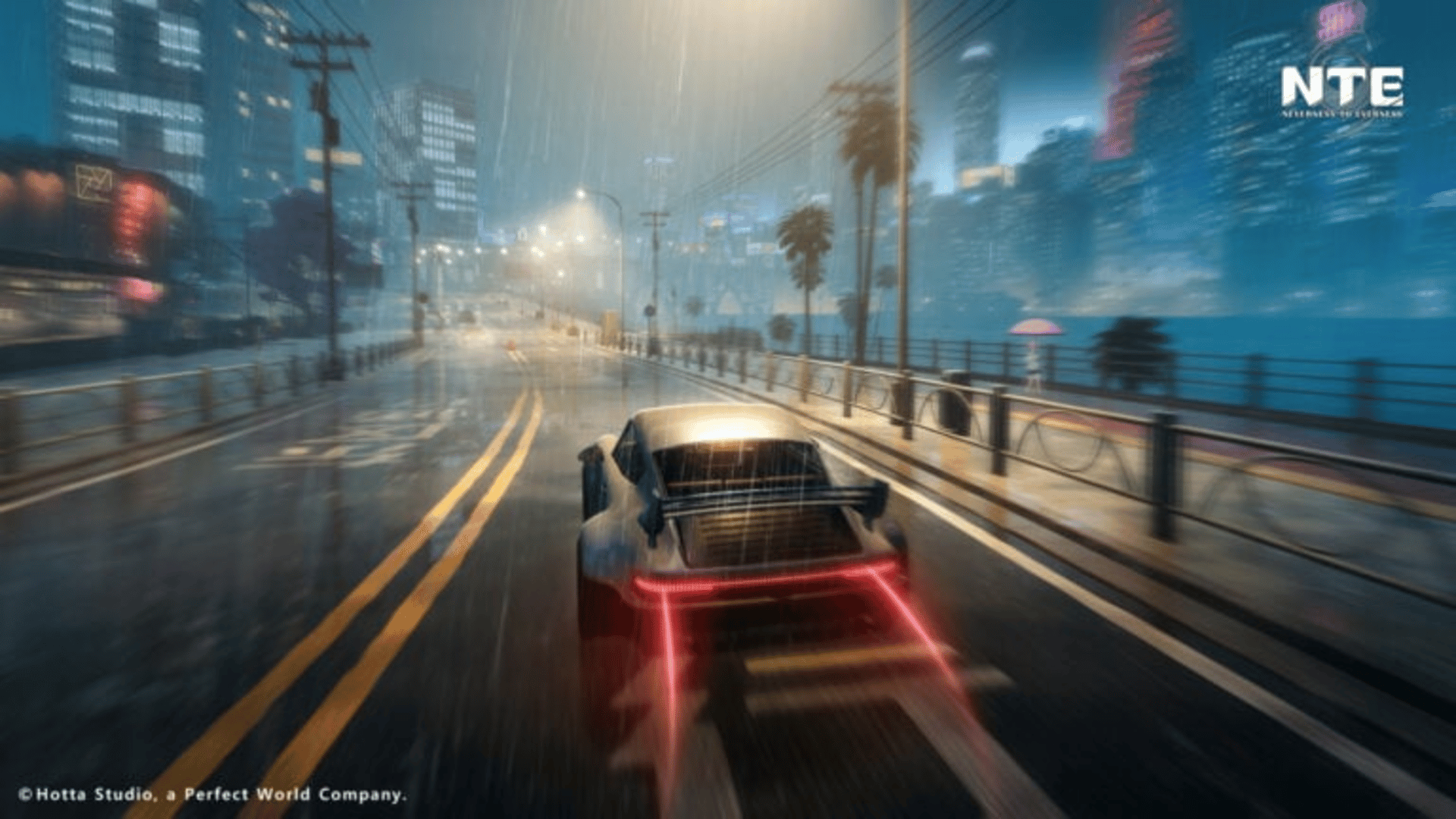
Weather Effects | The weather system affects vehicle handling. Wet or snowy roads reduce grip and increase slide distance during turns, making driving more challenging in adverse conditions. |
Radio Station | All vehicles feature an adjustable radio station, letting players listen to the game's soundtrack while driving. The radio evokes the feel of late-night cruising through the city. |
Vehicle Damage | Vehicles sustain visible damage as they take hits. Body panels dent, windows crack, tires can pop, and severely damaged vehicles may eventually break down or explode. Causing vehicular destruction adds to the player's wanted level. |
Horn and Eject | Players can honk the vehicle horn to alert NPCs and other players. A dedicated eject button allows the player to jump out of a moving vehicle mid-ride. |
Street Racing
Requisitioned vehicles can be used for impromptu driving, but organized street racing requires the player's own vehicle. Street racing is a multiplayer activity where players compete against friends or racing crews in different city districts. Races include delivery missions at high speed and head-to-head competitions in dedicated racing lobbies.
The drifting mechanic plays a central role in competitive racing. Mastering drifts on Hethereau's tight corners and rain-slicked roads is essential for winning races. Different weather conditions affect the track surface, meaning the same race route can feel very different depending on whether it is dry, raining, or snowing.
Vehicle Destruction
Requisitioned vehicles can be damaged and eventually destroyed through collisions, combat, or reckless driving. Causing vehicular destruction in the city adds to the player's wanted level, compounding the consequences if the vehicle was already forcibly requisitioned.
The game has a realistic vehicle damage model where body panels dent, windows crack, and components visually degrade as the vehicle takes punishment. At severe damage levels, vehicles may catch fire and eventually explode. Players are ejected from a vehicle before it is fully destroyed, preventing instant death but leaving the player exposed and on foot.
Tips
Always try the badge flash first. Most NPCs comply, and it avoids any wanted level increase.
If you need a vehicle quickly during a chase or mission, forcible requisition is faster but be prepared to deal with the police response.
Requisitioned vehicles cannot be customized or kept. Use your own vehicles from the garage for long-term use and street racing.
Evading the police after a forcible requisition is a fun challenge, but getting caught means time in the detention center and a fine.
Look for sports cars in wealthier districts if you need a fast getaway vehicle. Sedans are more common but slower.
Bail is available as an early release option if you do not want to play through the detention center activities.
Getting captured at least once is worth it for the unique prison outfit cosmetic and the opportunity to explore the detention center's activities.
Watch the weather before committing to a high-speed chase. Rain and snow reduce traction and make escaping police significantly harder.
If your wanted level hits three stars and drones appear, find cover immediately. Drone bombs deal heavy damage and can destroy a vehicle in seconds.