

This article is incomplete
Some sections are missing or need additional details. Help improve it by contributing.
KYORA is a 2D side-scroller, so gravity shapes almost every movement decision. The developers call gravity a humble but core part of the gameplay and give verticality the same weight, which is why a large share of development effort goes into movement systems and the options built on top of them. Traversal sits alongside the digging, crafting, and combat covered on the Gameplay page, and it applies across the whole procedurally generated world, which is divided into distinct biomes.
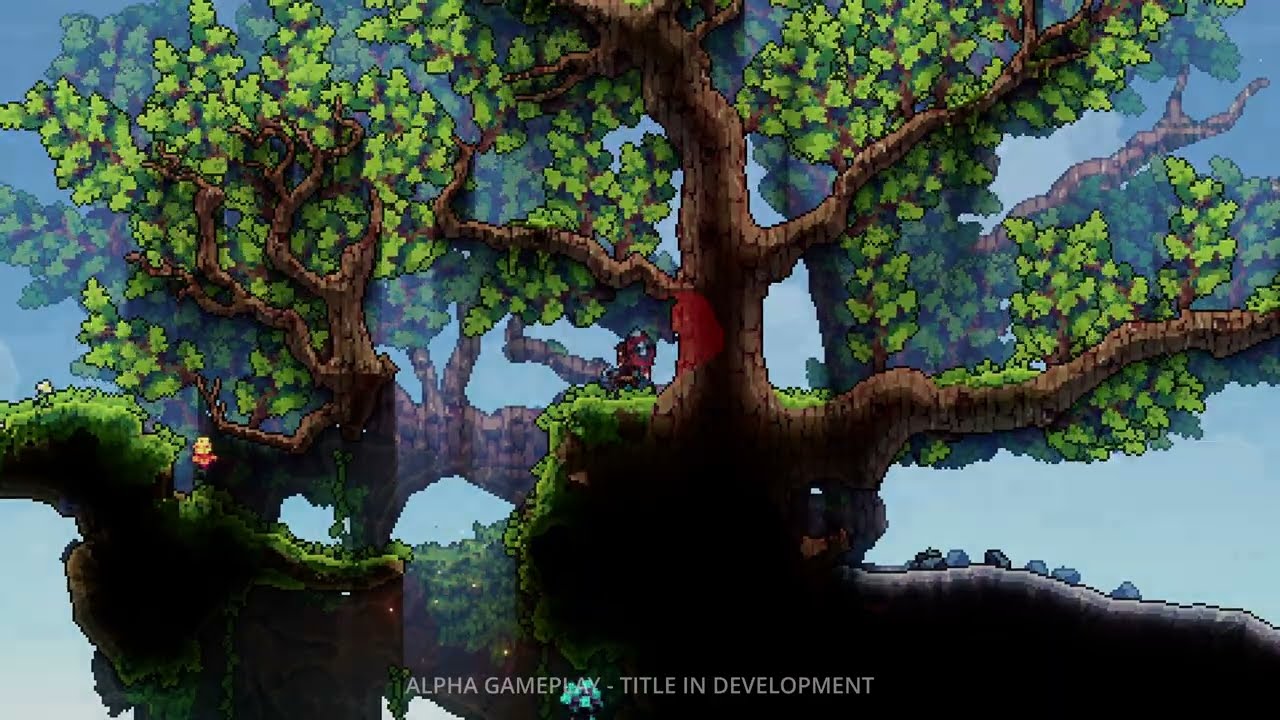
Everything described here was shown as experimental alpha footage from a title still in development. The developers labelled the features completely experimental at that stage, so treat the behaviour below as what has been demonstrated rather than as finished design.
Controlled and Uncontrolled Movement
The team frames movement as two broad modes, and the difference between them drives how the rest of the traversal toolkit is designed.
Mode | What It Feels Like | Examples |
|---|---|---|
Controlled | The player is in sync with the character, and satisfaction comes from skillful play. | Running through a cave, jumping a gap and landing exactly where intended, stepping between two attacks and avoiding both at once. |
Uncontrolled | Input is taken away and physics takes over. The team calls this tumble mode. | Being launched by an explosion into a tumble that blocks all input until recovery, or stepping into an unseen hole and dropping into the dark. |
Uncontrolled movement is deliberate rather than a failure state. The team treats the loss of control as the canvas for chaotic physics moments, which means the surrounding systems have to interact through physics and produce situations the player never planned for.
Controlled movement matters in combat too. The example the developers give of skillful play is slipping between two attacks and avoiding both, and fights against the Heralds are described as tests of reflexes and preparation, so positioning carries weight there alongside the wands a player brings.
Climbing Back Up
Descending is much easier than ascending in KYORA, so tumbling out of reach of something worth having is an expected part of play. Many games solve the return trip with checkpoints, teleportation, and rope and tunnel systems, and the team has said KYORA will have some of those options. Ropes in particular were listed among the technically difficult systems under active development in early 2026.
The stated goal is to supply enough tools that players are not forced to paint staircases across the world just to get back up, though sculpting a staircase out of the terrain remains a valid approach for anyone who prefers it.
The Glider
The developers have said that at points in KYORA players have to navigate airspace if they want to progress, which means crossing open air rather than digging through it. The traversal answer shown so far is a glider built in the style of a Da Vinci sketch.
The flight model is more detailed than a 2D side-scroller usually needs. The developers describe it as a fairly realistic, energy-conserving model that simulates lift based on angle of attack, induced drag, offset chord angles, and aerodynamic stalls. The reason given for that level of simulation is feel: those components are what sell the sensation of flight rather than just its appearance.
Gust Beetles
Gust Beetles are small clouds of critters that push a player upward through the air. They pair with the glider, giving a way to gain height in flight instead of relying on terrain. Players can also place them deliberately, and the developers demonstrated stacking a line of them into an improvised elevator.
Slingshrooms
Slingshrooms cover the moments where a player has to reach something high and cannot get there any other way. The developers describe a slingshroom as a throwable that throws you: the player holds to charge it, then on release is flung forward into an uncontrolled tumble. It gains height quickly at the cost of precision, which puts it firmly on the uncontrolled side of the movement model.
Traversal Tools at a Glance
Tool | Role | Control | Status |
|---|---|---|---|
Glider | Crossing open air and covering distance from height | Controlled, using a simulated flight model | Experimental, shown in alpha footage |
Gust Beetles | Gaining height in the air, or stacked into an improvised elevator | Controlled once positioned | Experimental, shown in alpha footage |
Slingshrooms | A quick burst of height or distance from a standing start | Uncontrolled, ends in a tumble | Experimental, shown in alpha footage |
Development Status
Every traversal feature above comes from a single development update published in July 2026, and each clip carried the same caveat: the footage is experimental alpha gameplay from a title in development, and the visuals are work in progress. No stats, crafting requirements, unlock conditions, or durability values have been published for the glider, Gust Beetles, or slingshrooms, and there is no confirmation that each one will ship in the Early Access build.