

This article is a stub
It lacks sufficient information and needs to be expanded. You can help by adding more content.
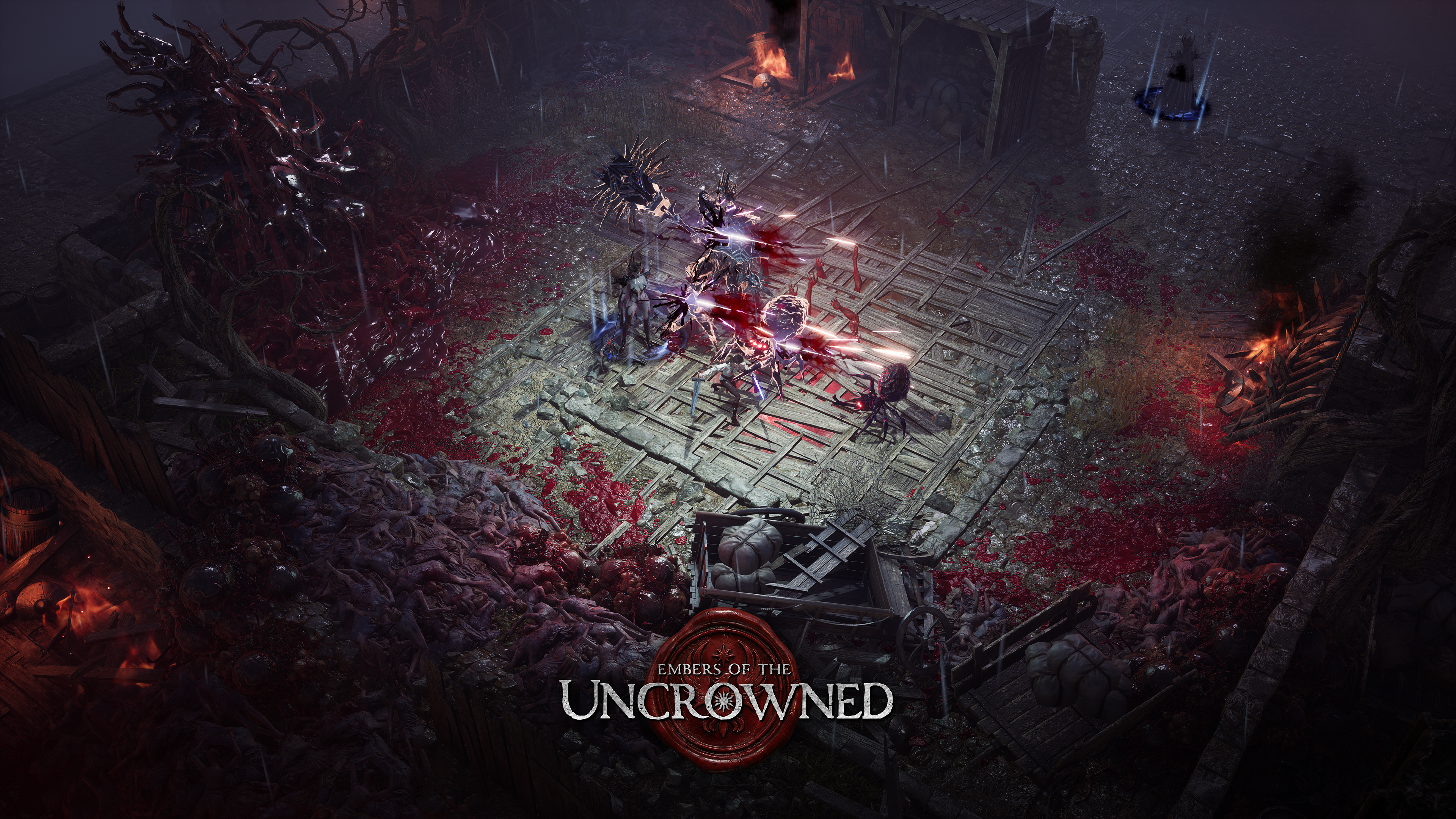
Combat in Embers of the Uncrowned is a fast-paced, skill-based isometric system designed around reading enemy intent and answering it with timely inputs rather than out-stat checking the encounter. Fights are presented from an overhead angle that keeps every threat on screen, and the visual language leans hard into a brutal, gory dark fantasy aesthetic. Hits feel weighty, finishers are violent, and even routine encounters stage their telegraphs in a way that asks the player to pay attention rather than mash.
Three named mechanics form the spine of the combat model and surface together in any meaningful encounter. Spell Interruption rewards reactions, the Stagger System rewards sustained pressure, and SP-based evasion governs how often the player can dodge lethal attacks. Together they describe a combat loop where the player chooses, every second, between offense and survival.
Core Mechanics
Mechanic | Role | When It Triggers | Why It Matters |
|---|---|---|---|
Spell Interruption | Reactive defense | When a boss begins a wind-up animation for a devastating skill | A correctly timed interrupt cancels the skill outright, denying massive damage and creating a pressure window for the group. |
Stagger System | Offensive pressure tracker | Builds up across an encounter as the team applies coordinated damage and key inputs | Once an enemy enters a staggered state, a limited window opens for burst damage. Coordinating cooldowns with this window is how hard content gets cleared on time. |
SP-Based Evasion | Finite mobility resource | Whenever the player needs to dodge an unblockable, lethal, or area-denial attack | SP is not infinite, so positioning and movement discipline matter more than panic-rolling. Burning SP early in a fight leaves nothing for the dangerous phase later on. |
No Auto-Combat
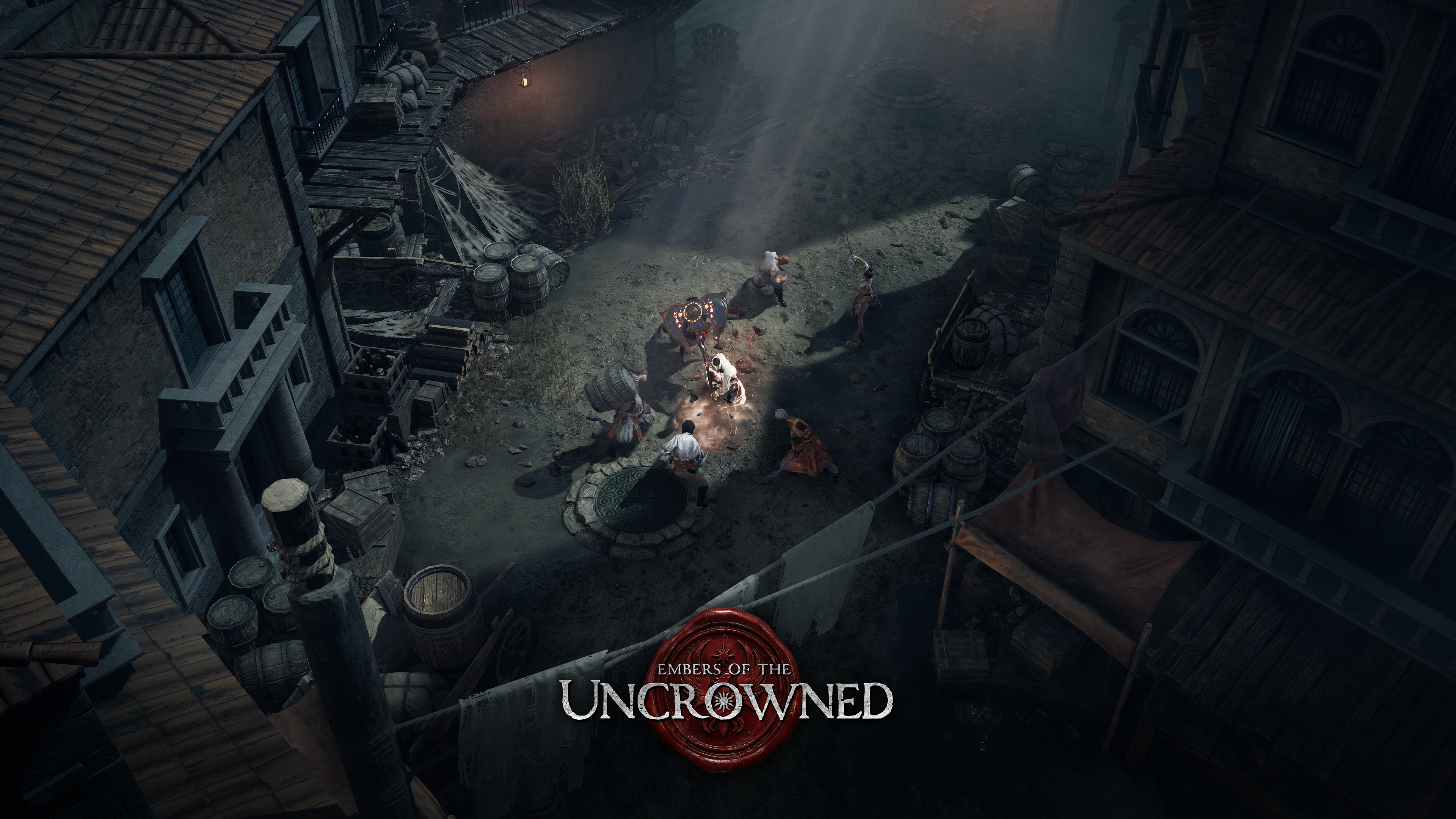
The dev team has stated explicitly: Embers of the Uncrowned does not support auto-combat. Every interrupt, every Stagger window detonation, every evade is the player's input, not a queued autoplay action. The team's reasoning is that the true thrill of combat comes from split-second decisions and precise timing, something only the player's own hands can deliver. Every per-class resource system, including Rage and Fury, Shade and Phantoms, and Aeroenergy and Overload, is built around active player control.
Spell Interruption
Devastating boss skills are designed to be telegraphed before they fire. The Spell Interruption layer rewards players who recognize those telegraphs and break the cast before damage lands. It is not a fixed timer or a shared cooldown: every encounter teaches its own set of interrupt-able patterns, and the choice of when to spend an interrupt window is part of the encounter's rhythm.
In raids and Domain Boss fights, interrupts go from a solo reflex to an assigned duty, with specific players holding responsibility for specific casts. In solo content they remain the player's own responsibility, but the same logic applies: the cast you let through is the cast that hits you. What this teaches is patience and pattern recognition. Players who memorize boss tells, identify which casts are interruptible, and assign interrupt duty inside the party will outperform players who are simply doing more raw damage.
In the demo build this is surfaced through clear UI cues. While a boss prepares a powerful skill, a purple gauge fills at the bottom of the monster information panel. Striking the boss with a skill that carries the Interrupt tag, marked by a purple diamond icon, within the time limit stops the skill from activating and also greatly reduces the boss's Stagger gauge.
The Stagger System
Sustained pressure on an enemy fills a stagger meter. When the meter breaks, the target enters a brief stagger state and the player has a limited burst window to deliver concentrated damage. The Stagger System is the game's pacing tool: it gives sustained pressure builds something to aim at, and rewards coordinated parties for stacking damage on a single window rather than spreading it thin.
Per-class systems are tuned around stagger windows. Executioner Fury, Spectral Blade Shade-burns, and Stormbringer Overload detonations are all designed to drop inside a fresh stagger window for maximum effect. What this teaches is rhythm and coordination: solo, the lesson is to save big cooldowns for the stagger window instead of dumping them on cooldown; in a group, the lesson is communication.
SP Evasion
Evasion costs SP, a limited resource the player must manage. Dodging a single lethal attack is cheap; chaining dodges drains SP quickly and leaves the player vulnerable until it recovers. The system pushes the player to recognize which attacks must be evaded and which can be tanked or sidestepped without spending SP.
The SP economy interacts with positioning and the per-class kits. A class with high natural mobility (Spectral Blade Stealth) can stretch SP further; the Executioner is built to take some hits in exchange for Rage, and the Stormbringer trades evasion for area control. What this teaches is discipline. Spamming dodges through the early portion of an encounter leaves the player out of SP exactly when the lethal attacks start landing.
Controls and Input
The game is played with mouse and keyboard or an Xbox controller, and it is optimized for keyboard and mouse. Controller support is partial and in beta: some functions such as chat still require a keyboard, and in the demo build controller bindings were fixed and could not be remapped. The game auto-detects whether keyboard/mouse or a gamepad is in use and switches control mode accordingly, with gamepad mode splitting into a character-control state and a menu-navigation state.
The default keyboard controls confirmed for the demo are below. Hotkeys can be combined with Ctrl, Shift, and Alt in Settings, though certain keys cannot be changed.
Action | Key |
|---|---|
Move (forward / back / left / right) | W / S / A / D |
Basic Attack | Left-click |
Rotate Camera | Right-click (or Left / Right arrow keys) |
Zoom In / Out | Up / Down arrow keys |
Evade | Space Bar |
Active Skill Slots 1 to 5 | Q, E, R, T, F |
Bloodline Skill | V |
Use HP Potion | 1 |
Use MP Potion | 2 |
Because the game has no auto-combat, every input is the player's own; the choice of keyboard and mouse or a controller is about feel rather than access to any combat layer. The studio has invited feedback on controller handling during the Steam Next Fest demo, so pad behavior may change before launch.
Recovery Potions
The player carries HP and MP recovery potions. Potions are refilled by resting at a Monument of Life, which is found in the House Settlement and across the continent. Defeating monsters also has a chance to replenish potions, and the stronger the monster, the higher the chance. Potions can additionally be replenished by using the Bloodline Skill or by destroying Elven Stakes left by the elven invaders.
Perfect Dodge
Pressing the Space Bar moves the character a set distance in the direction they face and grants brief immunity to attacks. Evading an enemy attack at the right moment counts as a Perfect Dodge. Evasion draws on the SP gauge, which is divided into multiple segments that recharge automatically over time. Each evasive move consumes a segment, so the SP economy described below is about banking segments for the moments that matter.
Per-Class Resource Systems
Each of the three confirmed classes layers its own resource system on top of the shared verbs above.
Class | Resource | How It Works |
|---|---|---|
Rage and Fury | Rage builds by striking and downing enemies. When enough is stored, dealing damage triggers Fury, a brief explosive state that spikes tempo and unlocks devastating skill chains. | |
Shade and Phantoms | Shade stacks through certain skills, then spends on empowered finishers or joint attacks with Phantom clones. Stealth and Rear Strike maximize per-Shade damage. | |
Aeroenergy (Wind) or Overload (Lightning) | Wind path uses Aeroenergy for instant recasts and Resonance debuff stacks. Lightning path stacks Overload through Lightning skills and detonates with Lightning Volley or Blade Storm. |
How Classes Use Combat
Each class engages the same combat pillars but expresses them through a different range and rhythm. None is mechanically simpler than the others; they are different lenses on the same model.
Class | Combat Identity | How It Engages the Pillars |
|---|---|---|
Agile melee duelist with Phantoms and Stealth | Fast, precise dual-blade work rewards constant repositioning. Tight footwork makes SP Evasion last longer, and Shade-fueled Phantom combos help fill the stagger track between dodges. Stealth-based ambushes align naturally with Stagger windows. | |
Heavy axe vanguard | Single crushing blows are well suited to stagger windows, where one large hit converts into massive burst. Rage-into-Fury is the class's primary stagger detonator. The trade-off is that heavy swings leave less room for casual mobility, so SP discipline is non-negotiable. | |
Vanguard mid-range mage | Wind and lightning casting keeps pressure on staggered targets from outside melee range. Aeroenergy's instant recasts pair with Spell Interruption duty, and Overload detonations are designed to land inside Stagger windows. |
Builds within each class are shaped by Skill Gems, and equipment scaling is handled through Gear Enhancement. Late-game characters layer Bloodline Awakening on top, awakening an ancient bloodline power that becomes another lever the player can pull during a fight.
Isometric Perspective
Combat is presented from an isometric perspective. The camera rotates and zooms within limits, but it stays overhead rather than dropping behind the character, and that angle keeps every enemy, hazard, and ground telegraph on screen at once. The trade-off is that traditional first-person and third-person reactive tools (precise camera control, parry timings tied to a forward-facing model) are replaced by spatial reading: where the player stands relative to ground hazards, friendly Phantoms, Stagger windows, and SP-cost evasion routes is what wins encounters.
The brutal dark fantasy presentation extends into the camera. Even routine encounters stage their telegraphs through environmental cues, blood effects, and Bella-style silver corrosion overlays that warn the player while staying inside the visual identity of the world.
Combat in Group Content
The three pillars become non-negotiable once the player enters structured group content. Domain Bosses are co-op encounters tied to liberating territory, and they are designed to test interrupt timing, stagger coordination, and SP economy as a unit rather than as solo play with extra targets. Raids push that demand further, with the developers describing the format as requiring perfect cooperation and flawless tactics from a larger group.
In practical terms, group content means assigning roles within the combat model itself. One or two players take responsibility for interrupts on critical casts, the group banks burst cooldowns for the stagger window, and every member is expected to manage their own SP pool so that no one runs out of evasion right when the boss telegraphs its hardest hit. The most demanding tests are the Domain Bosses and Raids; Bella's demo fight is the dev team's first tuning of these verbs against a named boss, presented as a teaching encounter that hands the player the full combat vocabulary.
Group and Multiplayer Content
The demo confirmed a layered set of multiplayer activities where the combat model is tested against tougher targets. Parties can also form in regular fields to take on challenging regions together.
Activity | Format | Notes |
|---|---|---|
Open-world co-op | Multiple players join forces to defeat the powerful final boss of each Domain. The pillar of Region Liberation. | |
Dungeon (Dynasty's Tomb) | Co-op, up to 3 players | A single complete run from entry to the final boss. Three difficulties (Easy, Normal, Hard), each with its own level and Combat Power thresholds. A Spoils Chest appears after the final boss, opened with a difficulty-tied Key that replenishes daily. |
Defense of the Spring | World event | Occurs periodically at set locations in Amber Coast and Towerstead. The goal is to defend the Aether Tree from waves of enemies and back-to-back boss fights. Any nearby player can join, and clearing more waves grants greater rewards; contribution-based rankings appear at the end. |
Arena | 2v2 PvP | Unlocks after the quest The Final Battle (entry into Towerstead). Combat Power is partially adjusted so growth differences matter less. First team to 10 points, or the most points within the time limit, wins. A 3-point lead Crowns the top contributor and places a bounty: eliminating the Crowned player awards the enemy team 3 points. |
Field Events and Exploration
Beyond the main story, the open field hosts smaller encounters that reward exploration:
Golden Bogart: a monster that carries stolen treasure on its back. It flees, and if you linger too long it sets off a smoke bomb and vanishes. Defeating it before it escapes yields generous rewards, including Gear enhancement materials and Skill Gems.
Abyss Cocoon: a vicious cocoon that hatches monsters in contaminated areas. Destroy the wave that pours out to earn Costume Coins, elixir crafting materials, and Skill Gems.
Buff Shrines: shrines scattered through the fields that grant powerful buffs to make battles easier.
Elven Assassins: groups of assassins sent to hunt the last of House Harborwell. They roam the paths and pursue the player relentlessly.
Repeatable Challenges round out the content. They can be opened with the ESC key or the menu button in the bottom-right corner, under the Challenges tab, and reward materials for completing objectives through normal play.
Balance Changes During the Demo
The combat model did not stay fixed across the demo week. Feedback arrived faster than NEXON expected and a maintenance on June 19 shipped a live tuning pass, so anyone comparing footage from the first days of the demo against the last days is looking at two different games.
Change | Effect |
|---|---|
Evasion and basic attack timing | Speed and delay values were adjusted across all three classes to improve overall responsiveness. |
SP recovery raised | SP regeneration was increased specifically to match the faster evasion, keeping the evade economy from tightening as a side effect of the speed-up. |
Evade zoom-in removed | The sudden camera zoom on dodge was removed for the Executioner and Spectral Blade. Zoom effects on other skills remain adjustable under Settings, Environment, Graphics Quality, Skill Effect. |
Camera field of view widened | The default field of view was opened up, and a camera rotation-speed slider was added under Settings, Controls. The slider could not be adjusted with a controller. |
Bloodline expansion | Three new Bloodlines were added, one at each Bloodline level, with a reset offered so players could explore the new build paths. |
Talent points on sale | The Trading Post merchant began offering extra Talent points. NEXON called this a temporary demo-only concession and said the offering will be adjusted for the full release. |
NEXON described the original pacing as deliberate rather than accidental: evasion and attack timing had been built with room in them so that one-on-one boss fights and PvP would reward precision. In practice, that room read as sluggishness, and the team said so plainly before changing it.
Planned Improvements for Launch
After the Steam Next Fest demo, the development team published the changes it is working on for the full release in response to player feedback. The three areas singled out as the top priority were the camera, the controls, and the UI. These are stated as planned improvements for launch rather than features present in the demo build.
For the camera, the team plans a rotation speed slider and a hold-to-rotate input mode, an expanded maximum zoom-out range so large bosses fit fully on screen, a pitch tuned closer to top-down for a more appropriate isometric field of view, and a character position that sits slightly above center at maximum zoom to open up forward visibility. The sudden zoom-in on dodge for the Executioner and Spectral Blade is also slated to be fixed, with a temporary workaround through the Skill Effects graphics setting in the meantime.
For controls, the team plans sharper input response for dodging and mouse clicks, free swapping of the left and right mouse buttons for movement and attack, broader rebinding support across the board including the dodge key, and full controller support covering UI and map navigation plus complete controller remapping. For the UI, the team plans a full review of the HUD and menus to rework the layout, icons, information hierarchy, and menu structure, and to surface essential combat information such as cast bars more clearly.
A later update sharpened that camera position. NEXON confirmed it had considered a full camera-perspective overhaul during the demo and rejected it, because the level design and systems as built could not absorb a change of that scale at that stage. Camera is now stated as the single top development priority, and two specific solutions are under review: a traditional isometric view camera, and a rotation scheme that does not interfere with combat. The team said further details would follow once the plans are finalized.
On controls, the commitment also grew firmer. The earlier note promised full controller navigation of menus and the map; a later one committed to controller-only play at official launch, meaning a player will not need a keyboard and mouse at all. Broader keyboard customization was named alongside it.
In August 2026 the team published the follow-up it had promised, and it narrows what the camera work actually involves. The stated aim is that the camera should never leave a player stuck behind terrain or scenery during a fight, so the objects and terrain that used to sit between the camera and the action are being cut back, and the underlying system is being rebuilt so the view stops shifting on its own mid-combat. Rotation is being kept rather than removed; what changes is how it is driven. The default rotation input moves to the keyboard, with a choice of mouse or keyboard exposed in the Options menu, and the bug that let the cursor drift during a rotation and fire clicks the player never intended has been fixed, so the cursor now holds its position. None of this settles which of the two camera schemes under review will ship.
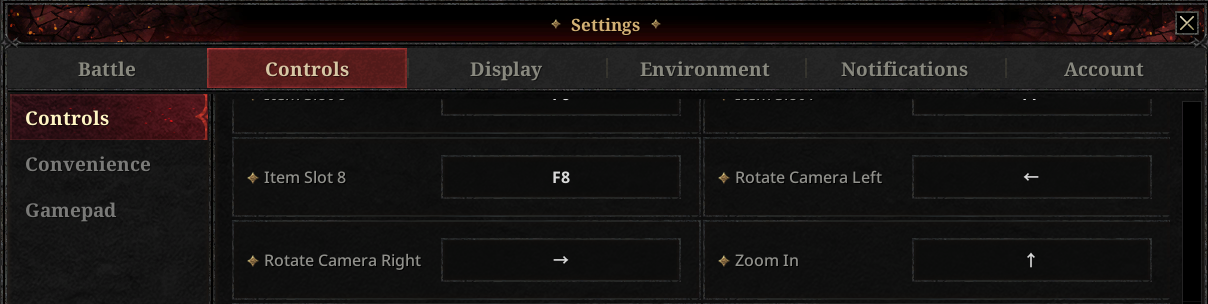
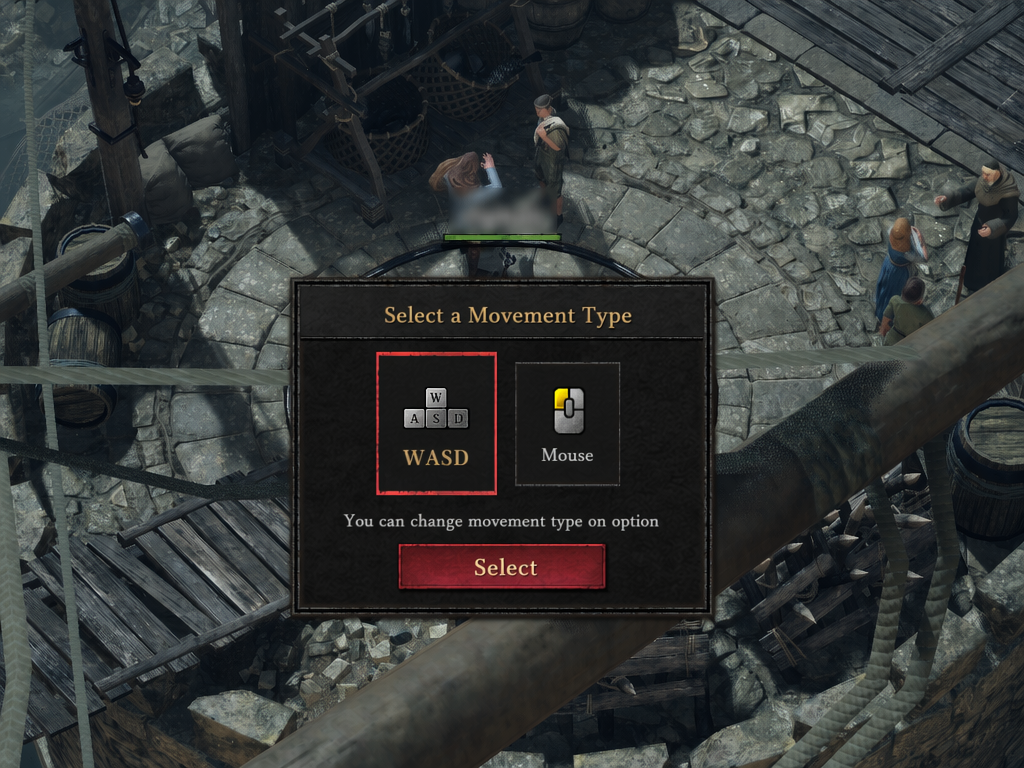
The same note covered controls. Movement gains the same freedom as rotation, with an option to move by mouse or by keyboard. Control settings are stored against the player account, so they follow the player to another PC, and switching between input methods no longer produces the misinputs that sudden cursor jumps used to cause. If a gamepad drops out mid-session, control passes straight to the keyboard rather than interrupting play. Dodge and dash were singled out for faster response, with the transition between basic attacks and dodges described as smoother than it was in the demo. Every item in the note carries the studio's standard caveat that the work is unfinished and may change before release.
Status of the Information
The Steam Next Fest demo confirmed the control scheme, the recovery-potion sources, the Perfect Dodge and segmented SP gauge, and the Interrupt-and-Stagger UI. Exact numbers such as SP segment counts per class, cooldown values, stagger thresholds, and full skill rotations have not been published. This page will expand as verified figures appear.
Related
Executioner
Spectral Blade
Domain Bosses
Raids
Bella