

DUST: Origins is played from a fixed isometric perspective with twin-stick controls, and its structure sits somewhere between an action shooter and a survival-horror game. The studio's own description is action horror. Firepower is available but never plentiful, the station is explored rather than funnelled through, and most encounters are meant to be solved with information as much as with a trigger.
The one thing the studio has been most insistent about is what the game is not. It published a short clip specifically to say that this is not a bullet hell. Ammunition is scarce, resources are limited, and the intended response to a room full of hostiles is to think rather than to out-shoot them. That framing shapes almost every system below.
Moment to Moment
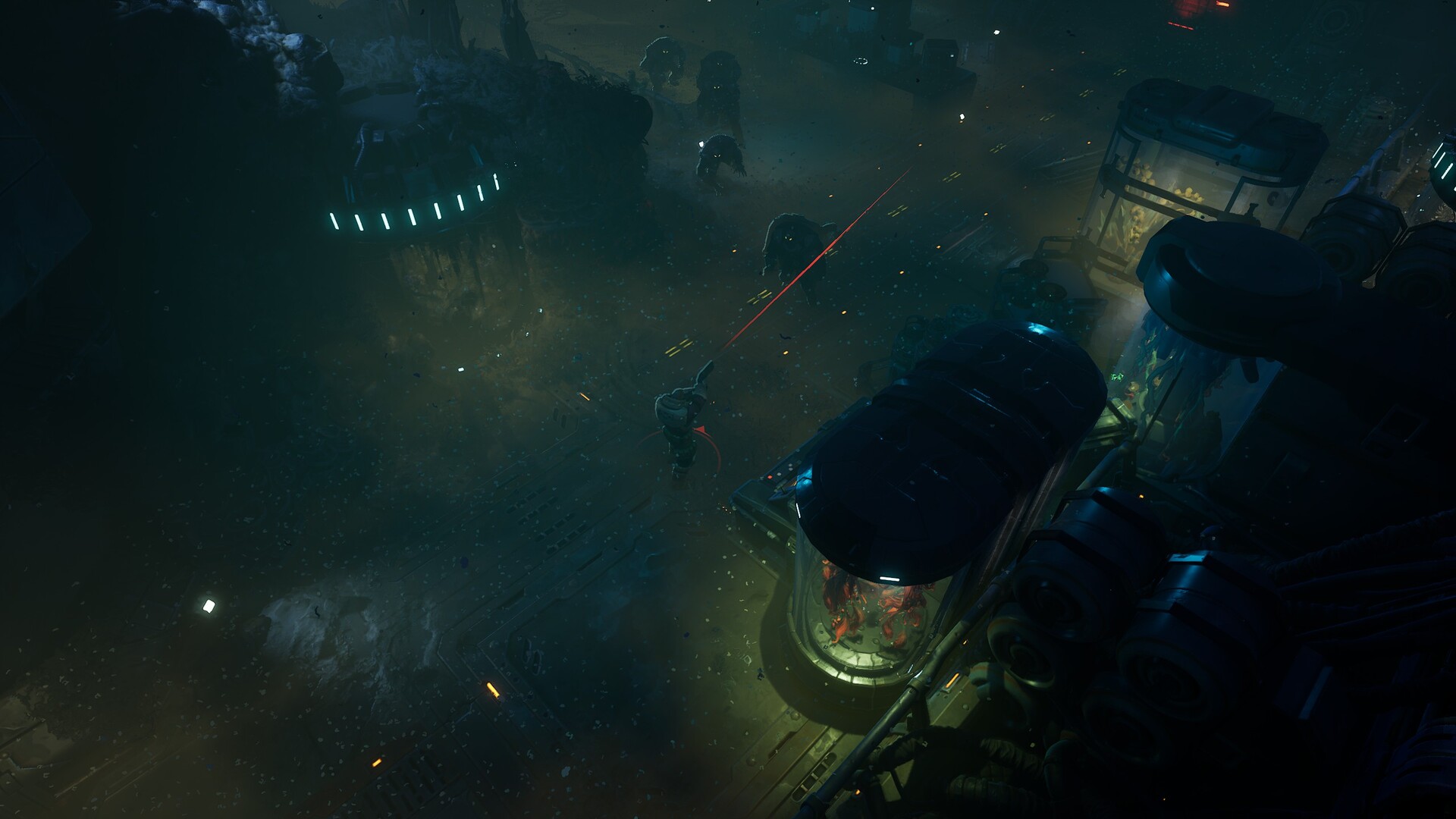
Encounters are built around positioning, ammunition conservation and environmental hazards. The studio describes each one as skillful and tactical for that reason: where you stand, what the room contains and how much you are willing to spend all feed into whether a fight is worth taking. Combat also allows for retreat. One of the studio's own clips frames it as flight to fight, meaning that running is sometimes correct and that a fight avoided now can be taken on better terms later.
Enemies are not uniform. Human threats include violent inmates and guards who have started executing prisoners. Non-human threats are escaped bio-experiments, aggressive and lethal, and the game expects the player to observe their behaviours and exploit their weaknesses rather than trade damage. The studio has also hinted that some creatures are more than they appear, without saying what that means.
Resources and Loadout
The player starts outmatched and outgunned. Early on the entire loadout may amount to a broken shiv and a handful of bullets, and everything after that has to be found. Scavenging is the supply line: ammunition, crafting materials and hidden items are distributed through the station, and the deeper the player goes the better the equipment gets.
Equipment is organised into a custom loadout across three slot types.
Slot | What it covers |
|---|---|
Weapons | Firearms and improvised tools. A flamethrower is confirmed. Exotic weapons also exist as New Game Plus unlocks. |
Armor | Defensive equipment found during exploration. |
Mods | Specialty modifiers that can be equipped into the loadout, some of which are crafted from collected materials. |
Inventory space is limited, so what to carry is a real decision rather than a formality. Capacity upgrades can be found on the station, which eases the pressure without removing it.
Exploration and Progression
Limbo-6 is described as vast, with more than one way to get around. Progression is not signposted, and the studio has said plainly that it does not hold the player's hand. The route forward comes out of three activities: exploring the station itself, talking to the survivors on it, and reading logs stored in the station's central terminal system.
That terminal layer is also a progression gate. Disks are collected, security is hacked, and restricted files are accessed to unlock upgrades and key items. Those items open new areas and make backtracking productive, which suggests the station is built to be re-crossed rather than walked through once. Each sector the player reaches is described as deepening the horrors waiting in it, so the difficulty curve is tied to how far in you are.
Survivors
A handful of other people have woken up on the station, and they are not allies by default. Each has motivations of their own and none of them owes the player anything. Trust is scarce, and the studio has said not to expect a warm welcome.
Talking to survivors is how the player learns about the station, its threats and ways to advance. Some of them offer optional side missions, and completing those can unlock new items and open areas that would otherwise stay shut. Helping a survivor makes them more likely to assist later; refusing or abandoning them can close routes. Playing as a lone wolf and leaving everyone to their fate is explicitly supported, and it changes what the player sees.
Replay Structure
The game is designed to be played more than once. Multiple endings, post-credits epilogues and a set of distinct death outcomes called dead ends all record into an Endings Collection, and each new one unlocks an extra. Those extras and additional difficulty settings are accessed through New Game Plus, so a second run starts from a stronger and stranger position than the first.
Not Yet Confirmed
Whether there is a stealth system, a cover system, or any dedicated non-combat traversal mechanic.
How the twin-stick scheme maps to keyboard and mouse versus controller.
Whether the game has character levels, skill trees or classes. Only permanent stat upgrades from crafting have been described.
How saving works, and whether death has a persistent cost outside of the dead-end system.
Run length, sector count, or whether the station is one continuous space or divided into discrete levels.
Any named enemy, weapon, mod or armour piece beyond the flamethrower.