

Synthesis combines two monsters into a new one. Square Enix describes it as the miraculous process at the center of DRAGON QUEST MONSTERS: The Withered World, and calls it a vital step rather than an optional one, because some monsters cannot be obtained any other way.
The basic rule
Befriend a monster and raise it to level 10. Below that level it cannot be used as a parent.
Pick two parents. The game shows you a selection of possible children.
Choose one. Both parents disappear, leaving the child behind.
The child can end up stronger than either parent, because it has the chance to inherit their Talents. Offspring are usually from the same monster family as one of the two parents, which is what makes family planning worth thinking about before you commit two raised monsters to the process. Families are covered on Monster Families and Ranks, and levels, Talents and Talent Points on Monster Growth and Talents.
Synthesis is not tied to a single facility. Square Enix stated in August 2026 that restoring one of the withered Roots of Creation out in the fields turns that spot into a place where monsters can be healed and where a synthesis can be carried out, on top of serving as a travel point. The restoration system that produces those spots is covered on Story and Setting.
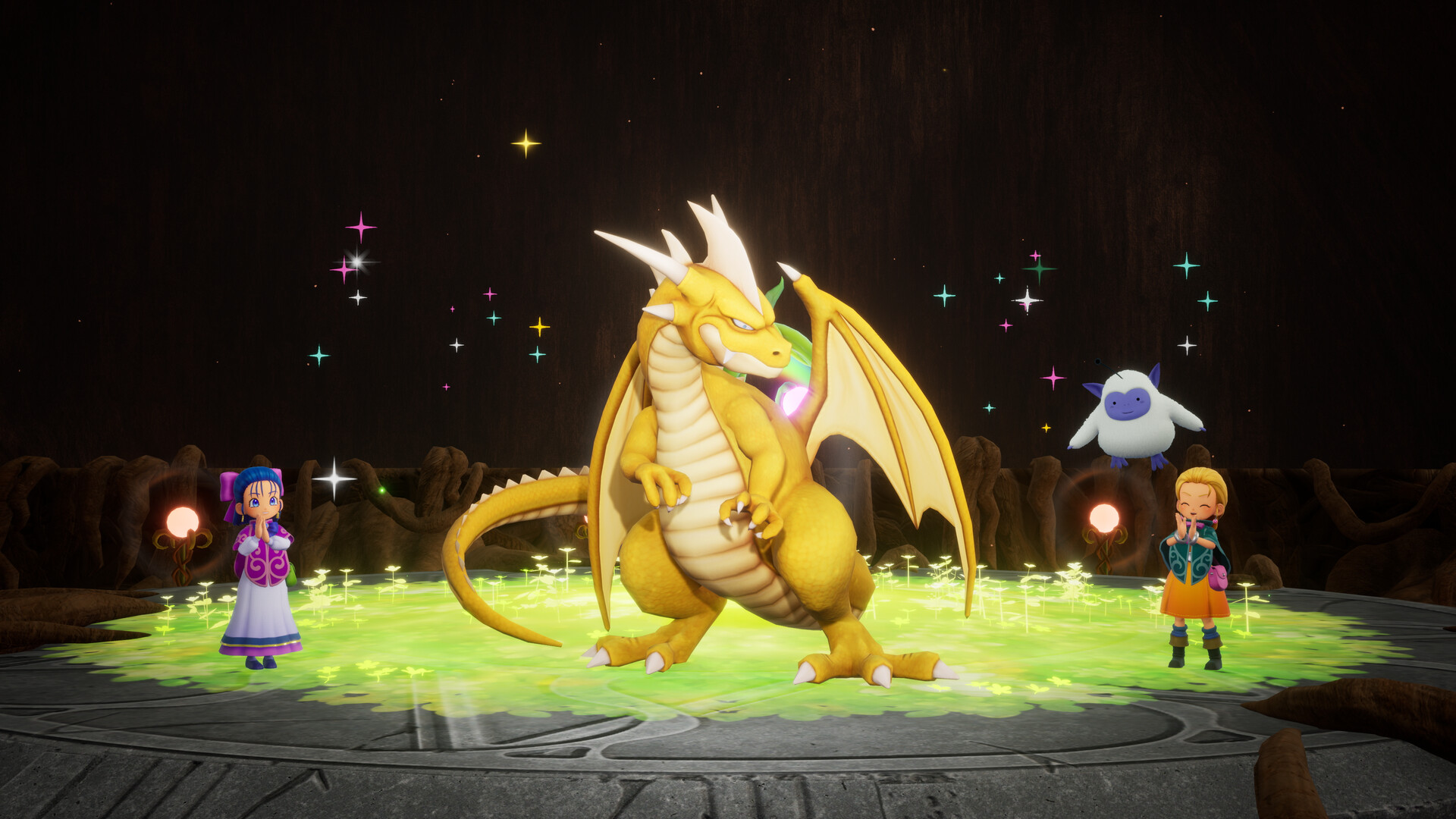
Talent inheritance
A child can inherit its parents' Talents. If you have maxed out the points in a parent's Talent before the synthesis, that Talent may evolve when the child inherits it, which gives a reason to finish a Talent rather than spread points thinly across the three a monster can hold.
Plus Value
Synthesis attaches a numeric attribute called a Plus Value to the resulting monster. Every subsequent synthesis can raise that value, and a high enough Plus Value earns the child a bonus to its base attributes. Pushed far enough, it can do more than that: the child may come out at a higher rank than either parent.
The game signals the opportunity rather than hiding it. When a parent monster carries a large Plus Value, a plus symbol appears on some of the synthesis options to flag that the child may outrank its parents.
Special synthesis
Some specific combinations produce unexpected offspring, including monsters that cannot be befriended any other way. A starry icon on a synthesis candidate marks it as the product of special synthesis.
Four-monster synthesis
A subset of the special patterns works across two generations. Four different monsters act as grandparents, paired into two couples. You then choose from the offspring those pairings can produce to serve as the parents, and that pair produces the final child. The grandparent combination is what fixes the result: whichever species the chosen parents turn out to be, the same child comes out at the end.
Published examples
Square Enix has published four worked examples. They are the only synthesis recipes that exist for this game so far, and they are illustrations of the rules rather than the beginning of a recipe list. Recipes from earlier games in the series do not carry over, because the series reworks its synthesis tables every entry.
Example | Combination | What it demonstrates |
|---|---|---|
1 | mud mannequin (material family) with jumping jackal (beast family) produces escudogre (material family) | Ordinary two-parent synthesis, with the child taking a parent's family |
2 | mud mannequin at rank G with jumping jackal at rank E produces well wisher at rank D | A high Plus Value producing a child that outranks both parents |
3 | stump chump with bad egg produces mitey oak | Special synthesis, flagged by the starry icon |
4 | Magmalice with Firn Fiend, and Golem with Coralossus, as four grandparents; the chosen offspring become the parents and produce Balhib | Four-monster synthesis |
What is not published
There is no synthesis chart, no family combination table, and no list of special patterns beyond the four examples above. Anything presenting itself as a fuller recipe list before launch is drawn from a different game.