

Warlock: Dungeons & Dragons is a single-player, third-person action-adventure. The player directs Kaatri in real time through an open world, casting spells, swinging summoned melee weapons and picking apart problems that the game rarely explains. The structural idea underneath all of it is that there is one toolset, not two: the spells used to win a fight are the same spells used to cross a chasm, drain a room of gas or work out where a missing person went.
One Toolset, Three Jobs
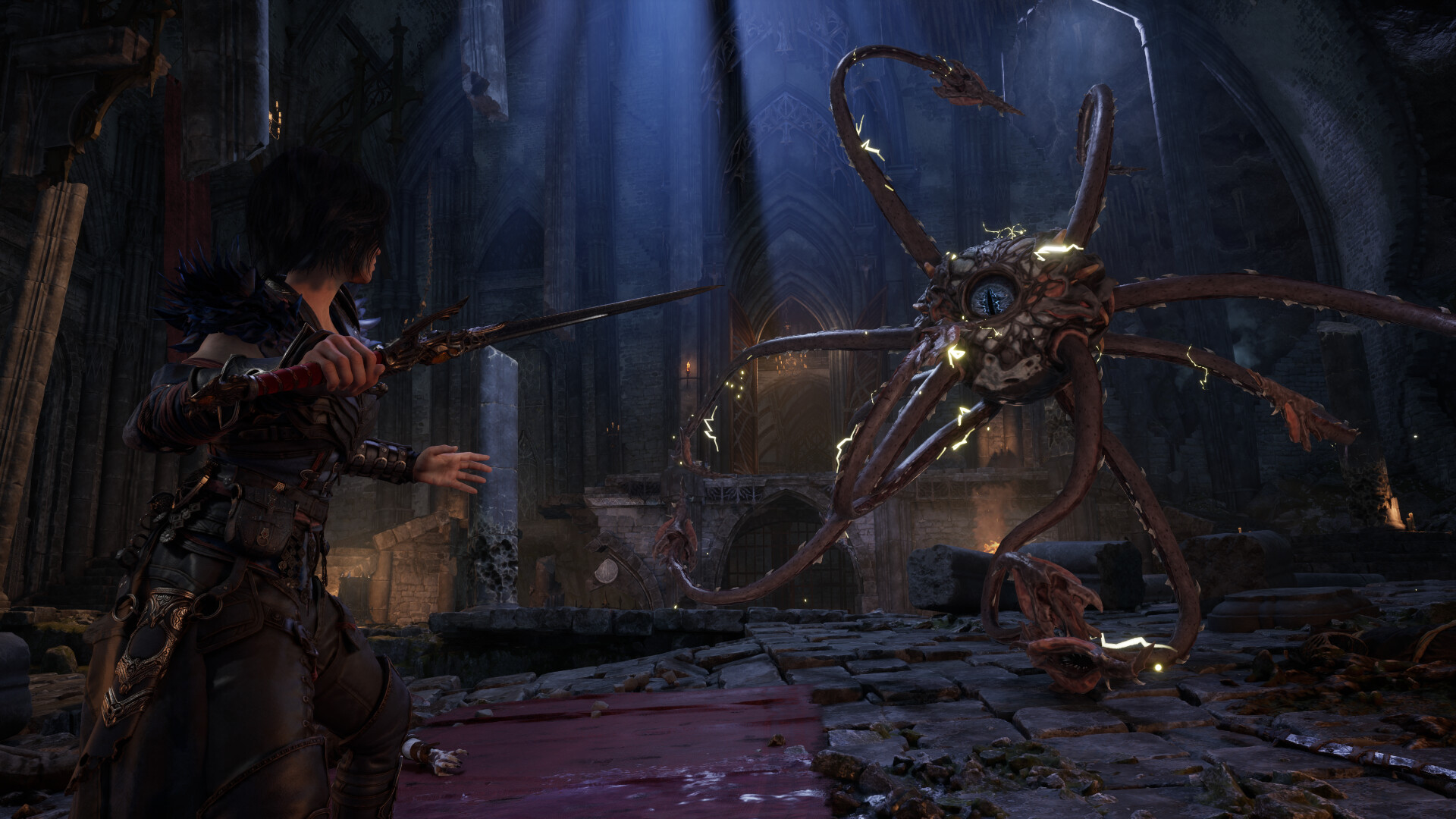
Every published spell has been written to serve combat, traversal and puzzle-solving at once. Gust of Wind pushes an enemy off balance, and it also fans flames and disperses gas. Levitate suspends a monster in mid air, and it also lifts a crate whose weight no longer applies. Black Tentacles pins whatever walks into them, and it also forms something to cross on. Misty Step dodges an attack, and it also passes through a barred grate. The full list is documented on Spells.
Developers have said that when a spell is designed they deliberately ask how it can be used in more than one way, that combat is only the obvious answer, and that avoiding a fight entirely is a perfectly good use of a spell. That has a practical consequence: spells can be used more freely when not in combat, and the whole kit stays available while exploring rather than being gated behind an encounter.
Progression Is the Spell List
Character progression is centred on magic. New spells are found out in the world rather than handed over on a level-up screen, and the studio head has said plainly that players will have to work for them and explore to get them. There is also an upgrade layer: spells can be improved, and one developer noted that the game carries several distinct variants of Eldritch Blast rather than a single fixed version of it.
Players are eased in rather than handed everything at once. The studio has described the number of spells and the number of things a player can do as ramping deliberately, which is part of why the interface can afford to stay quiet.
Guidance and the Interface
The build shown to press had no quest markers. The heads-up display is minimal and can be toggled on and off in the settings, and the studio head has described the approach as going easy on the hand-holding in order to keep the game immersive. He also noted that some interface elements were switched off entirely for the demo so that the footage would not overwhelm viewers, and that a few will be added back for release.
Guidance that does exist is coarse by design. The example the studio gives is that if the objective were to find a specific person at a convention, the map would highlight the general area they are in and give the player a compass, rather than pin the exact spot. Working out the rest is the player's job. See Exploration for how that shapes moving through the world.
Combat in Brief
Fights are real-time and mix casting with melee. The pattern the developers describe as optimal is to open with magic that puts a monster at a disadvantage and then convert that opening with a weapon, and they expect nearly every player to mix the two even though a magic-heavy run is possible. Kaatri can summon otherworldly melee weapons, each described as carrying its own power and tactical value. The Combat page covers this in full.
Structure and Length
The campaign is story-driven and follows Kaatri's search for a person who matters to her. Side content is described as world-based rather than listed: the player stumbles onto it while going somewhere else, rather than collecting it from a board. The studio head has said the open world takes tens of hours to explore and has explicitly declined the hundred-hour framing, so the intended shape is a substantial but bounded single-player game rather than an endless one.
Playing a Character, Not an Avatar
Kaatri is a written character with fixed limits. The studio head has said she has a written morality, and gave the concrete example that the player cannot walk into a village and start killing people, because it would not make sense for her. That places the game closer to a directed action-adventure than to an open-ended sandbox, whatever the size of the map.
Design Intent
The team has described the reason it chose a warlock at all: it wanted a magic user because creative magic use was the core of what it wanted in gameplay, and the warlock was the class that fit. The studio has also said it seeded the game with deep-cut references for players who know the tabletop game well, while designing so that someone with no background can figure things out as they play and still have a mystery to live in.
Not Yet Confirmed
How spells are equipped, swapped or limited at any one time.
Whether there is a resource cost, cooldown structure or slot system, and how it works.
Levels, skill trees, statistics, gear or crafting.
How spell upgrades are earned and what they cost.
Whether rituals are a separate system with their own rules.
Difficulty options, accessibility settings and photo mode.
Save structure, chapter structure and whether there is a new game plus.
Dialogue choice, branching or multiple endings.