

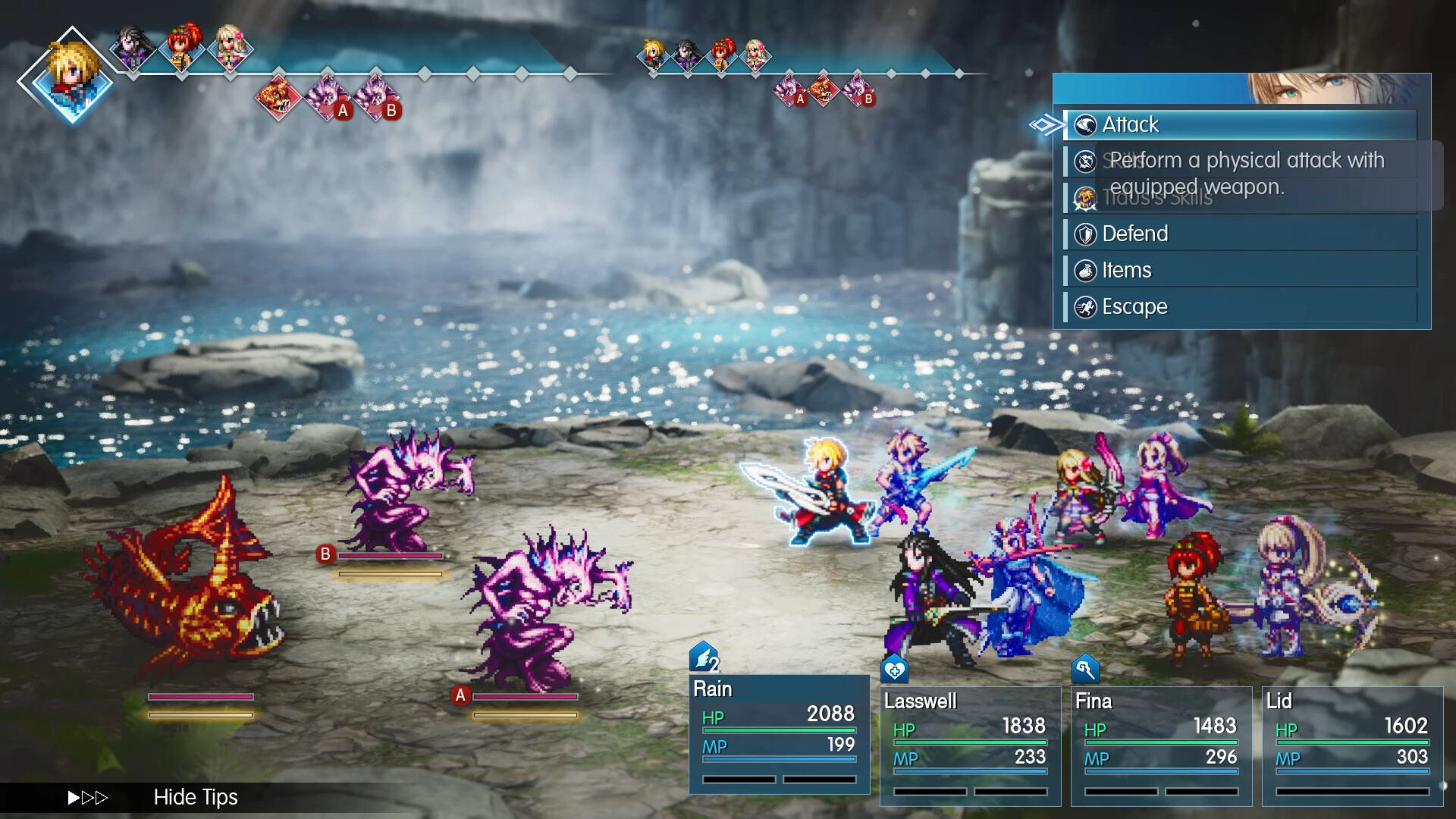
Final Fantasy Resonance uses turn-based command battles. There is no ATB gauge and no real-time pressure: combat runs in discrete turns, and every action is chosen from a command menu. The developers said the battle system strongly references Final Fantasy IV, V, and VI, pairing quick fights against regular enemies with deliberate boss battles that test preparation. The core loop is reading the turn order, shaving enemy Stagger Gauges, and converting staggers into extra actions and cinematic finishers.
Confirmed in a Playable Build
For most of 2026 the battle system could only be described from footage and from hands-off sessions. That changed on September 3, 2026, when Square Enix released a free demo covering the opening through the end of Chapter 1, and published its own English breakdown of the battle system on the same day. The timeline, the Stagger Gauge, the Extra Phase, the Sweeping Stagger condition for a Resonance, and the three-turn esper structure are all stated in that first-party English description and are all playable, so the rules below are no longer inferred from trailers. Level caps apply inside the demo, and Square Enix has said that its event builds carry content the downloadable demo does not, so the demo is a verified sample of the systems rather than the full extent of what has been shown.
The Timeline
A timeline runs across the top of the battle screen, displaying the upcoming action order of both allies and enemies through the next turn. Characters act from left to right. Because the order is always visible, fights reward planning: the player can focus an enemy down before its turn comes up, or spend an action bracing when a heavy attack sits later in the queue. Stagger timing interacts with the timeline too, since a staggered enemy loses its queued action for that turn, wiping a threat off the bar. Official materials present the timeline as the foundation of the system, and most tactical decisions flow from it.
Stagger, the Extra Phase, and Resonance
Under each enemy's HP bar sits a Stagger Gauge. Every hit shaves it, attacks that strike an elemental weakness shave more, and emptying the gauge staggers the enemy, which loses its action that turn and suffers a defense drop. The character who lands a stagger gains an extra action at the end of the turn, in a window Square Enix calls the Extra Phase, and staggering every enemy on the field triggers a sweeping stagger that grants the entire party Extra Phase actions. In a fight against a single enemy, staggering it counts as a sweeping stagger right away. A sweeping stagger also opens the strongest moves in the game: at the end of the Extra Phase, one character can fire a vision-specific ultimate with its own cinematic sequence. The full rules are covered on the Stagger System and Resonance Attacks pages.
Limit Bursts
Characters carry a limit gauge of their own, separate from the Stagger Gauge on the enemy side and separate from a Vision's Resonance. It fills two ways: when the character staggers an enemy, and when the character takes damage. Once it is full, that character can unleash a Limit Burst. Some Limit Bursts are straightforward high-damage attacks; others grant a boon that keeps paying out for the rest of the battle, so spending the gauge is a choice about the shape of the fight rather than a damage button. The system is covered in full at Limit Bursts.
Because staggering fills the gauge as well as opening the Extra Phase, a party built to shave Stagger Gauges quickly is also a party that reaches its Limit Bursts sooner. Taking damage feeding the same gauge cuts the other way: a fight that goes badly still builds toward a swing.
Finding a Weakness
An enemy's weakness element is hidden at the start of a fight. The slot reads as a question mark until an elemental attack lands on that enemy, at which point the element behind it is revealed. Casting Libra looks a weakness up directly instead, which saves spending turns probing for it. Since weakness hits shave more of the Stagger Gauge than neutral hits, finding the weakness early is what turns a long fight into a short one.
Official material has published one worked example of that against a specific boss. Against Shiva, the advice is to guard against her powerful ice attacks and answer with fire, which both deals heavy damage and shaves her Break gauge faster. The same material frames the fight as one that rewards preparation rather than improvisation.
Encounters and Pacing
Resonance uses random encounters rather than enemies visible on the field, and the developers said the choice was deliberate. The minimap doubles as a warning system: it shifts yellow as an encounter draws near, then red just before the fight triggers. Dungeons built around puzzles and gimmicks have lower encounter rates so their mechanics stay in focus.
Pacing follows a stated design target: fights against regular enemies resolve fast, while bosses are slower, more deliberate affairs. Resource pressure stretches across whole dungeons rather than resetting per fight; the developers said MP and item attrition is part of the challenge, so cheap, efficient staggering can matter more than raw spell power. Save points are placed directly before bosses. Rare cactuar encounters that pay out large amounts of EXP also exist.
Party Size and Targeting
The battle party holds up to four members. Each member can equip one Vision, and the equipped vision's character appears behind its wielder during combat, hovering rather than standing on the ground, so a full party can show up to eight figures on the player's side. Early chapters field fewer members; in preview builds, the opening hours ran with a three-person party. Spells and abilities that support it can be toggled between single-target and all-target use. Espers, the game's summons, add even more presence: a summoned esper fights alongside the party for three turns before departing.
No Auto-Battle, with Speed Controls
There is no auto-battle. The producer said a repeat-style mechanism existed early in development and was removed on purpose: automating routine fights flattened the experience and undercut the reason to think about party builds. In its place, battle speed-up toggles of 1.5x and 2x keep regular encounters quick, a concession the director framed as modern playability. Every fight takes input, but a party tuned for staggering clears standard encounters in short order.
Difficulty
Three difficulty settings are available, and the developers describe the game overall as not super high difficulty. Preview sessions that ran the opening on Casual moved briskly, while sessions played on Normal found even an early boss a serious fight.
Mode | Details |
|---|---|
Casual | Lowers enemy parameters and reduces damage taken. Enemies are easier to stagger, which suits story-focused runs. |
Normal | The developers compare it to Octopath Traveler's Normal and tuned it toward the challenge of Super Famicom era Final Fantasy. Bosses put up a serious fight. |
Expert | The most demanding of the three settings, for players who want heavier resistance. |
Design Influences
The battle director said preparation is the intended heart of the system: deciding how to build the party before a fight matters as much as the commands picked during it, with Final Fantasy V's Job system as an explicit reference point. The vision and ability setup is officially framed as an evolution of the series' Job system, and the build options are covered under Abilities and Mastery.
Abilities carry separate damage and stagger profiles. Some moves shave the Stagger Gauge hard while dealing little HP damage, others do the reverse, and on Normal and above the choice between them can decide a boss fight. The producer also said no single dominant build exists by design: every vision, the legacy heroes included, was tuned to have situations where it earns its slot, rather than one popular character outclassing the rest. The team has likewise cited the immediate, satisfying feel of Octopath Traveler as a touchstone, while pointing to the job systems of the early numbered Final Fantasy entries for depth.
The Turn as the Unit of Play
Square Enix confirmed on July 16, 2026 that staggering all enemies within a single turn is what enables a Resonance attack. That makes a round, rather than an individual action, the thing you are trying to win, and it explains how the announced pieces fit together: Visions are described by the elements they cover and how readily they stagger, Aileen lowers enemy defenses so damage lands harder, and a summoned esper ends its three-turn stay with a finisher that hits every enemy at once.
The three espers named in July all follow that same board-wide pattern: Ifrit's Hellfire, Shiva's Diamond Dust, and Titan's Gaia's Wrath each strike all opponents, in fire, ice, and earth respectively.
Enemies bring their own turn-economy tricks to the same board. The Iron Giant, a heavily armoured foe with a greatsword, buffs itself with an ability called Brave and then follows up with a run of merciless physical attacks, so the window to stagger it sits before that buff resolves.