
Loading...
Gameplay
November 27, 2026 at 02:59 AM
Add wikilinks to table cells (7 new links)
ROB RUN mixes an extraction shooter with a persistent crime sandbox. Kefir's own summary is that the game is built around money: you earn it in the city of Looty Bay by robbing, hauling cargo or working as a cop, protect it by laundering it, and spend it on land, bases, businesses and power on the desert Global Map. Every seven days a wipe resets the server and the climb starts again. This page covers the Early Access build as of November 2026.
Leave Lenny's Motel or your base and drive to Looty Bay. Everyone gets around by vehicle, starting with a rented car.
Pick a role when you enter the city: stay a Civilian, put on a mask to become one of the Criminals, or enlist with the Police if a slot is open.
Scout a target, then rob it: disable alarms, keep staff at gunpoint, open locked doors and safes, and fill your bag.
Get out of the city or reach a buyer alive. Cops and rival Criminals can attack you at any point.
Sell the loot to a fence, process cargo at your base, and launder the cash so it cannot be stolen.
Spend the money on gear, vehicles, land and buildings, and work up the Power Pyramid before the wipe.
Kefir describes the city part as a classic extraction shooter mechanic with a few twists: everyone drives, the police are real players, and the same location can pay out pocket change or a fortune depending on your gear, keys and preparation.
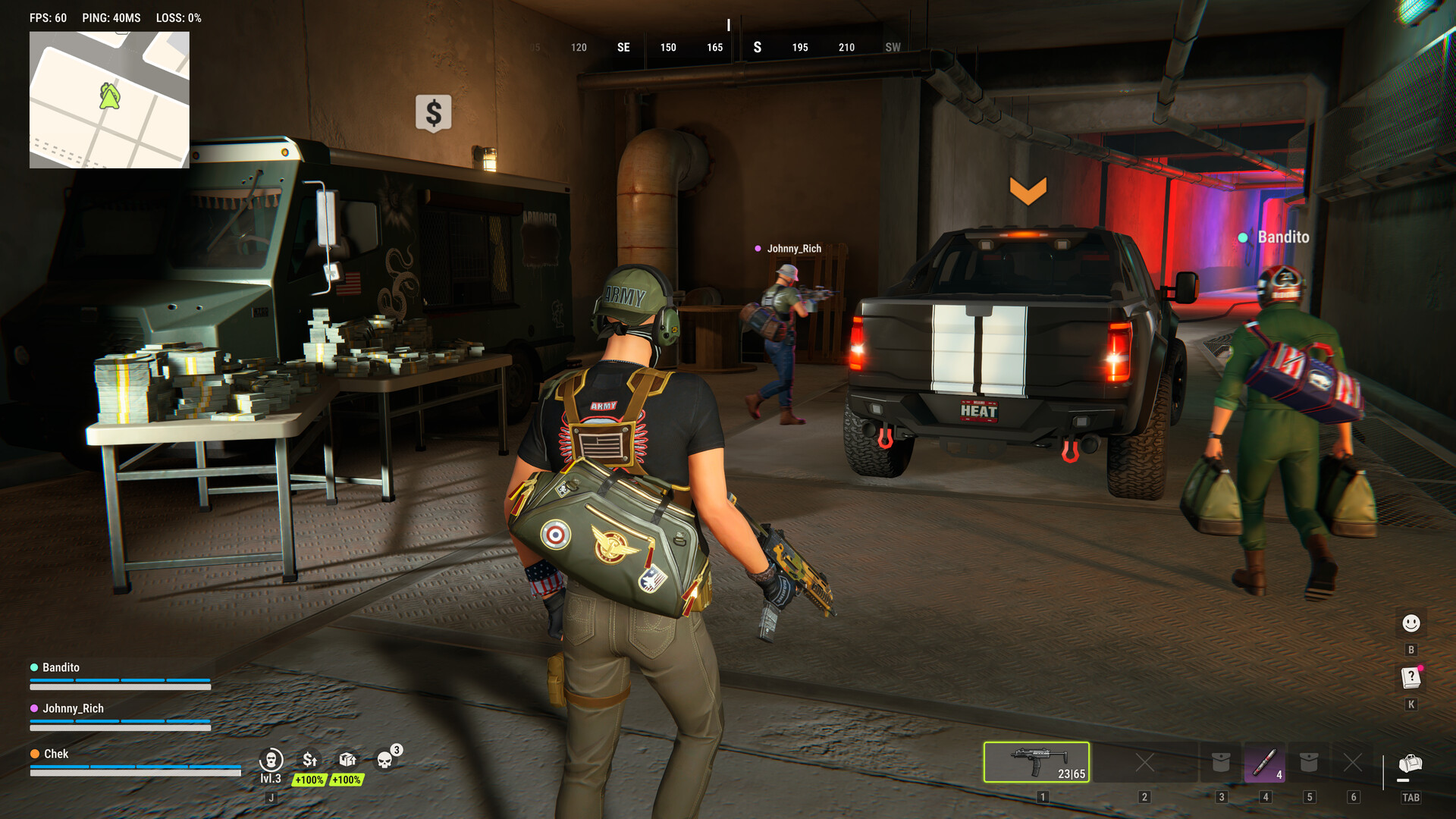
The split between cops and criminals only exists inside Looty Bay. Each time you enter the city you choose a role, or look around before deciding. The developer has said this is a per-visit choice, not a permanent faction, so there is no need to make a new character to switch.
Role | How you get it | What it means |
|---|---|---|
Enter the city without a mask | You can explore, scout targets and visit the bank. A Civilian who dies in the city keeps bag contents and equipped gear. | |
Put on a mask | You can commit robberies, but the police and other Criminals can attack you, and death costs everything in your bag. The status only clears when you leave the city. | |
Enlist at the Looty Bay Police Station when slots are open | You get free standard-issue gear and a basic vehicle, earn a cut of confiscated loot, and do not risk your own equipment on shift. |
Loss rules depend on your role and where you are:
Situation | Bag contents | Equipped gear |
|---|---|---|
Criminal dies in Looty Bay | Lost | Lost |
Criminal surrenders to the police | Confiscated | Kept |
Criminal pays a bribe that the cop accepts | The cop lets the suspect walk | Kept |
Civilian dies in Looty Bay | Kept | Kept |
Police Officer dies | Own equipment not at risk | Only state-issued gear is involved |
In the desert there are no police and no surrender: the desert is lawless, and any player can try to take your life. Gear also loses durability every time you die. The developer calls this an item sink that keeps the economy balanced, and as of November 2026 weapons cannot be repaired, though a repair mechanic is planned for a future update.
Kefir has explained several combat rules that were chosen partly to limit what cheaters can do:
There are no sniper rifles, and damage falls off steeply over distance.
Time-to-kill is deliberately high and headshot damage scaling is conservative, so single-shot kills are prevented and there is a window for counterplay.
You can carry only one primary weapon at a time, and switching weapons has a cooldown.
Vehicles close distance quickly, and much of the fighting happens indoors at point-blank range.
Hiding inside closets and some containers completely conceals your character, including from radar.
You can see health bars only for members of your own party.
See Weapons and Equipment for gear.
Money drives progression. Kefir's posts describe many ways to earn it: robbing shops and banks, stealing cargo such as safes, selling contraband, running farms, labs, smuggling and cargo cracking at your base, and working as a cop. Settlement owners and clans that control territory also collect Taxes. Cash you carry can be lost, while laundered money is safe from thieves, which is why Money Laundering matters.
The longer your crime spree goes on in Looty Bay, the higher your Notoriety level rises. Higher Notoriety means better loot and higher payout rates, but the risks scale up with it. Solo players start at level 4.
What you can buy depends on where you live. Kefir says the criminal contacts available to a player, and so the goods they can buy, depend on the level of their home territory, and a district's level changes the selection of items for sale there. Settlement Residents unlock new Shipments that motel dwellers cannot get, and contraband is bought on the Black Market. Many items must be researched before they can be bought.
Everyone starts each cycle as a Hobo at Lenny's Motel. Renting a plot makes you a Settlement Resident, buying a settlement makes you a Settlement Owner, a clan can take a whole district, and the leader of the clan holding the central Highlands district becomes the Shadow Governor. See Power Pyramid and Districts and Settlements.
The desert | ||
|---|---|---|
Main activities | Robberies, cargo theft, selling loot, police work | Bases, businesses, laundering, settlements, clan territory |
Law | Player police patrol the city | No police; the desert is lawless |
Death | Depends on role (see above) | No police and no surrender; any player can attack you |
Selling | Fences at drop-off points around the city | Central hubs in each district, where prices can be much higher |
Looty Bay changes during a session. Kefir mentions ATMs being restocked with fresh cash and arms stash locations leaking. Armored raids, deals and murders are part of the city's background crime, and rival Criminals or a passing patrol car can turn a clean job into a fight.
Every cycle starts at Lenny's Motel, where a player fresh out of prison crashes until they can afford land. Lenny sells goods on the Black Market, and the motel has a cash stash where money can be kept safe from other players, while stolen goods go to your base.
Before launch, Kefir described a neutral hub called the Bar, where the local shot-caller controls the turf so nobody gets shot. Players could meet, make deals, build criminal connections, take a break, play roulette and store a little loot there. In the live build the Bar is understood to be part of Lenny's Motel, where players report the small cash stash is kept. The game's content notes confirm a roulette mechanic that uses in-game currency only.
Once you can afford it, you rent a plot and build a base. Building is fully item-based: houses, fences, farms, garages, safes, racks, workbenches and other objects are deployed from your inventory, so they can be bought, found in loot or taken from someone's bag. A base is a storage point, a respawn point, a garage and a production site, and it can be raided. See Base Building and Raiding and Base Defense.
You can form a party of up to three players, and larger groups can form Clans of up to 100. Kefir tested bigger parties early in development and found that they reduced random encounters, so it has no plans to raise the cap for now. Solo players get built-in perks to compensate. See Parties and Co-op.
Each server runs for seven days before it is wiped. Kefir says a level playing field is what makes the rags-to-riches climb exciting, and that the more wealth you have accrued by the time the wipe hits, the longer your prison sentence will be. Jail time is tracked as a running total: since November 17, 2026 it has daily and overall limits, and some planned restricted servers will require a minimum amount of it. See Server Wipes and Prison and Jail Time.
A setting to invert the mouse Y-axis was added on November 17, 2026. Steam lists no controller support for the game as of November 2026.