

This article is incomplete
Some sections are missing or need additional details. Help improve it by contributing.
Multiplayer is the competitive player-versus-player mode in Warhammer 40,000: Dawn of War IV. At launch it supports 1v1, 2v2, and 3v3 matches, letting you face other players one-on-one or in teams of two or three. The details below reflect pre-release information and may change before release.
Team Sizes
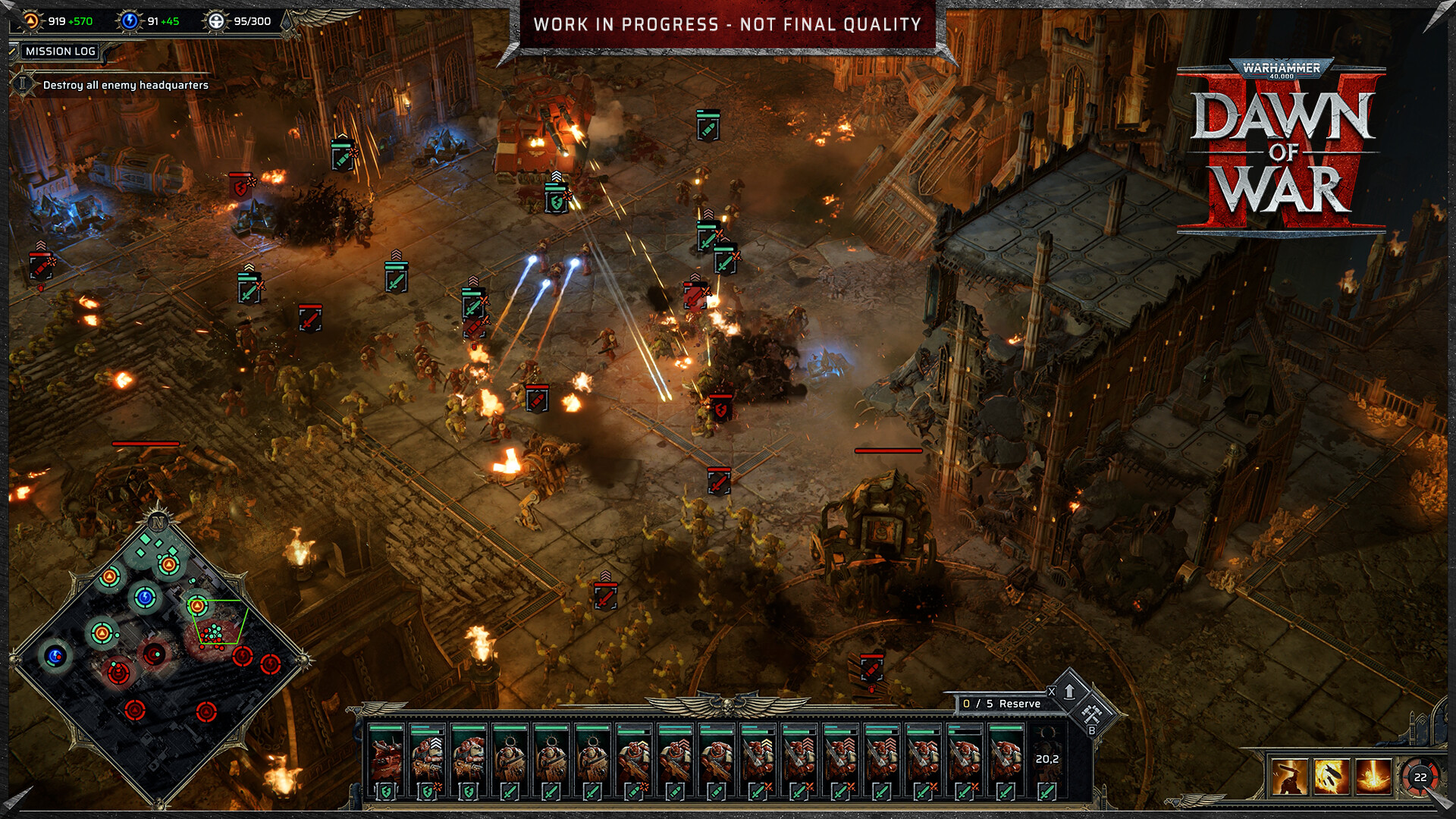
Three competitive formats are confirmed for launch. They scale from a single duel up to three-player teams on each side, so you can play a focused one-on-one match or coordinate with allies in a larger battle.
Format | Description |
|---|---|
1v1 | One player against one player |
2v2 | Two-player teams against each other |
3v3 | Three-player teams against each other |
How Competitive Play Works
Quick Match Modes
Quick Match defaults to Annihilation, but you can select any or all of the three modes below for matchmaking, so you decide which win conditions you are willing to be matched into.
Mode | Win Condition |
|---|---|
Annihilation | Destroy all enemy headquarters and protect your own. This is the Quick Match default |
Domination | Capture and hold more Strategic Positions than your opponents to gain Victory Points |
Maelstrom | Secure objectives that appear dynamically across the map to gain Victory Points |
Multiplayer matches use the same armies and systems as the rest of the game. You command one of the playable Factions, lead your forces with the game's Commanders, and fight using the Combat Director system that drives combat throughout Dawn of War IV. Against a human opponent, the emphasis shifts to reading and outplaying another commander rather than the AI, but the underlying gameplay foundation is shared with the single-player modes.
Because both sides field full armies, the larger 2v2 and 3v3 formats reward coordination between teammates, while 1v1 puts the full outcome on a single player's decisions. The over 110 units and buildings available across the Factions give each format a wide range of viable approaches.
Commanders in Multiplayer
Outside the campaigns, Commanders are generic faction units rather than the named story characters. You select one before the match alongside your faction and starting position. By default a Commander is produced from your headquarters for a cost, usually mid-match once you have unlocked the option, but the match settings let you start with one already on the field or disable Commanders entirely.
Cover, Retreat, and Reinforcement
Three battlefield tools decide how much of an army survives a fight, and each faction interacts with them differently.
Tool | How It Works | Faction Notes |
|---|---|---|
Cover | Significantly reduces damage taken from ranged units. Maps offer directional cover and garrisonable structures that protect from all directions. Flamers and grenades negate it, and melee forces units out of it | Orks build their own cover; the Adeptus Mechanicus build their own garrisonable structure; the Necrons do not use cover at all |
Retreat | Disengages units from melee or repositions them to your nearest production structure while taking reduced damage, at the cost of losing control of them for a time. The retreat icon above a unit turns from red to yellow, and while it is yellow the order can be cancelled | Shared by all factions |
On-Field Reinforcement | Spends resources to keep units fighting in the field. Units set to auto-reinforce are noticeably harder to kill, but running many of them drains an economy quickly | The Necrons have their own variant that is more effective during combat than the standard version |
The developers describe on-field reinforcement as the most powerful of the three, precisely because it pulls the economy into the middle of a fight: you can win the battle and lose the war. Cover is framed as an optimisation rather than a decisive factor, enough to swing an engagement that was already close. Units preserved this way keep the Unit Veterancy they have earned, which is the long-term reason to bother.
Base Building by Faction
Buildings and building upgrades unlock units, research, and sometimes further buildings, but each faction expands in a way that matches its identity. See Base Building and Resources for the shared economy layer.
Space Marines: the most straightforward. Structures upgrade to unlock additional units and research, and can be dropped from orbit anywhere within vision. Deployment takes longer the further the site is from the headquarters, and opposing players can see where a structure is about to land.
Orks: structures are cheap, can be built by almost any Ork infantry, and always come armed, which makes base crawling toward the enemy second nature and shortens the walk for freshly produced units.
Necrons: structures spread the Power Matrix, which is tied directly to their economy and empowers Necron units standing on it. The Tomb Pylon also serves as a teleport destination for forces sent from the headquarters.
Adeptus Mechanicus: structures are linked back to the headquarters to form the Noosphere Network, which is what unlocks their more powerful weaponry and grants economic and combat boons to everything inside it.
Balance and Counterplay
KING Art has said that authentic faction representation is a core pillar and that multiplayer balance is about keeping play fair while making as few compromises on that authenticity as possible. The studio has been open that no amount of internal testing will match the scale and creativity players bring at launch, and that the plan is to gather data after release, prioritise the most impactful issues, and explain the intent behind each change.
Against massed armies, many units carry weapons and wargear meant specifically for clearing crowds, from the Slugga Boyz' Burna to the Monolith's Particle Whip, and every faction has one powerful Stratagem available regardless of which Commander was picked. Positioning, dragging enemy ranged units into melee while shielding your own, and timing abilities well are where the developers place the ceiling on tactical skill.
What Is Confirmed
The confirmed facts about Multiplayer at launch are the three supported team sizes (1v1, 2v2, and 3v3), the three selectable Quick Match modes, and the Commander, cover, retreat, and reinforcement rules described above. Map pools, ranking systems, and seasonal structure have not been detailed in pre-release information and are not stated here as fact.
Playstyle and Faction Identity
KING Art has shown Dawn of War IV multiplayer in an official 1v1 match pitting the Space Marines against the Orks. The developer describes competitive play as defined by map control and momentum, with each faction's identity shaping how it fights. The Space Marines bring overwhelming firepower, while the Orks grow more dangerous the longer a match runs: if they are allowed to build up their numbers, the tide of a battle can spiral in their favour quickly. This rewards early pressure and keeping the initiative over letting an opponent settle in.
A second official 1v1 showcase sets the Adeptus Mechanicus against the Necrons, which the developer presents as two radically different factions that bring different strengths to the battlefield. The Adeptus Mechanicus excel at fortifying territory on the map, holding ground in a way that suits their methodical, defensive style. The Necrons instead apply relentless pressure that can quickly escalate into overwhelming force, so a Necron player who is left unchecked can turn that momentum into an onslaught the opponent has to survive. Both matches were shown while the studio continues to refine and balance the game, ahead of a launch now set for December 3, 2026.
Related Pages
Factions: the playable armies you command in competitive matches.
Commanders: the battlefield leaders who head each faction.
Combat Director: the system that drives combat in Multiplayer.
Game Modes: the hub covering every confirmed mode.