

Combat in Wo Long 2: Wings of Ember is built on what the developers describe as an evolved Chinese martial arts style that integrates both offensive and defensive fighting. Flowing between attack and defence is the central pillar, anchored by a deflect technique used to turn aside incoming blows. A Spirit system underpins this exchange: the champion fights with Spirit and uses it to deliver fatal blows to demonic bosses and beasts.
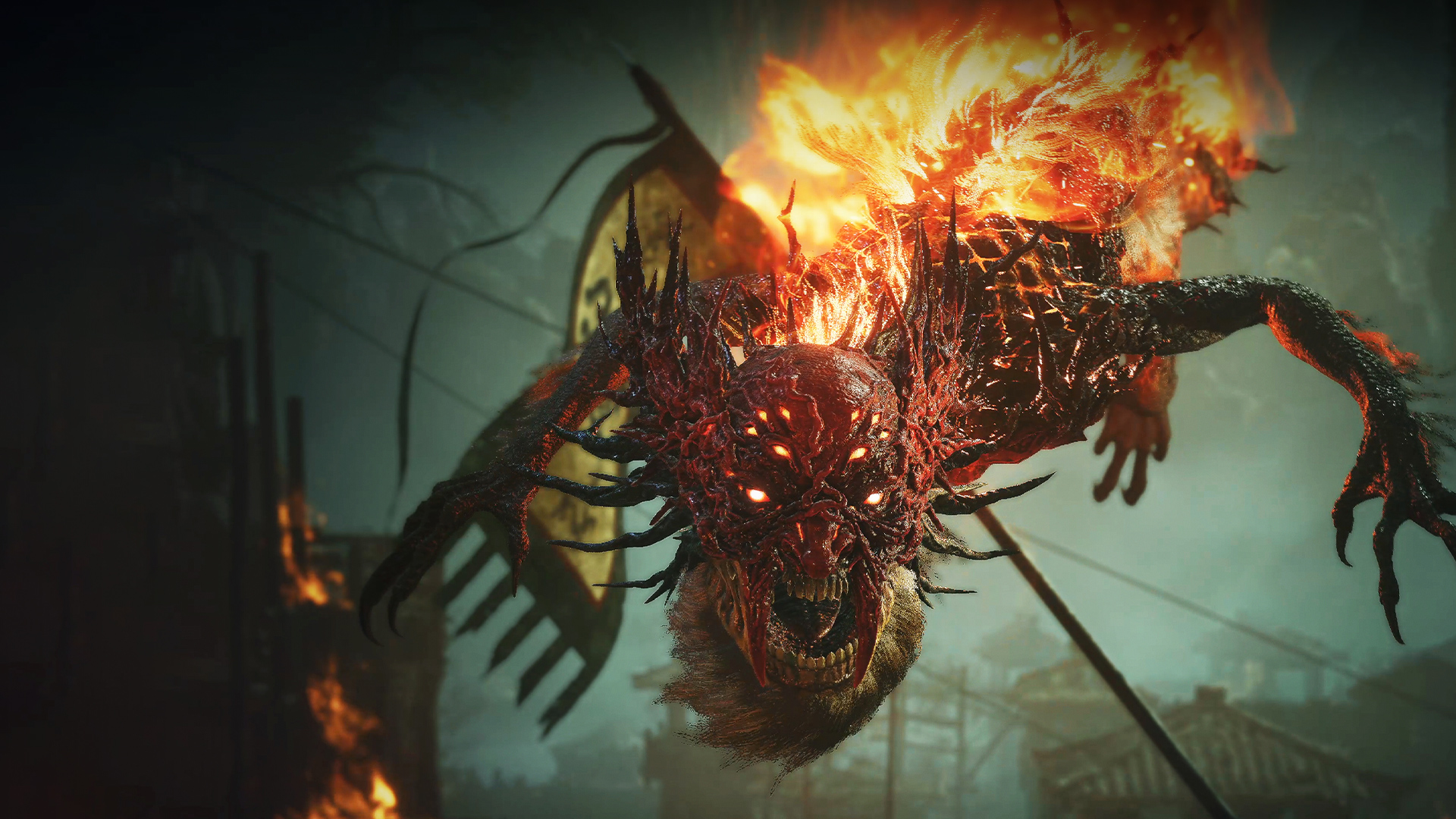
The Focus System
The sequel's headline addition is a new focus mechanic, introduced specifically to answer a criticism of the first game. Players there could deflect almost any attack, which made fights feel repetitive, and the team decided that simply raising the difficulty would not solve it. Alongside the ordinary deflect, the champion can now use a focus deflect against certain attacks, or skip deflecting altogether and use a focus jump to leave the ground and evade. The producer has framed this as widening the set of proactive options so that players answer each situation differently rather than holding one button.
Two focus techniques have now been shown running. Each spends Spirit, and each answers a different warning: unblockable attacks are marked with two shapes of red glow rather than one. A circling glow calls for the focus deflect, which turns the blow aside and launches the attacker hard enough to knock over the rank behind it, leaves an elite open for a couple of seconds, and can send ranged attacks back the way they came. A straight-line glow calls for the focus jump, which lifts the champion clear and stamps an airborne enemy down to the ground; its timing window is loose enough to absorb a step or two of misjudged distance, and it can be chained to pass through more than one incoming projectile. The ordinary deflect still costs no Spirit and adds a kick instead of a launch, so the choice between spending Spirit and saving it is left to the player. The focus techniques also break the guard of shield-carrying soldiers.
Only a small slice of the focus system was present in the build shown to press. The team has said it will be expanded for the finished game, and English names for its individual moves have not been published.
One caveat comes from the team itself. The focus deflect was tuned upward on purpose for the build handed to press, and its damage will be rebalanced against the ordinary deflect before release, so the weighting reporters played is not the finished one.
Fighting in the Air
Combat is no longer confined to the ground. The champion can kick off walls and run along walls and eaves, and fights extend upward into a full aerial layer of attack and defence. Flying enemies appear often enough that the team expects players to build for them. Both the game's special techniques and its spell arts can be used in mid-air, and loadouts are deliberately unconstrained: the studio chose not to give weapons air-focused or ground-focused movesets, on the grounds that specialising them would make them harder to use, and has not imposed fixed builds.
The producer has attributed the emphasis on three-dimensional movement to experience carried over from Team Ninja's other action work, whose development overlapped with this game. Falls are handled gently, costing a little health and returning the player to the path. The traversal side of this is covered under The Demon-Infested Three Kingdoms.
The build shown to press filled that out. The champion has a double jump, runs along smooth walls, and can bounce between two facing walls to climb. Aerial strings can be extended, spell arts fired between them, and the chain continued in the air after a fatal blow lands.
Returning Systems
Several systems from the first game have now been confirmed to return in altered form, and the studio has said further detail is coming.
System | What Has Been Confirmed |
|---|---|
Deflect | Returns as the core defensive technique, no longer the answer to every attack |
Spirit | Returns and underpins the exchange of attack and defence, feeding fatal blows |
Morale | Returns in reworked form, tracked by zone and raised through exploration, battle flags and captured strongholds rather than by clearing a level before a boss |
Divine beasts | Work as in the first game, earned by building bonds with generals |
Divine beast manifestation | New. Layers other divine beasts on top of the phoenix power for amplified or altered effects |
Multi-boss encounters | Return, with reworked boss behaviour and attacks from outside the camera addressed |
Spell arts | Return, usable in mid-air, and still built on the Five Phases. Each spell art now carries a point cost against a ceiling, and the strongest have limited uses |
Spell Arts and the Five Phases
Spell arts return, and the Five Phases framework the series builds its magic on returns with them. What has changed is that the set is now budgeted. Each Five Phases spell art carries a point value, the loadout a player brings into a fight cannot exceed a point ceiling, and that ceiling is tied to the matching Five Phases attribute rather than being a flat allowance. Several of the strongest spell arts also carry a limited number of uses.
Team Ninja has explained the trade directly. Spell arts in the first game had no use limits, which made genuinely powerful ones hard to balance, so capping a few of them is what lets the sequel offer spell arts stronger and more distinctive than it could otherwise support. The same change is meant to make loadout choice matter, and it pairs with the ability to cast spell arts in mid-air and thread them into aerial chains, which is covered above under Fighting in the Air.
Weapons and Gear
At least four weapon families were playable in the press build: a straight sword, a spear, a staff and a large blade. That list was given with an open ending rather than as a complete set, so more may have been present. Team Ninja has said it is reworking the weapon types carried over from the first game and also plans to add types that are entirely new, but it has published neither a full list nor a count, so the roster below launch remains open.
Gear follows a familiar shape. Rarity is marked by colour, and weapons and armour carry levels and rolled properties. Hands-on reports put its weight in perspective: the morale gap between the player and a given stretch of the map moved the difficulty far more than the rarity of anything equipped, which makes the map itself the primary difficulty lever rather than the loot. How morale is tracked and shifted is covered under The Demon-Infested Three Kingdoms.
Cooperative Play
Wo Long 2 supports online co-operative play. Official product information lists the game as a single-player experience with online multiplayer for up to three, so a session holds the player plus two companions. Which parts of the campaign open to a partner, and how matchmaking works, have not been described.
What Is Not Yet Confirmed
A full weapon list has not been published, and the studio has not said how many types the finished game will carry. Difficulty options, the English naming for the focus and manifestation systems, and the shape of the post-completion content the team says it is planning all remain unannounced. Character progression has been seen only in the fifteen-minute press build, so its finished balance is still unknown.